 Add to Chrome
 Add to Firefox
 Add to Edge
Cutscene Agent: An LLM Agent Framework for Automated 3D Cutscene Generation
Apr 28, 2026
Cutscenes are carefully choreographed cinematic sequences embedded in video games and interactive media, serving as the primary vehicle for narrative delivery, character development, and emotional engagement. Producing cutscenes is inherently complex: it demands seamless coordination across screenwriting, cinematography, character animation, voice acting, and technical direction, often requiring days to weeks of collaborative effort from multidisciplinary teams to produce minutes of polished content. In this work, we present Cutscene Agent, an LLM agent framework for automated end-to-end cutscene generation. The framework makes three contributions: (1)~a Cutscene Toolkit built on the Model Context Protocol (MCP) that establishes \emph{bidirectional} integration between LLM agents and the game engine -- agents not only invoke engine operations but continuously observe real-time scene state, enabling closed-loop generation of editable engine-native cinematic assets; (2)~a multi-agent system where a director agent orchestrates specialist subagents for animation, cinematography, and sound design, augmented by a visual reasoning feedback loop for perception-driven refinement; and (3)~CutsceneBench, a hierarchical evaluation benchmark for cutscene generation. Unlike typical tool-use benchmarks that evaluate short, isolated function calls, cutscene generation requires long-horizon, multi-step orchestration of dozens of interdependent tool invocations with strict ordering constraints -- a capability dimension that existing benchmarks do not cover. We evaluate a range of LLMs on CutsceneBench and analyze their performance across this challenging task.

Autonomous Materials Exploration by Integrating Automated Phase Identification and AI-Assisted Human Reasoning
Jan 13, 2026Autonomous experimentation holds the potential to accelerate materials development by combining artificial intelligence (AI) with modular robotic platforms to explore extensive combinatorial chemical and processing spaces. Such self-driving laboratories can not only increase the throughput of repetitive experiments, but also incorporate human domain expertise to drive the search towards user-defined objectives, including improved materials performance metrics. We present an autonomous materials synthesis extension to SARA, the Scientific Autonomous Reasoning Agent, utilizing phase information provided by an automated probabilistic phase labeling algorithm to expedite the search for targeted phase regions. By incorporating human input into an expanded SARA-H (SARA with human-in-the-loop) framework, we enhance the efficiency of the underlying reasoning process. Using synthetic benchmarks, we demonstrate the efficiency of our AI implementation and show that the human input can contribute to significant improvement in sampling efficiency. We conduct experimental active learning campaigns using robotic processing of thin-film samples of several oxide material systems, including Bi$_2$O$_3$, SnO$_x$, and Bi-Ti-O, using lateral-gradient laser spike annealing to synthesize and kinetically trap metastable phases. We showcase the utility of human-in-the-loop autonomous experimentation for the Bi-Ti-O system, where we identify extensive processing domains that stabilize $δ$-Bi$_2$O$_3$ and Bi$_2$Ti$_2$O$_7$, explore dwell-dependent ternary oxide phase behavior, and provide evidence confirming predictions that cationic substitutional doping of TiO$_2$ with Bi inhibits the unfavorable transformation of the metastable anatase to the ground-state rutile phase. The autonomous methods we have developed enable the discovery of new materials and new understanding of materials synthesis and properties.
Probabilistic Phase Labeling and Lattice Refinement for Autonomous Material Research
Aug 15, 2023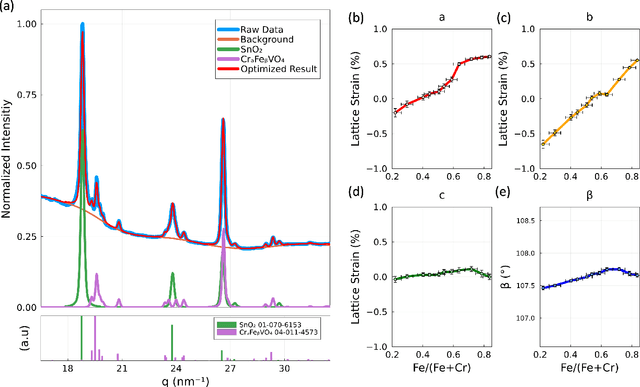
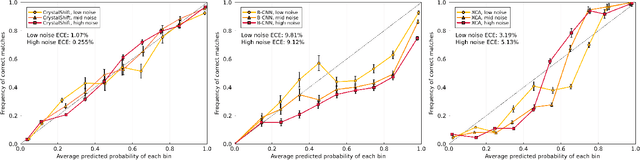
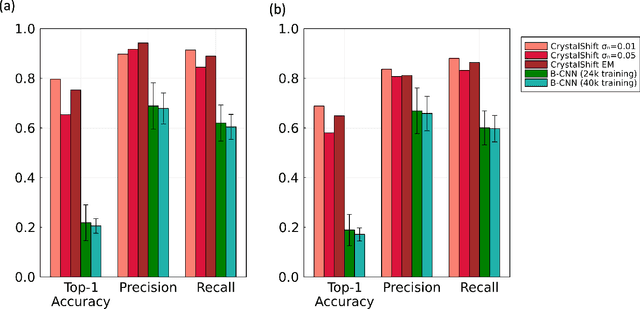
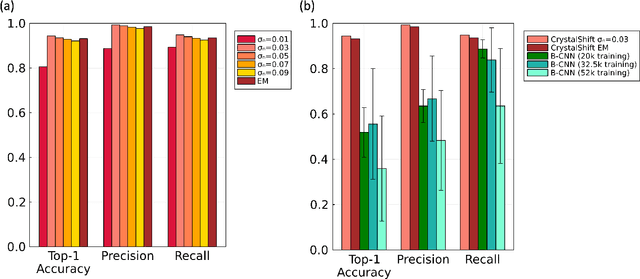
X-ray diffraction (XRD) is an essential technique to determine a material's crystal structure in high-throughput experimentation, and has recently been incorporated in artificially intelligent agents in autonomous scientific discovery processes. However, rapid, automated and reliable analysis method of XRD data matching the incoming data rate remains a major challenge. To address these issues, we present CrystalShift, an efficient algorithm for probabilistic XRD phase labeling that employs symmetry-constrained pseudo-refinement optimization, best-first tree search, and Bayesian model comparison to estimate probabilities for phase combinations without requiring phase space information or training. We demonstrate that CrystalShift provides robust probability estimates, outperforming existing methods on synthetic and experimental datasets, and can be readily integrated into high-throughput experimental workflows. In addition to efficient phase-mapping, CrystalShift offers quantitative insights into materials' structural parameters, which facilitate both expert evaluation and AI-based modeling of the phase space, ultimately accelerating materials identification and discovery.
Automating Crystal-Structure Phase Mapping: Combining Deep Learning with Constraint Reasoning
Aug 21, 2021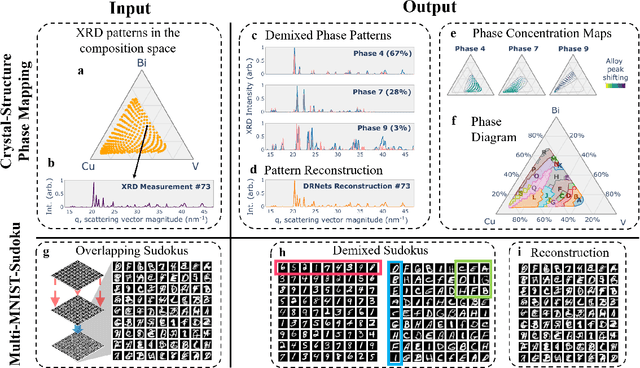
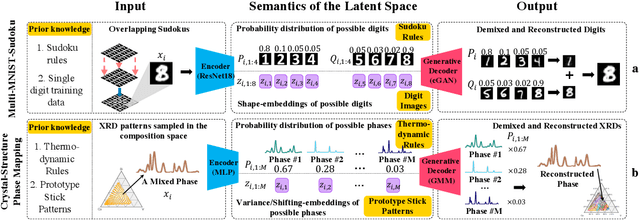
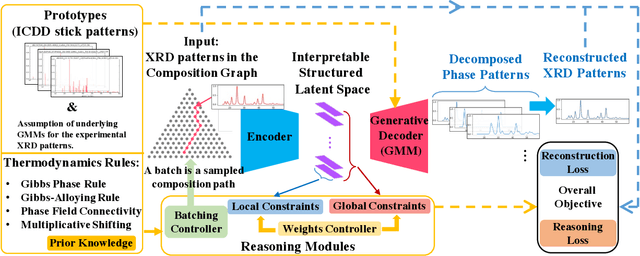
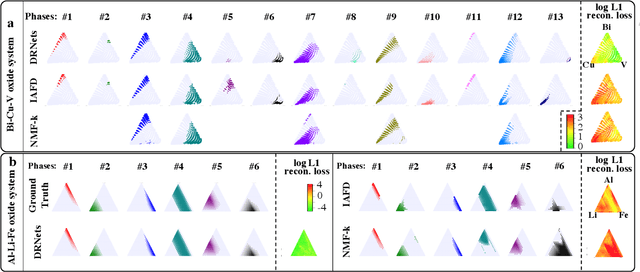
Crystal-structure phase mapping is a core, long-standing challenge in materials science that requires identifying crystal structures, or mixtures thereof, in synthesized materials. Materials science experts excel at solving simple systems but cannot solve complex systems, creating a major bottleneck in high-throughput materials discovery. Herein we show how to automate crystal-structure phase mapping. We formulate phase mapping as an unsupervised pattern demixing problem and describe how to solve it using Deep Reasoning Networks (DRNets). DRNets combine deep learning with constraint reasoning for incorporating scientific prior knowledge and consequently require only a modest amount of (unlabeled) data. DRNets compensate for the limited data by exploiting and magnifying the rich prior knowledge about the thermodynamic rules governing the mixtures of crystals with constraint reasoning seamlessly integrated into neural network optimization. DRNets are designed with an interpretable latent space for encoding prior-knowledge domain constraints and seamlessly integrate constraint reasoning into neural network optimization. DRNets surpass previous approaches on crystal-structure phase mapping, unraveling the Bi-Cu-V oxide phase diagram, and aiding the discovery of solar-fuels materials.