 Add to Chrome
 Add to Firefox
 Add to Edge
A Comprehensive Survey and Systematic Real-World Evaluation of Embodied Vision-and-Language Navigation
Jul 09, 2026
Navigation is a fundamental capability of autonomous systems, yet most existing approaches rely on highly structured models and strong prior assumptions, limiting their robustness in open and uncertain real-world environments. Vision-and-Language Navigation (VLN) offers a promising direction by enabling robots to integrate natural language understanding with visual perception in a data-driven manner. Although VLN has attracted increasing research attention, systematic methodological taxonomy and real-world validation remain limited. This survey presents a comprehensive review of VLN research. Specifically, state-of-the-art methods are organized along two orthogonal dimensions: action paradigms, including hierarchical and monolithic frameworks, and model paradigms, including discriminative and generative approaches. A critical analysis of their respective strengths and limitations is provided. Additionally, we conduct a systematic real-world evaluation of representative VLN system configurations on a physical robotic platform. Experiments across ten diverse real-world scenes show a substantial performance gap between simulation and real-world deployment under the tested configurations: a representative monolithic RGB-only method achieves 61% success in simulation but drops to 22% in real-world deployment, while a hierarchical framework achieves a higher real-world success rate of 51%, suggesting stronger robustness in our evaluation setting. Finally, we highlight key challenges in perception, decision-making, and control that must be addressed in future research.

FAST: A Holistic Framework for Optimizing Memory-I/O, Computation, and Sampling in Temporal GNN Training
Jul 06, 2026Temporal Graph Neural Networks (TGNNs) are widely used for learning from dynamic graphs in applications such as recommendation, social network analysis, and traffic forecasting. However, scaling TGNN training to large dynamic graphs remains challenging due to three intertwined bottlenecks: memory I/O, irregular computation, and temporal neighbor sampling. Existing systems often optimize these stages in isolation, leaving substantial performance headroom on the table. We present FAST, a holistic framework that accelerates end-to-end TGNN training by jointly optimizing sampling, memory I/O, and computation. FAST introduces SlimCache, which exploits within-batch compression and cross-batch caching to reduce host-device data movement under limited GPU memory budgets. It further designs thread-efficient graph operators tailored to sparse temporal subgraphs, improving GPU cache locality and reducing the latency of aggregation and edge softmax. In addition, FAST employs a topology-aware sampling strategy that improves CPU cache locality and accelerates temporal neighbor sampling. Extensive experiments on real-world large dynamic graphs show that FAST achieves an average of 2.1x (up to 4.7x) speedup over state-of-the-art systems without sacrificing model accuracy.
P2DNav: Panorama-to-Downview Reasoning for Zero-shot Vision-and-Language Navigation
May 19, 2026Vision-and-language navigation (VLN) requires an embodied agent to ground natural-language instructions into executable navigation actions in unseen environments. Existing zero-shot methods typically rely on additional waypoint prediction modules, which often entangle high-level directional reasoning with fine-grained local grounding, leading to error-prone and unstable decisions. In this paper, we propose P2DNav, a hierarchical framework for zero-shot vision-and-language navigation. P2DNav consists of three core components: Panorama-to-Downview (P2D), Sliding-Window Dialogue Memory (SDM), and Reflective Reorientation Mechanism (RRM). P2D explicitly decomposes navigation decision-making into two stages: panoramic direction selection and downview local grounding. It first selects the instruction-relevant direction from a 360° panorama, and then predicts a pixel-level target point from the downview RGB observation in that direction. In addition, SDM organizes navigation history as a multi-turn dialogue context and maintains recent visual observations within a sliding window to support long-horizon navigation. RRM further enables reflective reorientation by assessing the reliability of local grounding based on the downview observation and returning to panoramic direction selection when necessary. Experiments on the R2R-CE benchmark show that P2DNav achieves strong performance among zero-shot methods. In particular, compared with the state-of-the-art (SOTA) zero-shot waypoint-based and waypoint-free methods, P2DNav achieves SR gains of 146.6% and 58.9%, respectively, demonstrating the effectiveness of P2D, SDM, and RRM for zero-shot VLN. Code will be released for public use.
Cutscene Agent: An LLM Agent Framework for Automated 3D Cutscene Generation
Apr 28, 2026Cutscenes are carefully choreographed cinematic sequences embedded in video games and interactive media, serving as the primary vehicle for narrative delivery, character development, and emotional engagement. Producing cutscenes is inherently complex: it demands seamless coordination across screenwriting, cinematography, character animation, voice acting, and technical direction, often requiring days to weeks of collaborative effort from multidisciplinary teams to produce minutes of polished content. In this work, we present Cutscene Agent, an LLM agent framework for automated end-to-end cutscene generation. The framework makes three contributions: (1)~a Cutscene Toolkit built on the Model Context Protocol (MCP) that establishes \emph{bidirectional} integration between LLM agents and the game engine -- agents not only invoke engine operations but continuously observe real-time scene state, enabling closed-loop generation of editable engine-native cinematic assets; (2)~a multi-agent system where a director agent orchestrates specialist subagents for animation, cinematography, and sound design, augmented by a visual reasoning feedback loop for perception-driven refinement; and (3)~CutsceneBench, a hierarchical evaluation benchmark for cutscene generation. Unlike typical tool-use benchmarks that evaluate short, isolated function calls, cutscene generation requires long-horizon, multi-step orchestration of dozens of interdependent tool invocations with strict ordering constraints -- a capability dimension that existing benchmarks do not cover. We evaluate a range of LLMs on CutsceneBench and analyze their performance across this challenging task.
ILNet: Trajectory Prediction with Inverse Learning Attention for Enhancing Intention Capture
Jul 09, 2025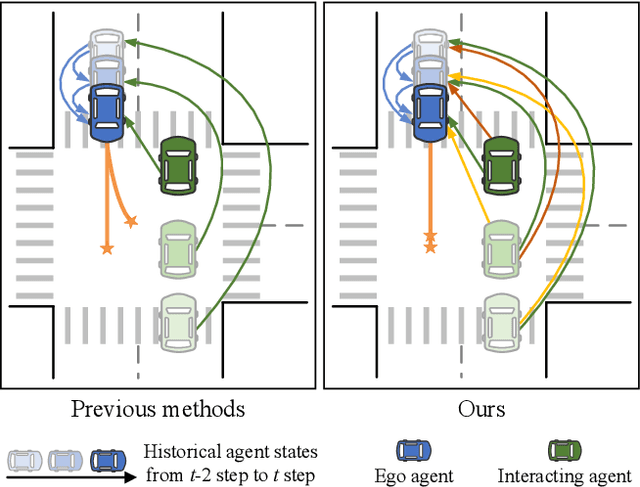
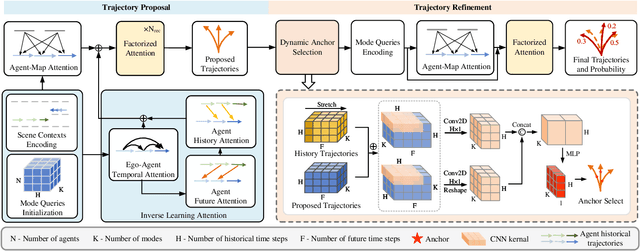
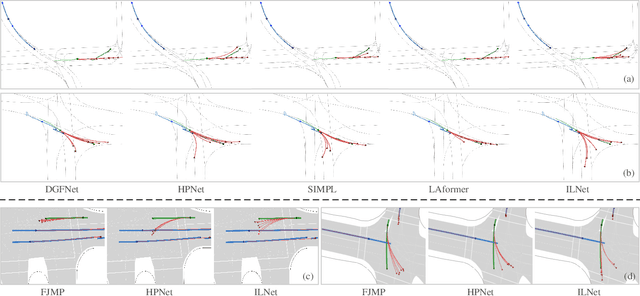
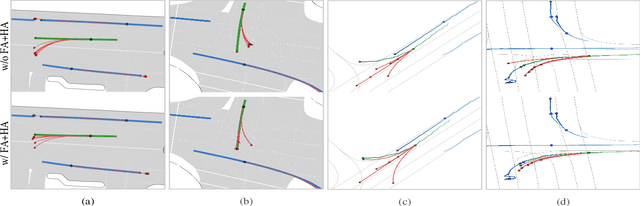
Trajectory prediction for multi-agent interaction scenarios is a crucial challenge. Most advanced methods model agent interactions by efficiently factorized attention based on the temporal and agent axes. However, this static and foward modeling lacks explicit interactive spatio-temporal coordination, capturing only obvious and immediate behavioral intentions. Alternatively, the modern trajectory prediction framework refines the successive predictions by a fixed-anchor selection strategy, which is difficult to adapt in different future environments. It is acknowledged that human drivers dynamically adjust initial driving decisions based on further assumptions about the intentions of surrounding vehicles. Motivated by human driving behaviors, this paper proposes ILNet, a multi-agent trajectory prediction method with Inverse Learning (IL) attention and Dynamic Anchor Selection (DAS) module. IL Attention employs an inverse learning paradigm to model interactions at neighboring moments, introducing proposed intentions to dynamically encode the spatio-temporal coordination of interactions, thereby enhancing the model's ability to capture complex interaction patterns. Then, the learnable DAS module is proposed to extract multiple trajectory change keypoints as anchors in parallel with almost no increase in parameters. Experimental results show that the ILNet achieves state-of-the-art performance on the INTERACTION and Argoverse motion forecasting datasets. Particularly, in challenged interaction scenarios, ILNet achieves higher accuracy and more multimodal distributions of trajectories over fewer parameters. Our codes are available at https://github.com/mjZeng11/ILNet.