 Add to Chrome
 Add to Firefox
 Add to Edge
Generation of Synthetic Fingerphotos with GANs
Aug 15, 2026
Contactless fingerprinting is an emerging approach to biometric authentication that allows users to scan their fingerprints without touching a scanner. Due to the limited amount of contactless fingerprint data available and the security risks associated with sharing real individuals' fingerprints, it is valuable to explore methods of generating synthetic data that can be used in place of - or in conjunction with - real data to develop and evaluate contactless fingerprinting systems. In this paper, we present and evaluate synthetic fingerphotos generated using StyleGAN2-ADA and StyleGAN3, existing image generation architectures. We evaluate the realism, privacy preservation, and variety of the synthetic fingerphotos by comparing their biometric feature statistics to those of real fingerphotos, computing match scores between real and synthetic fingerphotos, and computing match scores between different synthetic fingerphotos. This paper provides a quantitative comparison point for future evaluations of synthetic fingerphotos. The evaluation code is made available at https://github.com/cmillerlynch/fingerphoto-gan.

Liveness Detection Competition -- Noncontact-based Fingerprint Algorithms and Systems (LivDet-2023 Noncontact Fingerprint)
Oct 01, 2023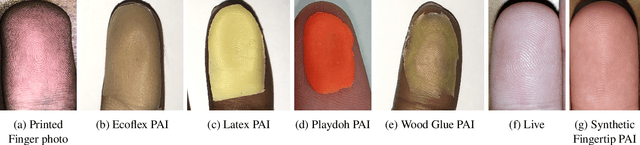
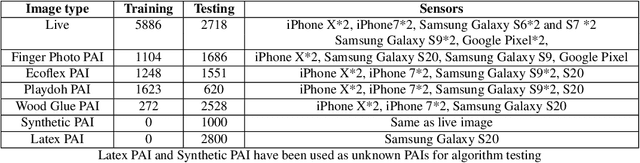

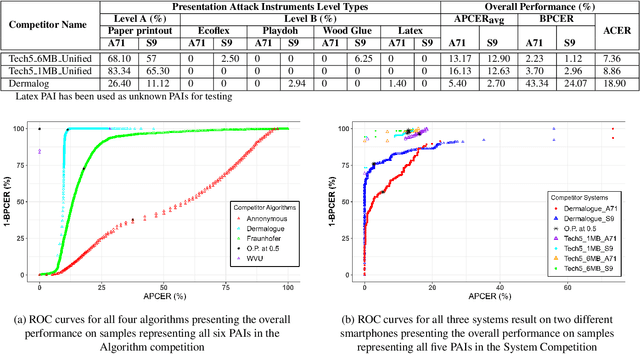
Liveness Detection (LivDet) is an international competition series open to academia and industry with the objec-tive to assess and report state-of-the-art in Presentation Attack Detection (PAD). LivDet-2023 Noncontact Fingerprint is the first edition of the noncontact fingerprint-based PAD competition for algorithms and systems. The competition serves as an important benchmark in noncontact-based fingerprint PAD, offering (a) independent assessment of the state-of-the-art in noncontact-based fingerprint PAD for algorithms and systems, and (b) common evaluation protocol, which includes finger photos of a variety of Presentation Attack Instruments (PAIs) and live fingers to the biometric research community (c) provides standard algorithm and system evaluation protocols, along with the comparative analysis of state-of-the-art algorithms from academia and industry with both old and new android smartphones. The winning algorithm achieved an APCER of 11.35% averaged overall PAIs and a BPCER of 0.62%. The winning system achieved an APCER of 13.0.4%, averaged over all PAIs tested over all the smartphones, and a BPCER of 1.68% over all smartphones tested. Four-finger systems that make individual finger-based PAD decisions were also tested. The dataset used for competition will be available 1 to all researchers as per data share protocol