 Add to Chrome
 Add to Firefox
 Add to Edge
Generation of Synthetic Fingerphotos with GANs
Aug 15, 2026
Contactless fingerprinting is an emerging approach to biometric authentication that allows users to scan their fingerprints without touching a scanner. Due to the limited amount of contactless fingerprint data available and the security risks associated with sharing real individuals' fingerprints, it is valuable to explore methods of generating synthetic data that can be used in place of - or in conjunction with - real data to develop and evaluate contactless fingerprinting systems. In this paper, we present and evaluate synthetic fingerphotos generated using StyleGAN2-ADA and StyleGAN3, existing image generation architectures. We evaluate the realism, privacy preservation, and variety of the synthetic fingerphotos by comparing their biometric feature statistics to those of real fingerphotos, computing match scores between real and synthetic fingerphotos, and computing match scores between different synthetic fingerphotos. This paper provides a quantitative comparison point for future evaluations of synthetic fingerphotos. The evaluation code is made available at https://github.com/cmillerlynch/fingerphoto-gan.

Deep Learning-Based Approaches for Contactless Fingerprints Segmentation and Extraction
Nov 26, 2023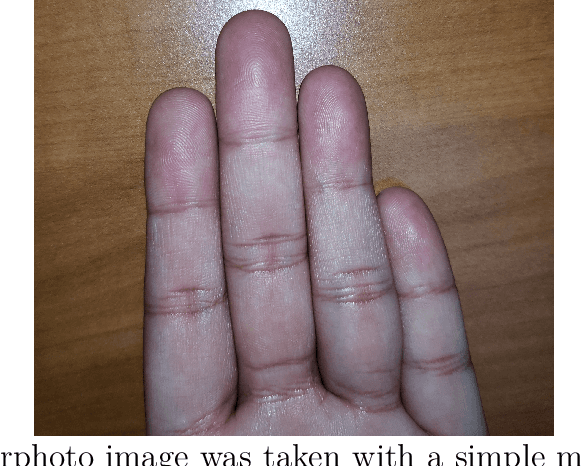

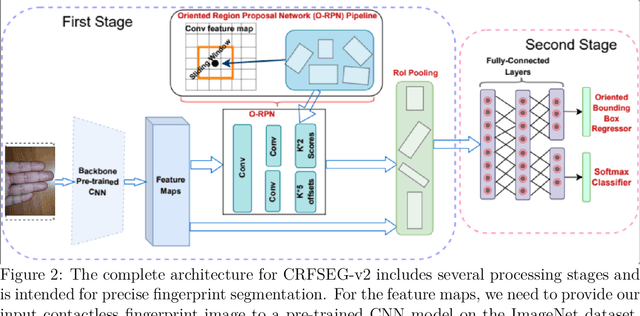
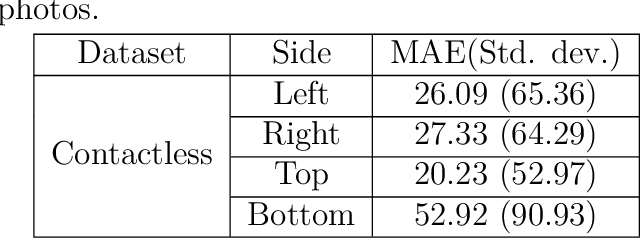
Fingerprints are widely recognized as one of the most unique and reliable characteristics of human identity. Most modern fingerprint authentication systems rely on contact-based fingerprints, which require the use of fingerprint scanners or fingerprint sensors for capturing fingerprints during the authentication process. Various types of fingerprint sensors, such as optical, capacitive, and ultrasonic sensors, employ distinct techniques to gather and analyze fingerprint data. This dependency on specific hardware or sensors creates a barrier or challenge for the broader adoption of fingerprint based biometric systems. This limitation hinders the widespread adoption of fingerprint authentication in various applications and scenarios. Border control, healthcare systems, educational institutions, financial transactions, and airport security face challenges when fingerprint sensors are not universally available. To mitigate the dependence on additional hardware, the use of contactless fingerprints has emerged as an alternative. Developing precise fingerprint segmentation methods, accurate fingerprint extraction tools, and reliable fingerprint matchers are crucial for the successful implementation of a robust contactless fingerprint authentication system. This paper focuses on the development of a deep learning-based segmentation tool for contactless fingerprint localization and segmentation. Our system leverages deep learning techniques to achieve high segmentation accuracy and reliable extraction of fingerprints from contactless fingerprint images. In our evaluation, our segmentation method demonstrated an average mean absolute error (MAE) of 30 pixels, an error in angle prediction (EAP) of 5.92 degrees, and a labeling accuracy of 97.46%. These results demonstrate the effectiveness of our novel contactless fingerprint segmentation and extraction tools.