 Add to Chrome
 Add to Firefox
 Add to Edge
Generation of Synthetic Fingerphotos with GANs
Aug 15, 2026
Contactless fingerprinting is an emerging approach to biometric authentication that allows users to scan their fingerprints without touching a scanner. Due to the limited amount of contactless fingerprint data available and the security risks associated with sharing real individuals' fingerprints, it is valuable to explore methods of generating synthetic data that can be used in place of - or in conjunction with - real data to develop and evaluate contactless fingerprinting systems. In this paper, we present and evaluate synthetic fingerphotos generated using StyleGAN2-ADA and StyleGAN3, existing image generation architectures. We evaluate the realism, privacy preservation, and variety of the synthetic fingerphotos by comparing their biometric feature statistics to those of real fingerphotos, computing match scores between real and synthetic fingerphotos, and computing match scores between different synthetic fingerphotos. This paper provides a quantitative comparison point for future evaluations of synthetic fingerphotos. The evaluation code is made available at https://github.com/cmillerlynch/fingerphoto-gan.

Presentation Attack Detection with Advanced CNN Models for Noncontact-based Fingerprint Systems
Mar 09, 2023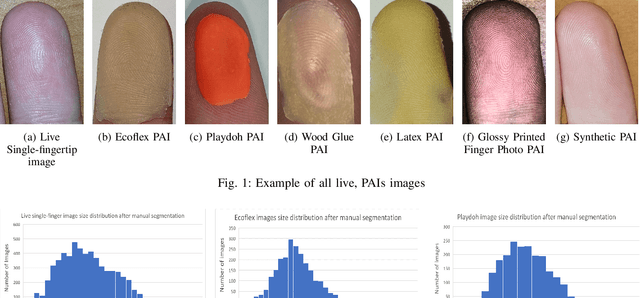
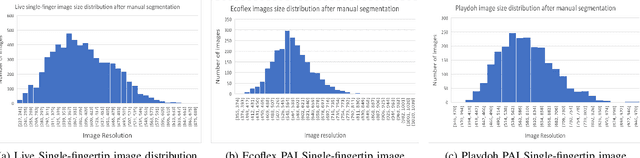
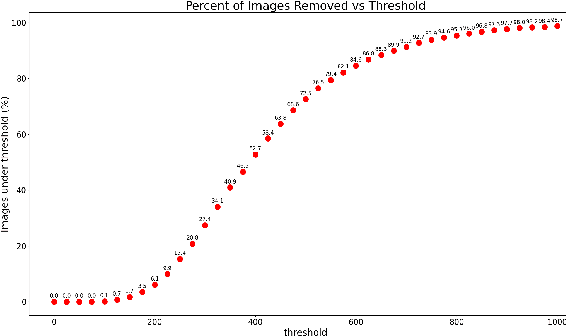
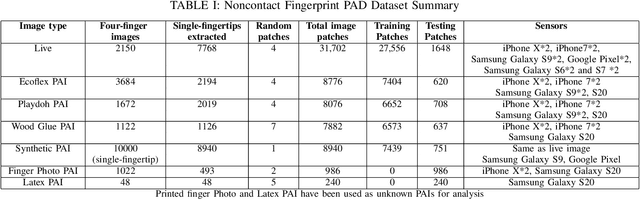
Touch-based fingerprint biometrics is one of the most popular biometric modalities with applications in several fields. Problems associated with touch-based techniques such as the presence of latent fingerprints and hygiene issues due to many people touching the same surface motivated the community to look for non-contact-based solutions. For the last few years, contactless fingerprint systems are on the rise and in demand because of the ability to turn any device with a camera into a fingerprint reader. Yet, before we can fully utilize the benefit of noncontact-based methods, the biometric community needs to resolve a few concerns such as the resiliency of the system against presentation attacks. One of the major obstacles is the limited publicly available data sets with inadequate spoof and live data. In this publication, we have developed a Presentation attack detection (PAD) dataset of more than 7500 four-finger images and more than 14,000 manually segmented single-fingertip images, and 10,000 synthetic fingertips (deepfakes). The PAD dataset was collected from six different Presentation Attack Instruments (PAI) of three different difficulty levels according to FIDO protocols, with five different types of PAI materials, and different smartphone cameras with manual focusing. We have utilized DenseNet-121 and NasNetMobile models and our proposed dataset to develop PAD algorithms and achieved PAD accuracy of Attack presentation classification error rate (APCER) 0.14\% and Bonafide presentation classification error rate (BPCER) 0.18\%. We have also reported the test results of the models against unseen spoof types to replicate uncertain real-world testing scenarios.