 Add to Chrome
 Add to Firefox
 Add to Edge
Quantitative Local Convergence of Mean-Field Stein Variational Gradient Flow
May 10, 2026
Stein Variational Gradient Descent (SVGD) is a deterministic interacting-particle method for sampling from a target probability measure given access to its score function. In the mean-field and continuous-time limit, it is known that the flow converges weakly toward the target, but no quantitative rate is known for the last iterate. In this paper, we establish quantitative local convergence in strong norms for this dynamics, when the interaction kernel is of Riesz type on the $d$-dimensional torus. Specifically, assuming that the initial density and the target are smooth and close in $L^2$-norm, we obtain explicit polynomial convergence rates in $L^2$-norm that depend on the dimension and on the regularity parameters of the kernel, the initialization and the target. We further show that these rates are sharp in certain regimes, and support the theory with numerical experiments. In the edge case of kernels with a Coulomb singularity, we recover the global exponential convergence result established in prior work. Our analysis is inspired by recent results on Wasserstein gradient flows of kernel mean discrepancies.

ResNets of All Shapes and Sizes: Convergence of Training Dynamics in the Large-scale Limit
Mar 18, 2026We establish convergence of the training dynamics of residual neural networks (ResNets) to their joint infinite depth L, hidden width M, and embedding dimension D limit. Specifically, we consider ResNets with two-layer perceptron blocks in the maximal local feature update (MLU) regime and prove that, after a bounded number of training steps, the error between the ResNet and its large-scale limit is O(1/L + sqrt(D/(L M)) + 1/sqrt(D)). This error rate is empirically tight when measured in embedding space. For a budget of P = Theta(L M D) parameters, this yields a convergence rate O(P^(-1/6)) for the scalings of (L, M, D) that minimize the bound. Our analysis exploits in an essential way the depth-two structure of residual blocks and applies formally to a broad class of state-of-the-art architectures, including Transformers with bounded key-query dimension. From a technical viewpoint, this work completes the program initiated in the companion paper [Chi25] where it is proved that for a fixed embedding dimension D, the training dynamics converges to a Mean ODE dynamics at rate O(1/L + sqrt(D)/sqrt(L M)). Here, we study the large-D limit of this Mean ODE model and establish convergence at rate O(1/sqrt(D)), yielding the above bound by a triangle inequality. To handle the rich probabilistic structure of the limit dynamics and obtain one of the first rigorous quantitative convergence for a DMFT-type limit, we combine the cavity method with propagation of chaos arguments at a functional level on so-called skeleton maps, which express the weight updates as functions of CLT-type sums from the past.
Quantitative Convergence of Wasserstein Gradient Flows of Kernel Mean Discrepancies
Mar 02, 2026We study the quantitative convergence of Wasserstein gradient flows of Kernel Mean Discrepancy (KMD) (also known as Maximum Mean Discrepancy (MMD)) functionals. Our setting covers in particular the training dynamics of shallow neural networks in the infinite-width and continuous time limit, as well as interacting particle systems with pairwise Riesz kernel interaction in the mean-field and overdamped limit. Our main analysis concerns the model case of KMD functionals given by the squared Sobolev distance $ \mathscr{E}^ν_{s}(μ)= \frac{1}{2}\lVert μ-ν\rVert_{\dot H^{-s}}^{2}$ for any $s\geq 1 $ and $ν$ a fixed probability measure on the $d$-dimensional torus. First, inspired by Yudovich theory for the $2d$-Euler equation, we establish existence and uniqueness in natural weak regularity classes. Next, we show that for $s=1$ the flow converges globally at an exponential rate under minimal assumptions, while for $s>1$ we prove local convergence at polynomial rates that depend explicitly on $s$ and on the Sobolev regularity of $μ$ and $ν$. These rates hold both at the energy level and in higher regularity classes and are tight for $ν$ uniform. We then consider the gradient flow of the population loss for shallow neural networks with ReLU activation, which can be cast as a Wasserstein--Fisher--Rao gradient flow on the space of nonnegative measures on the sphere $\mathbb{S}^d$. Exploiting a correspondence with the Sobolev energy case with $s=(d+3)/2$, we derive an explicit polynomial local convergence rate for this dynamics. Except for the special case $s=1$, even non-quantitative convergence was previously open in all these settings. We also include numerical experiments in dimension $d=1$ using both PDE and particle methods which illustrate our analysis.
Annealed Sinkhorn for Optimal Transport: convergence, regularization path and debiasing
Aug 21, 2024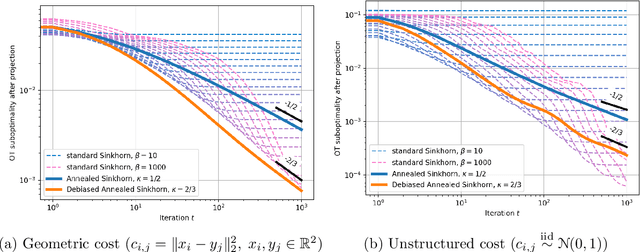
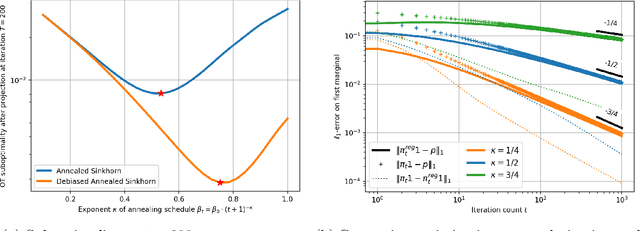


Sinkhorn's algorithm is a method of choice to solve large-scale optimal transport (OT) problems. In this context, it involves an inverse temperature parameter $\beta$ that determines the speed-accuracy trade-off. To improve this trade-off, practitioners often use a variant of this algorithm, Annealed Sinkhorn, that uses an nondecreasing sequence $(\beta_t)_{t\in \mathbb{N}}$ where $t$ is the iteration count. However, besides for the schedule $\beta_t=\Theta(\log t)$ which is impractically slow, it is not known whether this variant is guaranteed to actually solve OT. Our first contribution answers this question: we show that a concave annealing schedule asymptotically solves OT if and only if $\beta_t\to+\infty$ and $\beta_t-\beta_{t-1}\to 0$. The proof is based on an equivalence with Online Mirror Descent and further suggests that the iterates of Annealed Sinkhorn follow the solutions of a sequence of relaxed, entropic OT problems, the regularization path. An analysis of this path reveals that, in addition to the well-known "entropic" error in $\Theta(\beta^{-1}_t)$, the annealing procedure induces a "relaxation" error in $\Theta(\beta_{t}-\beta_{t-1})$. The best error trade-off is achieved with the schedule $\beta_t = \Theta(\sqrt{t})$ which, albeit slow, is a universal limitation of this method. Going beyond this limitation, we propose a simple modification of Annealed Sinkhorn that reduces the relaxation error, and therefore enables faster annealing schedules. In toy experiments, we observe the effectiveness of our Debiased Annealed Sinkhorn's algorithm: a single run of this algorithm spans the whole speed-accuracy Pareto front of the standard Sinkhorn's algorithm.
Mean-Field Langevin Dynamics for Signed Measures via a Bilevel Approach
Jun 26, 2024Mean-field Langevin dynamics (MLFD) is a class of interacting particle methods that tackle convex optimization over probability measures on a manifold, which are scalable, versatile, and enjoy computational guarantees. However, some important problems -- such as risk minimization for infinite width two-layer neural networks, or sparse deconvolution -- are originally defined over the set of signed, rather than probability, measures. In this paper, we investigate how to extend the MFLD framework to convex optimization problems over signed measures. Among two known reductions from signed to probability measures -- the lifting and the bilevel approaches -- we show that the bilevel reduction leads to stronger guarantees and faster rates (at the price of a higher per-iteration complexity). In particular, we investigate the convergence rate of MFLD applied to the bilevel reduction in the low-noise regime and obtain two results. First, this dynamics is amenable to an annealing schedule, adapted from Suzuki et al. (2023), that results in improved convergence rates to a fixed multiplicative accuracy. Second, we investigate the problem of learning a single neuron with the bilevel approach and obtain local exponential convergence rates that depend polynomially on the dimension and noise level (to compare with the exponential dependence that would result from prior analyses).
Deep linear networks for regression are implicitly regularized towards flat minima
May 22, 2024The largest eigenvalue of the Hessian, or sharpness, of neural networks is a key quantity to understand their optimization dynamics. In this paper, we study the sharpness of deep linear networks for overdetermined univariate regression. Minimizers can have arbitrarily large sharpness, but not an arbitrarily small one. Indeed, we show a lower bound on the sharpness of minimizers, which grows linearly with depth. We then study the properties of the minimizer found by gradient flow, which is the limit of gradient descent with vanishing learning rate. We show an implicit regularization towards flat minima: the sharpness of the minimizer is no more than a constant times the lower bound. The constant depends on the condition number of the data covariance matrix, but not on width or depth. This result is proven both for a small-scale initialization and a residual initialization. Results of independent interest are shown in both cases. For small-scale initialization, we show that the learned weight matrices are approximately rank-one and that their singular vectors align. For residual initialization, convergence of the gradient flow for a Gaussian initialization of the residual network is proven. Numerical experiments illustrate our results and connect them to gradient descent with non-vanishing learning rate.
Steering Deep Feature Learning with Backward Aligned Feature Updates
Nov 30, 2023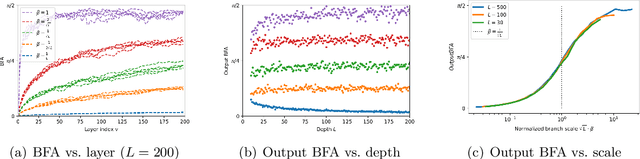
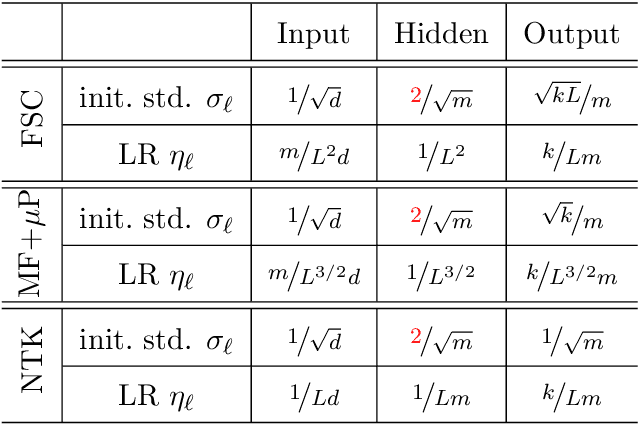
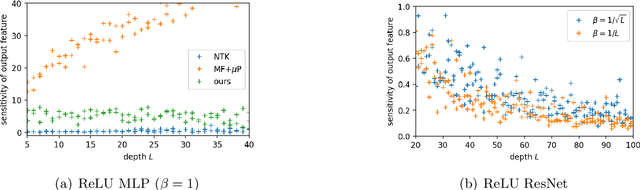
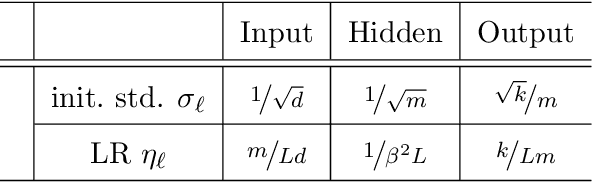
Deep learning succeeds by doing hierarchical feature learning, yet tuning Hyper-Parameters (HP) such as initialization scales, learning rates etc., only give indirect control over this behavior. In this paper, we propose the alignment between the feature updates and the backward pass as a key notion to predict, measure and control feature learning. On the one hand, we show that when alignment holds, the magnitude of feature updates after one SGD step is related to the magnitude of the forward and backward passes by a simple and general formula. This leads to techniques to automatically adjust HPs (initialization scales and learning rates) at initialization and throughout training to attain a desired feature learning behavior. On the other hand, we show that, at random initialization, this alignment is determined by the spectrum of a certain kernel, and that well-conditioned layer-to-layer Jacobians (aka dynamical isometry) implies alignment. Finally, we investigate ReLU MLPs and ResNets in the large width-then-depth limit. Combining hints from random matrix theory and numerical experiments, we show that (i) in MLP with iid initializations, alignment degenerates with depth, making it impossible to start training, and that (ii) in ResNets, the branch scale $1/\sqrt{\text{depth}}$ is the only one maintaining non-trivial alignment at infinite depth.
Computational Guarantees for Doubly Entropic Wasserstein Barycenters via Damped Sinkhorn Iterations
Jul 25, 2023We study the computation of doubly regularized Wasserstein barycenters, a recently introduced family of entropic barycenters governed by inner and outer regularization strengths. Previous research has demonstrated that various regularization parameter choices unify several notions of entropy-penalized barycenters while also revealing new ones, including a special case of debiased barycenters. In this paper, we propose and analyze an algorithm for computing doubly regularized Wasserstein barycenters. Our procedure builds on damped Sinkhorn iterations followed by exact maximization/minimization steps and guarantees convergence for any choice of regularization parameters. An inexact variant of our algorithm, implementable using approximate Monte Carlo sampling, offers the first non-asymptotic convergence guarantees for approximating Wasserstein barycenters between discrete point clouds in the free-support/grid-free setting.
Local Convergence of Gradient Methods for Min-Max Games under Partial Curvature
May 26, 2023We study the convergence to local Nash equilibria of gradient methods for two-player zero-sum differentiable games. It is well-known that such dynamics converge locally when $S \succ 0$ and may diverge when $S=0$, where $S\succeq 0$ is the symmetric part of the Jacobian at equilibrium that accounts for the "potential" component of the game. We show that these dynamics also converge as soon as $S$ is nonzero (partial curvature) and the eigenvectors of the antisymmetric part $A$ are in general position with respect to the kernel of $S$. We then study the convergence rates when $S \ll A$ and prove that they typically depend on the average of the eigenvalues of $S$, instead of the minimum as an analogy with minimization problems would suggest. To illustrate our results, we consider the problem of computing mixed Nash equilibria of continuous games. We show that, thanks to partial curvature, conic particle methods -- which optimize over both weights and supports of the mixed strategies -- generically converge faster than fixed-support methods. For min-max games, it is thus beneficial to add degrees of freedom "with curvature": this can be interpreted as yet another benefit of over-parameterization.
On the Effect of Initialization: The Scaling Path of 2-Layer Neural Networks
Mar 31, 2023In supervised learning, the regularization path is sometimes used as a convenient theoretical proxy for the optimization path of gradient descent initialized with zero. In this paper, we study a modification of the regularization path for infinite-width 2-layer ReLU neural networks with non-zero initial distribution of the weights at different scales. By exploiting a link with unbalanced optimal transport theory, we show that, despite the non-convexity of the 2-layer network training, this problem admits an infinite dimensional convex counterpart. We formulate the corresponding functional optimization problem and investigate its main properties. In particular, we show that as the scale of the initialization ranges between $0$ and $+\infty$, the associated path interpolates continuously between the so-called kernel and rich regimes. The numerical experiments confirm that, in our setting, the scaling path and the final states of the optimization path behave similarly even beyond these extreme points.