 Add to Chrome
 Add to Firefox
 Add to Edge
Decision trees, Frobenius traces, and Weierstrass coefficients of elliptic curves
Jul 27, 2026
We investigate the extent to which the reduced minimal Weierstrass coefficients of an elliptic curve over $\mathbb{Q}$ may be computed from it's Frobenius traces. Decision tree models reveal that the first two reduced minimal Weierstrass coefficients can be recovered with perfect accuracy from the Frobenius traces at the primes $2$ and $3$, and the third by supplementing these two traces with the conductor parity. We subsequently prove explicit formulae for these coefficients using the Frobenius traces and conductor parity. These formulae appear to be new. In particular, we deduce that the first three reduced minimal Weierstrass coefficients of an elliptic curve are determined by its isogeny class.

Discovering a Zeta Map Algorithm on Dyck Paths via Mechanistic Interpretability
May 28, 2026Machine learning is increasingly used in mathematical discovery, but in mathematics the desired output is often not a prediction itself, but an explicit construction that can be checked independently. We study this setting through the zeta map on Dyck paths, a classical bijection in the combinatorics of the q,t-Catalan numbers. We train a deliberately small one-layer, one-head encoder-decoder transformer on this map and analyze its learned computation using mechanistic interpretability tools, including decoder cross-attention analysis, linear probing, and causal intervention. The analysis reveals a level-based mechanism: encoder representations make path levels linearly accessible, while the decoder selects and traverses input positions in a structured way. Translating these signals into combinatorics leads to the scaffolding map, an explicit peak-centered traversal algorithm for Dyck paths. We prove that this algorithm agrees with the zeta map, modulo a reversal convention in the labeling. This gives a controlled example of AI-assisted mathematical discovery in which mechanistic interpretability turns model behavior into a precise, human-verifiable combinatorial algorithm.
Murmurations, Mestre--Nagao sums, and Convolutional Neural Networks for elliptic curves
Mar 18, 2026We apply one-dimensional convolutional neural networks to the Frobenius traces of elliptic curves over $\mathbb{Q}$ and evaluate and interpret their predictive capacity. In keeping with similar experiments by Kazalicki--Vlah, Bujanović--Kazalicki--Novak, and Pozdnyakov, we observe high accuracy predictions for the analytic rank across a range of conductors. We interpret the prediction using saliency curves and explore the interesting interplay between murmurations and Mestre--Nagao sums, the details of which vary with the conductor and the (predicted) rank.
Murmurations: a case study in AI-assisted mathematics
Mar 10, 2026We report the emergence of a striking new phenomenon in arithmetic, which we call murmurations. First observed experimentally through averages over large arithmetic datasets, murmurations can be detected and analyzed using standard interpretability tools from machine learning, including principal component weightings, saliency curves, and convolutional filters. Although discovered computationally, they constitute a genuinely new and intriguing phenomenon in arithmetic that can be formulated and investigated using established tools of number theory. In particular, murmurations encode subtle information about Frobenius traces and naturally belong to the framework of arithmetic statistics. More precisely, murmurations connect to central themes surrounding the conjecture of Birch and Swinnerton-Dyer and perspectives from random matrix theory. In this paper, we present an overview of murmurations, contextualizing them within number theory and AI.
From Black Box to Bijection: Interpreting Machine Learning to Build a Zeta Map Algorithm
Nov 16, 2025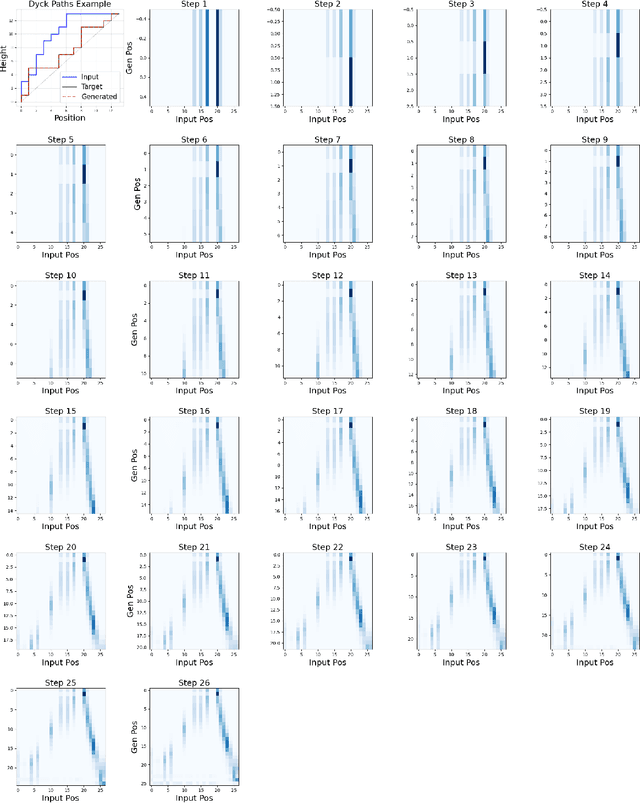
There is a large class of problems in algebraic combinatorics which can be distilled into the same challenge: construct an explicit combinatorial bijection. Traditionally, researchers have solved challenges like these by visually inspecting the data for patterns, formulating conjectures, and then proving them. But what is to be done if patterns fail to emerge until the data grows beyond human scale? In this paper, we propose a new workflow for discovering combinatorial bijections via machine learning. As a proof of concept, we train a transformer on paired Dyck paths and use its learned attention patterns to derive a new algorithmic description of the zeta map, which we call the \textit{Scaffolding Map}.
Interpretable Machine Learning for Kronecker Coefficients
Feb 17, 2025We analyze the saliency of neural networks and employ interpretable machine learning models to predict whether the Kronecker coefficients of the symmetric group are zero or not. Our models use triples of partitions as input features, as well as b-loadings derived from the principal component of an embedding that captures the differences between partitions. Across all approaches, we achieve an accuracy of approximately 83% and derive explicit formulas for a decision function in terms of b-loadings. Additionally, we develop transformer-based models for prediction, achieving the highest reported accuracy of over 99%.
Mathematical Data Science
Feb 12, 2025Can machine learning help discover new mathematical structures? In this article we discuss an approach to doing this which one can call "mathematical data science". In this paradigm, one studies mathematical objects collectively rather than individually, by creating datasets and doing machine learning experiments and interpretations. After an overview, we present two case studies: murmurations in number theory and loadings of partitions related to Kronecker coefficients in representation theory and combinatorics.
Learning Fricke signs from Maass form Coefficients
Jan 03, 2025
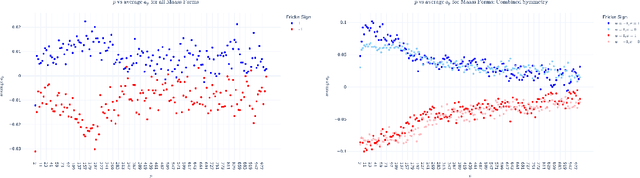

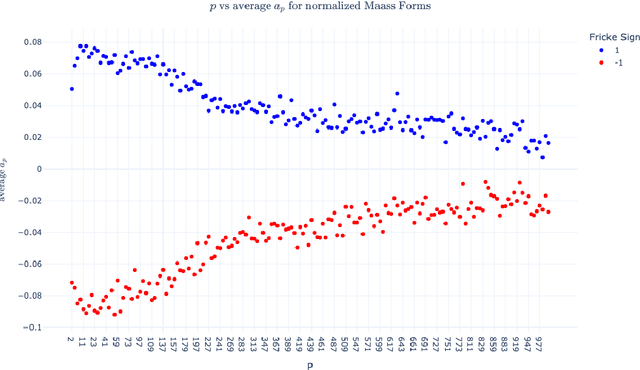
In this paper, we conduct a data-scientific investigation of Maass forms. We find that averaging the Fourier coefficients of Maass forms with the same Fricke sign reveals patterns analogous to the recently discovered "murmuration" phenomenon, and that these patterns become more pronounced when parity is incorporated as an additional feature. Approximately 43% of the forms in our dataset have an unknown Fricke sign. For the remaining forms, we employ Linear Discriminant Analysis (LDA) to machine learn their Fricke sign, achieving 96% (resp. 94%) accuracy for forms with even (resp. odd) parity. We apply the trained LDA model to forms with unknown Fricke signs to make predictions. The average values based on the predicted Fricke signs are computed and compared to those for forms with known signs to verify the reasonableness of the predictions. Additionally, a subset of these predictions is evaluated against heuristic guesses provided by Hejhal's algorithm, showing a match approximately 95% of the time. We also use neural networks to obtain results comparable to those from the LDA model.
Machine Learning Mutation-Acyclicity of Quivers
Nov 06, 2024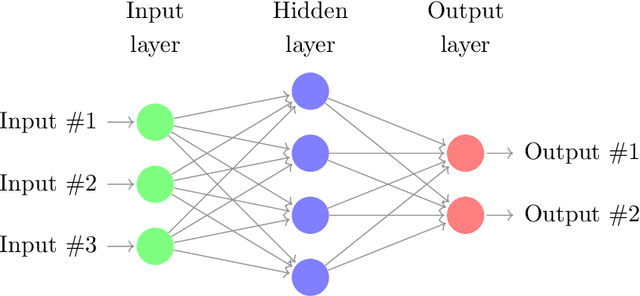

Machine learning (ML) has emerged as a powerful tool in mathematical research in recent years. This paper applies ML techniques to the study of quivers--a type of directed multigraph with significant relevance in algebra, combinatorics, computer science, and mathematical physics. Specifically, we focus on the challenging problem of determining the mutation-acyclicity of a quiver on 4 vertices, a property that is pivotal since mutation-acyclicity is often a necessary condition for theorems involving path algebras and cluster algebras. Although this classification is known for quivers with at most 3 vertices, little is known about quivers on more than 3 vertices. We give a computer-assisted proof of a theorem to prove that mutation-acyclicity is decidable for quivers on 4 vertices with edge weight at most 2. By leveraging neural networks (NNs) and support vector machines (SVMs), we then accurately classify more general 4-vertex quivers as mutation-acyclic or non-mutation-acyclic. Our results demonstrate that ML models can efficiently detect mutation-acyclicity, providing a promising computational approach to this combinatorial problem, from which the trained SVM equation provides a starting point to guide future theoretical development.
Machine-Learning Kronecker Coefficients
Jun 07, 2023The Kronecker coefficients are the decomposition multiplicities of the tensor product of two irreducible representations of the symmetric group. Unlike the Littlewood--Richardson coefficients, which are the analogues for the general linear group, there is no known combinatorial description of the Kronecker coefficients, and it is an NP-hard problem to decide whether a given Kronecker coefficient is zero or not. In this paper, we show that standard machine-learning algorithms such as Nearest Neighbors, Convolutional Neural Networks and Gradient Boosting Decision Trees may be trained to predict whether a given Kronecker coefficient is zero or not. Our results show that a trained machine can efficiently perform this binary classification with high accuracy ($\approx 0.98$).