 Add to Chrome
 Add to Firefox
 Add to Edge
Learning the Graphical Nature of Symmetries
Jul 13, 2026
Finite groups are rigid algebraic objects, whose Cayley graphs expose a rich network geometry through which group-theoretic structure can be measured, compared, and learned. In this paper, a dataset of $131{,}406$ Cayley graphs is constructed, covering all groups of order at most $767$ except order $512$, recording exact algebraic labels for group properties together with a broad collection of graph, cycle, distance, and spectral statistics. This census aims to provide novel benchmarks for studying how finite-group properties are reflected in Cayley graph observables. It also yields new enumerative contributions: alongside recovering known OEIS sequences for standard group classes, new sequences for monolithic groups and for groups generated by at most three, four, and five elements are contributed to the OEIS. The accompanying network analysis identifies several empirical regularities and formulates testable conjectures, including relationships involving square clustering, Cayley graph diameter, average graph disorder, and spectral eigengaps of nilpotent groups. Finally, a comparison between classical models, an MLP, and graph neural network architectures is performed for predicting algebraic group properties directly from Cayley graph data. The results show that engineered graph statistics are highly informative, while GNNs, especially GIN and in some fixed-order settings GCN, can recover substantial structural signal directly from the graph. Such that graph-aware architectures show phases of optimality on these group-theoretic graph representations.

Black Hole Black Boxes: Numerical Black Hole Metrics via AInstein Neural Networks
Jul 06, 2026The AInstein architecture introduced an unsupervised neural method for solving the Riemannian Einstein equations on arbitrary manifolds. This Physics Informed Neural Network approach (PINN) is extended here to Lorentzian signature, validated by recovering the maximally extended Schwarzschild geometry, and tested as novel search method for arbitrary black hole solutions. The topology is built into the architecture by treating $S^{2}$ globally through its standard embedding, such that the network learns an ambient metric on the manifold $\mathbb{R}^{2} \times \mathbb{R}^{3}$, where Penrose coordinates are chosen for $\mathbb{R}^2$ and the metric on $S^{2}$ is obtained by pullback. The architecture is first trained with the objective of recovering the Schwarzschild metric via losses encoding the vacuum Einstein equation, a quadratic Weyl scalar constraint, and the $SO(3)$ symmetry of the resultant metric; directly motivated by the Birkhoff--Jebsen theorem. Following this, the objective is generalised to use the Petrov speciality index, a horizon curvature anchor, and a trapped-surface constraint, to allow search for algebraically general Petrov type I solutions, finding potentially novel general-type Lorentzian Einstein metrics with a genuinely trapped interior.
PINNs in More General Geometry
Apr 27, 2026Neural architectures trained with losses inspired by differential conditions are the basis for PINN models. Since many constructions in differential geometry may be framed as minimisation of a differential functional, these functionals can be coded as loss functions to align the AI loss-minimisation goal with that of solving the geometric problem. This contribution to the Recent Progress in Computational String Geometry workshop proceedings introduces the PINN architecture defining principles, motivates how they are well suited for problems in differential geometry, and demonstrates their use via summaries of three works at this intersection.
Minimising Willmore Energy via Neural Flow
Apr 06, 2026The neural Willmore flow of a closed oriented $2$-surface in $\mathbb{R}^3$ is introduced as a natural evolution process to minimise the Willmore energy, which is the squared $L^2$-norm of mean curvature. Neural architectures are used to model maps from topological $2d$ domains to $3d$ Euclidean space, where the learning process minimises a PINN-style loss for the Willmore energy as a functional on the embedding. Training reproduces the expected round sphere for genus $0$ surfaces, and the Clifford torus for genus $1$ surfaces, respectively. Furthermore, the experiment in the genus $2$ case provides a novel approach to search for minimal Willmore surfaces in this open problem.
A Machine Learning Approach to the Nirenberg Problem
Feb 12, 2026This work introduces the Nirenberg Neural Network: a numerical approach to the Nirenberg problem of prescribing Gaussian curvature on $S^2$ for metrics that are pointwise conformal to the round metric. Our mesh-free physics-informed neural network (PINN) approach directly parametrises the conformal factor globally and is trained with a geometry-aware loss enforcing the curvature equation. Additional consistency checks were performed via the Gauss-Bonnet theorem, and spherical-harmonic expansions were fit to the learnt models to provide interpretability. For prescribed curvatures with known realisability, the neural network achieves very low losses ($10^{-7} - 10^{-10}$), while unrealisable curvatures yield significantly higher losses. This distinction enables the assessment of unknown cases, separating likely realisable functions from non-realisable ones. The current capabilities of the Nirenberg Neural Network demonstrate that neural solvers can serve as exploratory tools in geometric analysis, offering a quantitative computational perspective on longstanding existence questions.
Neural and numerical methods for $\mathrm{G}_2$-structures on contact Calabi-Yau 7-manifolds
Feb 12, 2026A numerical framework for approximating $\mathrm{G}_2$-structure 3-forms on contact Calabi-Yau manifolds is presented. The approach proceeds in three stages: first, existing neural network models are employed to compute an approximate Ricci-flat metric on a Calabi-Yau threefold. Second, using this metric and the explicit construction of a $\mathrm{G}_2$-structure on the associated 7-dimensional Calabi-Yau link in the 9-sphere, numerical approximations of the 3-form are generated on a large set of sampled points. Finally, a dedicated neural architecture is trained to learn the 3-form and its induced Riemannian metric directly from data, validating the learned structure and its torsion via a numerical implementation of the exterior derivative, which may be of independent interest.
Versor: A Geometric Sequence Architecture
Feb 10, 2026A novel sequence architecture design is introduced, Versor, which uses Conformal Geometric Algebra (CGA) in place of the traditional fundamental non-linear operations to achieve structural generalization and significant performance improvements on a variety of tasks, while offering improved interpretability and efficiency. By embedding states in the $Cl_{4,1}$ manifold and evolving them via geometric transformations (rotors), Versor natively represents $SE(3)$-equivariant relationships without requiring explicit structural encoding. Versor is validated on chaotic N-body dynamics, topological reasoning, and standard multimodal benchmarks (CIFAR-10, WikiText-103), consistently outperforming Transformers, Graph Networks, and geometric baselines (GATr, EGNN). Key results include: orders of magnitude fewer parameters ($200\times$ vs. Transformers); interpretable attention decomposing into proximity and orientational components; zero-shot scale generalization (99.3% MCC on topology vs. 50.4% for ViT); and $O(L)$ linear complexity via the novel Recursive Rotor Accumulator. In out-of-distribution tests, Versor maintains stable predictions while Transformers fail catastrophically. Custom Clifford kernels achieve up to $78\times$ speedup, providing a scalable foundation for geometrically-aware scientific modeling.
Grokking vs. Learning: Same Features, Different Encodings
Feb 03, 2025
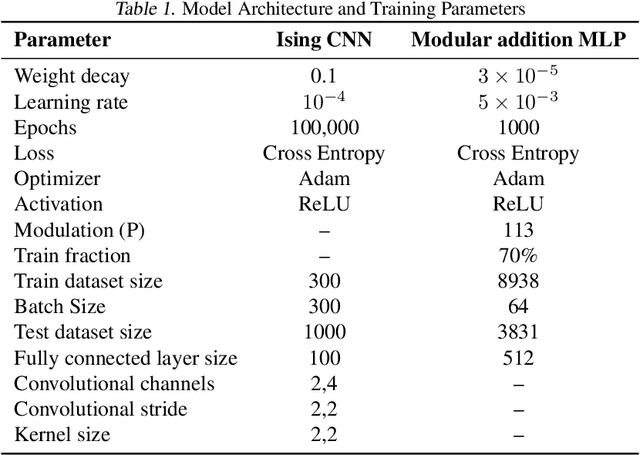
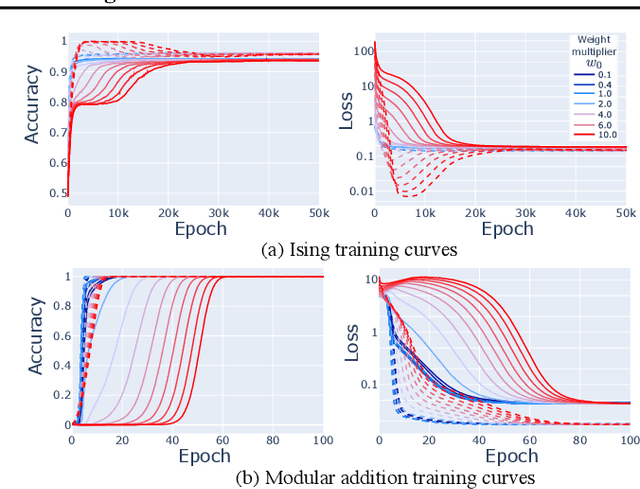
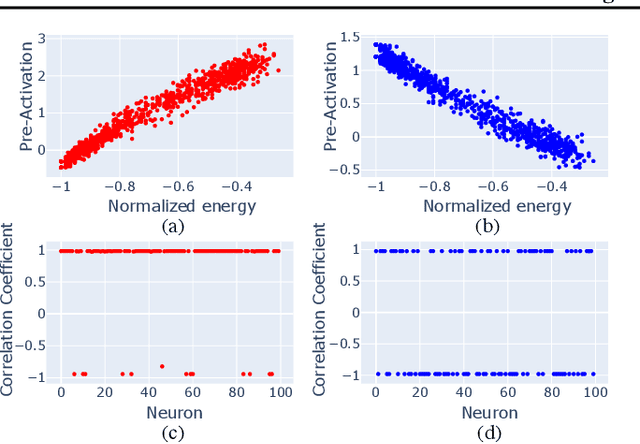
Grokking typically achieves similar loss to ordinary, "steady", learning. We ask whether these different learning paths - grokking versus ordinary training - lead to fundamental differences in the learned models. To do so we compare the features, compressibility, and learning dynamics of models trained via each path in two tasks. We find that grokked and steadily trained models learn the same features, but there can be large differences in the efficiency with which these features are encoded. In particular, we find a novel "compressive regime" of steady training in which there emerges a linear trade-off between model loss and compressibility, and which is absent in grokking. In this regime, we can achieve compression factors 25x times the base model, and 5x times the compression achieved in grokking. We then track how model features and compressibility develop through training. We show that model development in grokking is task-dependent, and that peak compressibility is achieved immediately after the grokking plateau. Finally, novel information-geometric measures are introduced which demonstrate that models undergoing grokking follow a straight path in information space.
Machine Learning Mutation-Acyclicity of Quivers
Nov 06, 2024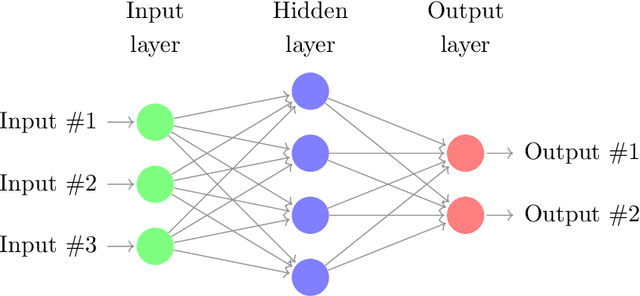

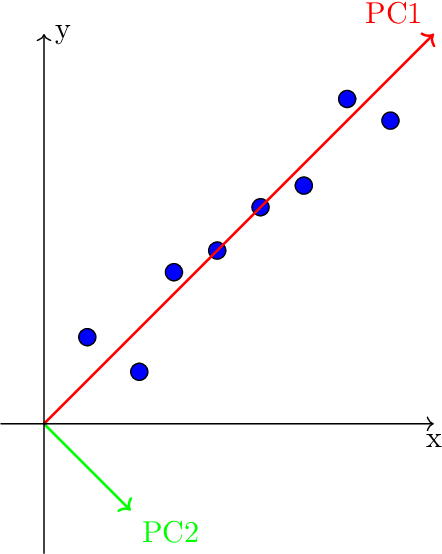
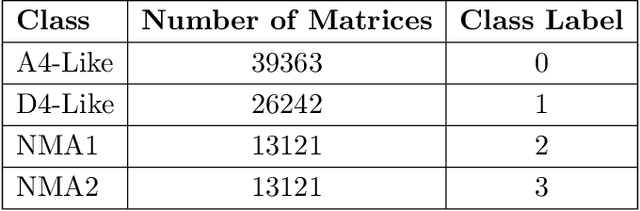
Machine learning (ML) has emerged as a powerful tool in mathematical research in recent years. This paper applies ML techniques to the study of quivers--a type of directed multigraph with significant relevance in algebra, combinatorics, computer science, and mathematical physics. Specifically, we focus on the challenging problem of determining the mutation-acyclicity of a quiver on 4 vertices, a property that is pivotal since mutation-acyclicity is often a necessary condition for theorems involving path algebras and cluster algebras. Although this classification is known for quivers with at most 3 vertices, little is known about quivers on more than 3 vertices. We give a computer-assisted proof of a theorem to prove that mutation-acyclicity is decidable for quivers on 4 vertices with edge weight at most 2. By leveraging neural networks (NNs) and support vector machines (SVMs), we then accurately classify more general 4-vertex quivers as mutation-acyclic or non-mutation-acyclic. Our results demonstrate that ML models can efficiently detect mutation-acyclicity, providing a promising computational approach to this combinatorial problem, from which the trained SVM equation provides a starting point to guide future theoretical development.
Learning 3-Manifold Triangulations
May 15, 2024Real 3-manifold triangulations can be uniquely represented by isomorphism signatures. Databases of these isomorphism signatures are generated for a variety of 3-manifolds and knot complements, using SnapPy and Regina, then these language-like inputs are used to train various machine learning architectures to differentiate the manifolds, as well as their Dehn surgeries, via their triangulations. Gradient saliency analysis then extracts key parts of this language-like encoding scheme from the trained models. The isomorphism signature databases are taken from the 3-manifolds' Pachner graphs, which are also generated in bulk for some selected manifolds of focus and for the subset of the SnapPy orientable cusped census with $<8$ initial tetrahedra. These Pachner graphs are further analysed through the lens of network science to identify new structure in the triangulation representation; in particular for the hyperbolic case, a relation between the length of the shortest geodesic (systole) and the size of the Pachner graph's ball is observed.