 Add to Chrome
 Add to Firefox
 Add to Edge
Murmurations, Mestre--Nagao sums, and Convolutional Neural Networks for elliptic curves
Mar 18, 2026
We apply one-dimensional convolutional neural networks to the Frobenius traces of elliptic curves over $\mathbb{Q}$ and evaluate and interpret their predictive capacity. In keeping with similar experiments by Kazalicki--Vlah, Bujanović--Kazalicki--Novak, and Pozdnyakov, we observe high accuracy predictions for the analytic rank across a range of conductors. We interpret the prediction using saliency curves and explore the interesting interplay between murmurations and Mestre--Nagao sums, the details of which vary with the conductor and the (predicted) rank.

Learning Fricke signs from Maass form Coefficients
Jan 03, 2025
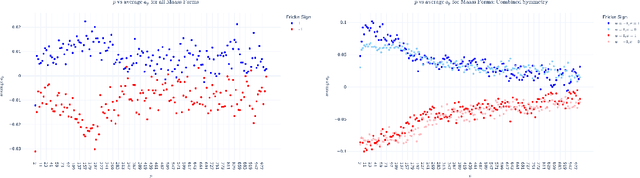

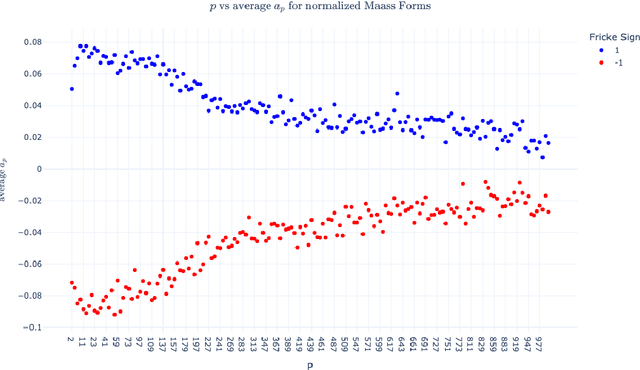
In this paper, we conduct a data-scientific investigation of Maass forms. We find that averaging the Fourier coefficients of Maass forms with the same Fricke sign reveals patterns analogous to the recently discovered "murmuration" phenomenon, and that these patterns become more pronounced when parity is incorporated as an additional feature. Approximately 43% of the forms in our dataset have an unknown Fricke sign. For the remaining forms, we employ Linear Discriminant Analysis (LDA) to machine learn their Fricke sign, achieving 96% (resp. 94%) accuracy for forms with even (resp. odd) parity. We apply the trained LDA model to forms with unknown Fricke signs to make predictions. The average values based on the predicted Fricke signs are computed and compared to those for forms with known signs to verify the reasonableness of the predictions. Additionally, a subset of these predictions is evaluated against heuristic guesses provided by Hejhal's algorithm, showing a match approximately 95% of the time. We also use neural networks to obtain results comparable to those from the LDA model.