 Add to Chrome
 Add to Firefox
 Add to Edge
ViVid-1-to-3: Novel View Synthesis with Video Diffusion Models
Dec 03, 2023
Generating novel views of an object from a single image is a challenging task. It requires an understanding of the underlying 3D structure of the object from an image and rendering high-quality, spatially consistent new views. While recent methods for view synthesis based on diffusion have shown great progress, achieving consistency among various view estimates and at the same time abiding by the desired camera pose remains a critical problem yet to be solved. In this work, we demonstrate a strikingly simple method, where we utilize a pre-trained video diffusion model to solve this problem. Our key idea is that synthesizing a novel view could be reformulated as synthesizing a video of a camera going around the object of interest -- a scanning video -- which then allows us to leverage the powerful priors that a video diffusion model would have learned. Thus, to perform novel-view synthesis, we create a smooth camera trajectory to the target view that we wish to render, and denoise using both a view-conditioned diffusion model and a video diffusion model. By doing so, we obtain a highly consistent novel view synthesis, outperforming the state of the art.

Volumetric Rendering with Baked Quadrature Fields
Dec 02, 2023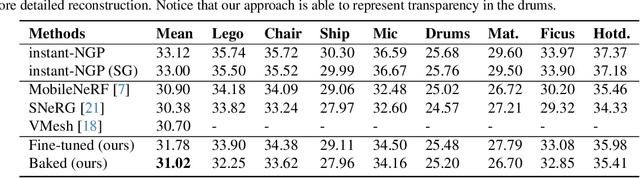
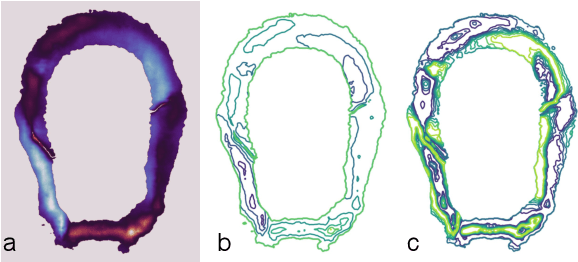


We propose a novel Neural Radiance Field (NeRF) representation for non-opaque scenes that allows fast inference by utilizing textured polygons. Despite the high-quality novel view rendering that NeRF provides, a critical limitation is that it relies on volume rendering that can be computationally expensive and does not utilize the advancements in modern graphics hardware. Existing methods for this problem fall short when it comes to modelling volumetric effects as they rely purely on surface rendering. We thus propose to model the scene with polygons, which can then be used to obtain the quadrature points required to model volumetric effects, and also their opacity and colour from the texture. To obtain such polygonal mesh, we train a specialized field whose zero-crossings would correspond to the quadrature points when volume rendering, and perform marching cubes on this field. We then rasterize the polygons and utilize the fragment shaders to obtain the final colour image. Our method allows rendering on various devices and easy integration with existing graphics frameworks while keeping the benefits of volume rendering alive.
Accelerating Neural Field Training via Soft Mining
Nov 29, 2023We present an approach to accelerate Neural Field training by efficiently selecting sampling locations. While Neural Fields have recently become popular, it is often trained by uniformly sampling the training domain, or through handcrafted heuristics. We show that improved convergence and final training quality can be achieved by a soft mining technique based on importance sampling: rather than either considering or ignoring a pixel completely, we weigh the corresponding loss by a scalar. To implement our idea we use Langevin Monte-Carlo sampling. We show that by doing so, regions with higher error are being selected more frequently, leading to more than 2x improvement in convergence speed. The code and related resources for this study are publicly available at https://ubc-vision.github.io/nf-soft-mining/.
INVE: Interactive Neural Video Editing
Jul 15, 2023We present Interactive Neural Video Editing (INVE), a real-time video editing solution, which can assist the video editing process by consistently propagating sparse frame edits to the entire video clip. Our method is inspired by the recent work on Layered Neural Atlas (LNA). LNA, however, suffers from two major drawbacks: (1) the method is too slow for interactive editing, and (2) it offers insufficient support for some editing use cases, including direct frame editing and rigid texture tracking. To address these challenges we leverage and adopt highly efficient network architectures, powered by hash-grids encoding, to substantially improve processing speed. In addition, we learn bi-directional functions between image-atlas and introduce vectorized editing, which collectively enables a much greater variety of edits in both the atlas and the frames directly. Compared to LNA, our INVE reduces the learning and inference time by a factor of 5, and supports various video editing operations that LNA cannot. We showcase the superiority of INVE over LNA in interactive video editing through a comprehensive quantitative and qualitative analysis, highlighting its numerous advantages and improved performance. For video results, please see https://gabriel-huang.github.io/inve/
Unsupervised Semantic Correspondence Using Stable Diffusion
May 24, 2023Text-to-image diffusion models are now capable of generating images that are often indistinguishable from real images. To generate such images, these models must understand the semantics of the objects they are asked to generate. In this work we show that, without any training, one can leverage this semantic knowledge within diffusion models to find semantic correspondences -- locations in multiple images that have the same semantic meaning. Specifically, given an image, we optimize the prompt embeddings of these models for maximum attention on the regions of interest. These optimized embeddings capture semantic information about the location, which can then be transferred to another image. By doing so we obtain results on par with the strongly supervised state of the art on the PF-Willow dataset and significantly outperform (20.9% relative for the SPair-71k dataset) any existing weakly or unsupervised method on PF-Willow, CUB-200 and SPair-71k datasets.
PPDONet: Deep Operator Networks for Fast Prediction of Steady-State Solutions in Disk-Planet Systems
May 18, 2023We develop a tool, which we name Protoplanetary Disk Operator Network (PPDONet), that can predict the solution of disk-planet interactions in protoplanetary disks in real-time. We base our tool on Deep Operator Networks (DeepONets), a class of neural networks capable of learning non-linear operators to represent deterministic and stochastic differential equations. With PPDONet we map three scalar parameters in a disk-planet system -- the Shakura \& Sunyaev viscosity $\alpha$, the disk aspect ratio $h_\mathrm{0}$, and the planet-star mass ratio $q$ -- to steady-state solutions of the disk surface density, radial velocity, and azimuthal velocity. We demonstrate the accuracy of the PPDONet solutions using a comprehensive set of tests. Our tool is able to predict the outcome of disk-planet interaction for one system in less than a second on a laptop. A public implementation of PPDONet is available at \url{https://github.com/smao-astro/PPDONet}.
BlendFields: Few-Shot Example-Driven Facial Modeling
May 12, 2023
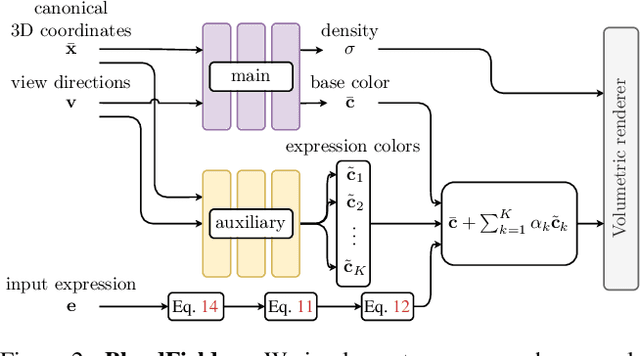
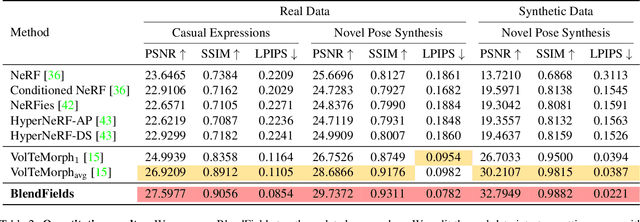
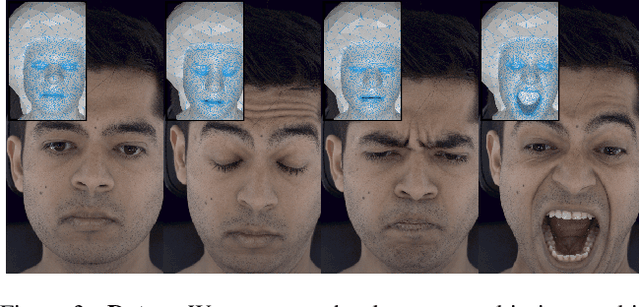
Generating faithful visualizations of human faces requires capturing both coarse and fine-level details of the face geometry and appearance. Existing methods are either data-driven, requiring an extensive corpus of data not publicly accessible to the research community, or fail to capture fine details because they rely on geometric face models that cannot represent fine-grained details in texture with a mesh discretization and linear deformation designed to model only a coarse face geometry. We introduce a method that bridges this gap by drawing inspiration from traditional computer graphics techniques. Unseen expressions are modeled by blending appearance from a sparse set of extreme poses. This blending is performed by measuring local volumetric changes in those expressions and locally reproducing their appearance whenever a similar expression is performed at test time. We show that our method generalizes to unseen expressions, adding fine-grained effects on top of smooth volumetric deformations of a face, and demonstrate how it generalizes beyond faces.
Pointersect: Neural Rendering with Cloud-Ray Intersection
Apr 24, 2023
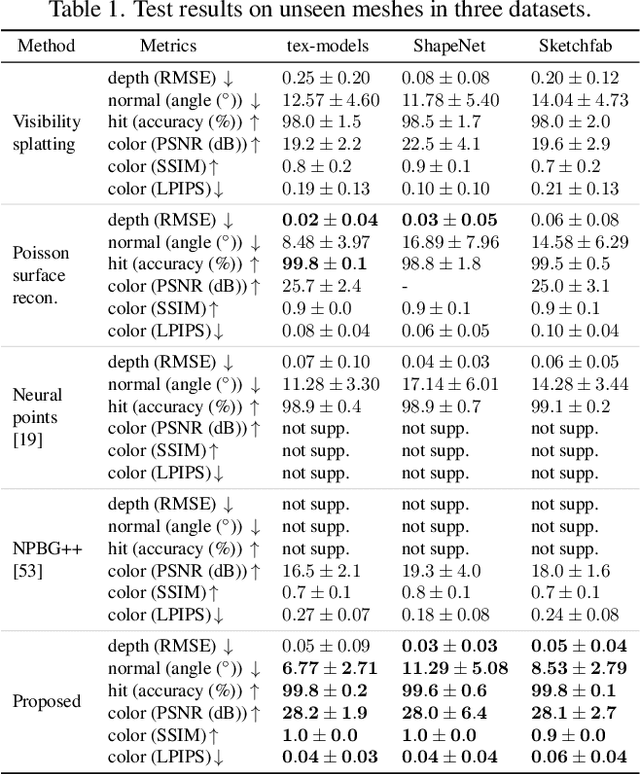
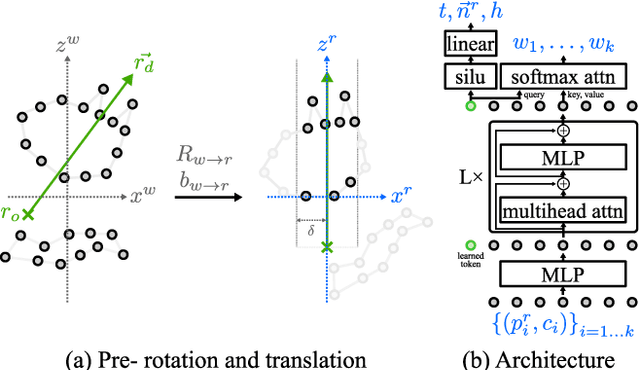

We propose a novel method that renders point clouds as if they are surfaces. The proposed method is differentiable and requires no scene-specific optimization. This unique capability enables, out-of-the-box, surface normal estimation, rendering room-scale point clouds, inverse rendering, and ray tracing with global illumination. Unlike existing work that focuses on converting point clouds to other representations--e.g., surfaces or implicit functions--our key idea is to directly infer the intersection of a light ray with the underlying surface represented by the given point cloud. Specifically, we train a set transformer that, given a small number of local neighbor points along a light ray, provides the intersection point, the surface normal, and the material blending weights, which are used to render the outcome of this light ray. Localizing the problem into small neighborhoods enables us to train a model with only 48 meshes and apply it to unseen point clouds. Our model achieves higher estimation accuracy than state-of-the-art surface reconstruction and point-cloud rendering methods on three test sets. When applied to room-scale point clouds, without any scene-specific optimization, the model achieves competitive quality with the state-of-the-art novel-view rendering methods. Moreover, we demonstrate ability to render and manipulate Lidar-scanned point clouds such as lighting control and object insertion.
FaceLit: Neural 3D Relightable Faces
Mar 27, 2023We propose a generative framework, FaceLit, capable of generating a 3D face that can be rendered at various user-defined lighting conditions and views, learned purely from 2D images in-the-wild without any manual annotation. Unlike existing works that require careful capture setup or human labor, we rely on off-the-shelf pose and illumination estimators. With these estimates, we incorporate the Phong reflectance model in the neural volume rendering framework. Our model learns to generate shape and material properties of a face such that, when rendered according to the natural statistics of pose and illumination, produces photorealistic face images with multiview 3D and illumination consistency. Our method enables photorealistic generation of faces with explicit illumination and view controls on multiple datasets - FFHQ, MetFaces and CelebA-HQ. We show state-of-the-art photorealism among 3D aware GANs on FFHQ dataset achieving an FID score of 3.5.
Neural Fourier Filter Bank
Dec 04, 2022We present a novel method to provide efficient and highly detailed reconstructions. Inspired by wavelets, our main idea is to learn a neural field that decompose the signal both spatially and frequency-wise. We follow the recent grid-based paradigm for spatial decomposition, but unlike existing work, encourage specific frequencies to be stored in each grid via Fourier features encodings. We then apply a multi-layer perceptron with sine activations, taking these Fourier encoded features in at appropriate layers so that higher-frequency components are accumulated on top of lower-frequency components sequentially, which we sum up to form the final output. We demonstrate that our method outperforms the state of the art regarding model compactness and efficiency on multiple tasks: 2D image fitting, 3D shape reconstruction, and neural radiance fields.