 Add to Chrome
 Add to Firefox
 Add to Edge
Embedded Arena: Iterative Optimization via Hardware Feedback
Jun 15, 2026
Embedded devices from wildlife monitoring stations to clinical wearables require local AI inference due to latency, communication, or privacy constraints. Optimizing models for heterogeneous microcontrollers (MCUs) requires simultaneously satisfying hard physical constraints on memory, power, and temperature while preserving accuracy, a multidimensional optimization that is today performed manually by experts. We ask whether an LLM agent can autonomously navigate this complex, multi-turn pipeline guided by real hardware feedback, and introduce a hardware-in-the-loop agent arena in which the agent iteratively refines both model and firmware -- compiling, flashing, and measuring on real hardware -- to enable closed-loop optimization. Frontier models, including Claude Opus 4.7 and Gemini 3.1 Pro, fail entirely without hardware feedback (0% deployment success), whereas our hardware-in-the-loop formulation achieves the first successful deployment within three iterations and can surpass human expert results within seven. This agentic co-optimization achieves 250x compression for vision models with <3.3% accuracy loss and 400x for audio with <6% Feature Error Rate loss, enabling battery-free operation on a commercial MCU via solar harvesting. We demonstrate practical impact in two real-world systems: an elk-detection camera trap (96.7% accuracy) and a phonetic-transcription wearable (8.44% FER) for child development research.

Efficient Mixture of Geographical Species for On Device Wildlife Monitoring
Apr 11, 2025Efficient on-device models have become attractive for near-sensor insight generation, of particular interest to the ecological conservation community. For this reason, deep learning researchers are proposing more approaches to develop lower compute models. However, since vision transformers are very new to the edge use case, there are still unexplored approaches, most notably conditional execution of subnetworks based on input data. In this work, we explore the training of a single species detector which uses conditional computation to bias structured sub networks in a geographically-aware manner. We propose a method for pruning the expert model per location and demonstrate conditional computation performance on two geographically distributed datasets: iNaturalist and iWildcam.
Towards Vision Mixture of Experts for Wildlife Monitoring on the Edge
Nov 12, 2024
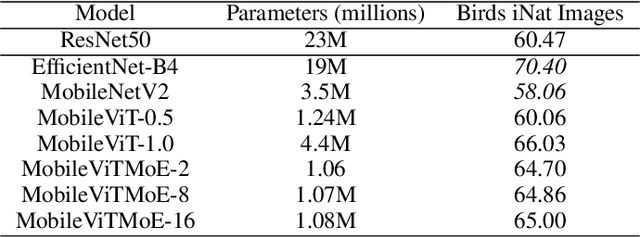
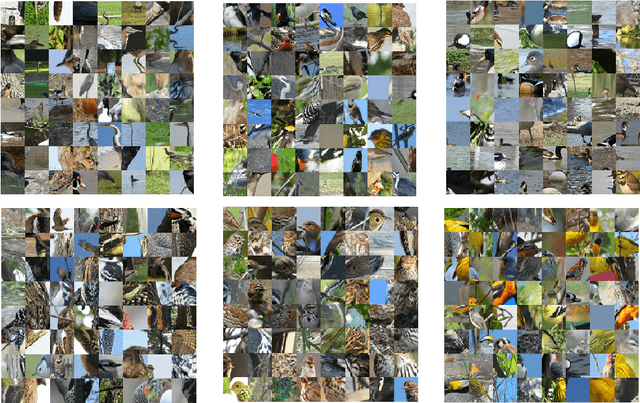
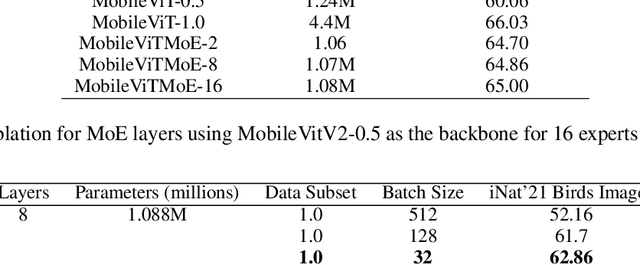
The explosion of IoT sensors in industrial, consumer and remote sensing use cases has come with unprecedented demand for computing infrastructure to transmit and to analyze petabytes of data. Concurrently, the world is slowly shifting its focus towards more sustainable computing. For these reasons, there has been a recent effort to reduce the footprint of related computing infrastructure, especially by deep learning algorithms, for advanced insight generation. The `TinyML' community is actively proposing methods to save communication bandwidth and excessive cloud storage costs while reducing algorithm inference latency and promoting data privacy. Such proposed approaches should ideally process multiple types of data, including time series, audio, satellite images, and video, near the network edge as multiple data streams has been shown to improve the discriminative ability of learning algorithms, especially for generating fine grained results. Incidentally, there has been recent work on data driven conditional computation of subnetworks that has shown real progress in using a single model to share parameters among very different types of inputs such as images and text, reducing the computation requirement of multi-tower multimodal networks. Inspired by such line of work, we explore similar per patch conditional computation for the first time for mobile vision transformers (vision only case), that will eventually be used for single-tower multimodal edge models. We evaluate the model on Cornell Sap Sucker Woods 60, a fine grained bird species discrimination dataset. Our initial experiments uses $4X$ fewer parameters compared to MobileViTV2-1.0 with a $1$% accuracy drop on the iNaturalist '21 birds test data provided as part of the SSW60 dataset.