 Add to Chrome
 Add to Firefox
 Add to Edge
Fluid-Antenna-aided AAV Secure Communications in Eavesdropper Uncertain Location
Sep 10, 2025
For autonomous aerial vehicle (AAV) secure communications, traditional designs based on fixed position antenna (FPA) lack sufficient spatial degrees of freedom (DoF), which leaves the line-of-sight-dominated AAV links vulnerable to eavesdropping. To overcome this problem, this paper proposes a framework that effectively incorporates the fluid antenna (FA) and the artificial noise (AN) techniques. Specifically, the minimum secrecy rate (MSR) among multiple eavesdroppers is maximized by jointly optimizing AAV deployment, signal and AN precoders, and FA positions. In particular, the worst-case MSR is considered by taking the channel uncertainties due to the uncertainty about eavesdropping locations into account. To tackle the highly coupled optimization variables and the channel uncertainties in the formulated problem, an efficient and robust algorithm is proposed. Particularly, the uncertain regions of eavesdroppers, whose shapes can be arbitrary, are disposed by constructing convex hull. In addition, two movement modes of FAs are considered, namely, free movement mode and zonal movement mode, for which different optimization techniques are applied, respectively. Numerical results show that, the proposed FA schemes boost security by exploiting additional spatial DoF rather than transmit power, while AN provides remarkable gains under high transmit power. Furthermore, the synergy between FA and AN results in a secure advantage that exceeds the sum of their individual contributions, achieving a balance between security and reliability under limited resources.

Secure Wireless-Powered zeRIS Communications
Mar 10, 2025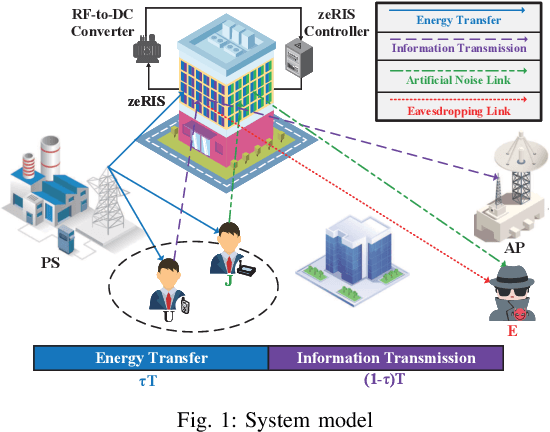
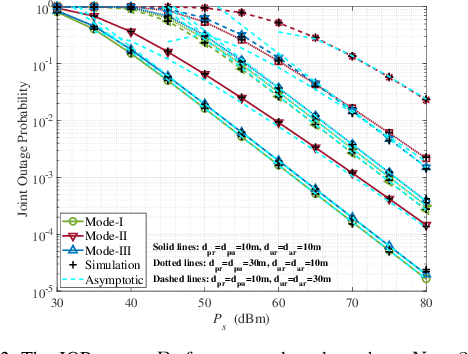
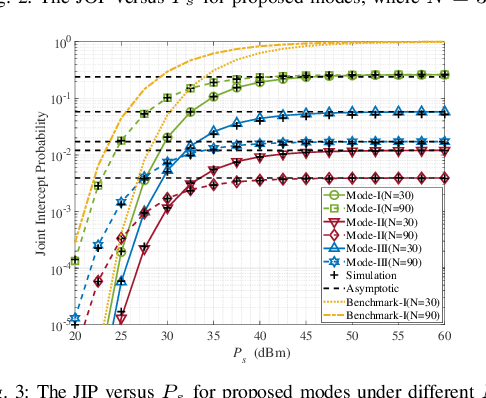
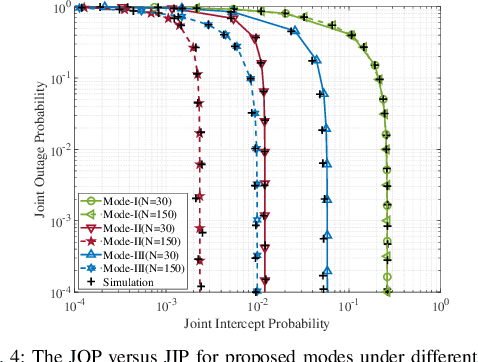
This paper introduces the concept of wireless-powered zero-energy reconfigurable intelligent surface (zeRIS), and investigates a wireless-powered zeRIS aided communication system in terms of security, reliability and energy efficiency. In particular, we propose three new wireless-powered zeRIS modes: 1) in mode-I, N reconfigurable reflecting elements are adjusted to the optimal phase shift design of information user to maximize the reliability of the system; 2) in mode-II, N reconfigurable reflecting elements are adjusted to the optimal phase shift design of cooperative jamming user to maximize the security of the system; 3) in mode-III, N1 and N2 (N1+N2=N) reconfigurable reflecting elements are respectively adjusted to the optimal phase shift designs of information user and cooperative jamming user to balance the reliability and security of the system. Then, we propose three new metrics, i.e., joint outage probability (JOP), joint intercept probability (JIP), and secrecy energy efficiency (SEE), and analyze their closed-form expressions in three modes, respectively. The results show that under high transmission power, all the diversity gains of three modes are 1, and the JOPs of mode-I, mode-II and mode-III are improved by increasing the number of zeRIS elements, which are related to N2, N, and N^2_1, respectively. In addition, mode-I achieves the best JOP, while mode-II achieves the best JIP among three modes. We exploit two security-reliability trade-off (SRT) metrics, i.e., JOP versus JIP, and normalized joint intercept and outage probability (JIOP), to reveal the SRT performance of the proposed three modes. It is obtained that mode-II outperforms the other two modes in the JOP versus JIP, while mode-III and mode-II achieve the best performance of normalized JIOP at low and high transmission power, respectively.