 Add to Chrome
 Add to Firefox
 Add to Edge
Cross-Modal Unlearning via Influential Neuron Path Editing in Multimodal Large Language Models
Nov 10, 2025
Multimodal Large Language Models (MLLMs) extend foundation models to real-world applications by integrating inputs such as text and vision. However, their broad knowledge capacity raises growing concerns about privacy leakage, toxicity mitigation, and intellectual property violations. Machine Unlearning (MU) offers a practical solution by selectively forgetting targeted knowledge while preserving overall model utility. When applied to MLLMs, existing neuron-editing-based MU approaches face two fundamental challenges: (1) forgetting becomes inconsistent across modalities because existing point-wise attribution methods fail to capture the structured, layer-by-layer information flow that connects different modalities; and (2) general knowledge performance declines when sensitive neurons that also support important reasoning paths are pruned, as this disrupts the model's ability to generalize. To alleviate these limitations, we propose a multimodal influential neuron path editor (MIP-Editor) for MU. Our approach introduces modality-specific attribution scores to identify influential neuron paths responsible for encoding forget-set knowledge and applies influential-path-aware neuron-editing via representation misdirection. This strategy also enables effective and coordinated forgetting across modalities while preserving the model's general capabilities. Experimental results demonstrate that MIP-Editor achieves a superior unlearning performance on multimodal tasks, with a maximum forgetting rate of 87.75% and up to 54.26% improvement in general knowledge retention. On textual tasks, MIP-Editor achieves up to 80.65% forgetting and preserves 77.9% of general performance. Codes are available at https://github.com/PreckLi/MIP-Editor.

SES: Bridging the Gap Between Explainability and Prediction of Graph Neural Networks
Jul 16, 2024

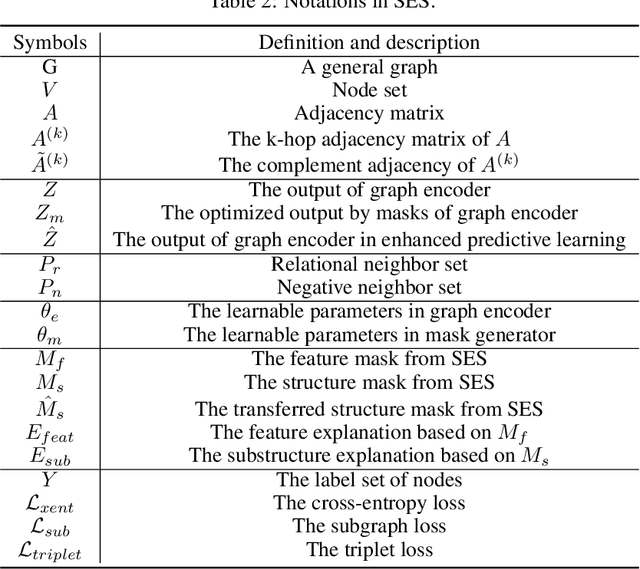

Despite the Graph Neural Networks' (GNNs) proficiency in analyzing graph data, achieving high-accuracy and interpretable predictions remains challenging. Existing GNN interpreters typically provide post-hoc explanations disjointed from GNNs' predictions, resulting in misrepresentations. Self-explainable GNNs offer built-in explanations during the training process. However, they cannot exploit the explanatory outcomes to augment prediction performance, and they fail to provide high-quality explanations of node features and require additional processes to generate explainable subgraphs, which is costly. To address the aforementioned limitations, we propose a self-explained and self-supervised graph neural network (SES) to bridge the gap between explainability and prediction. SES comprises two processes: explainable training and enhanced predictive learning. During explainable training, SES employs a global mask generator co-trained with a graph encoder and directly produces crucial structure and feature masks, reducing time consumption and providing node feature and subgraph explanations. In the enhanced predictive learning phase, mask-based positive-negative pairs are constructed utilizing the explanations to compute a triplet loss and enhance the node representations by contrastive learning.
Graph Structure Prompt Learning: A Novel Methodology to Improve Performance of Graph Neural Networks
Jul 16, 2024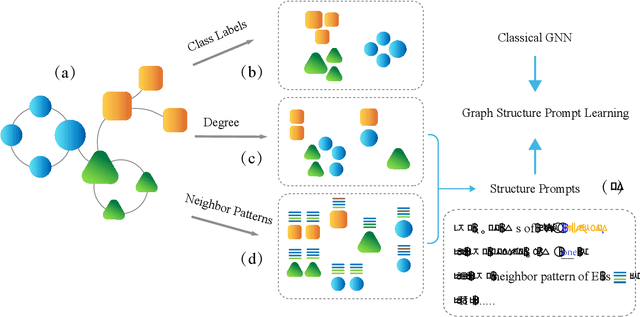


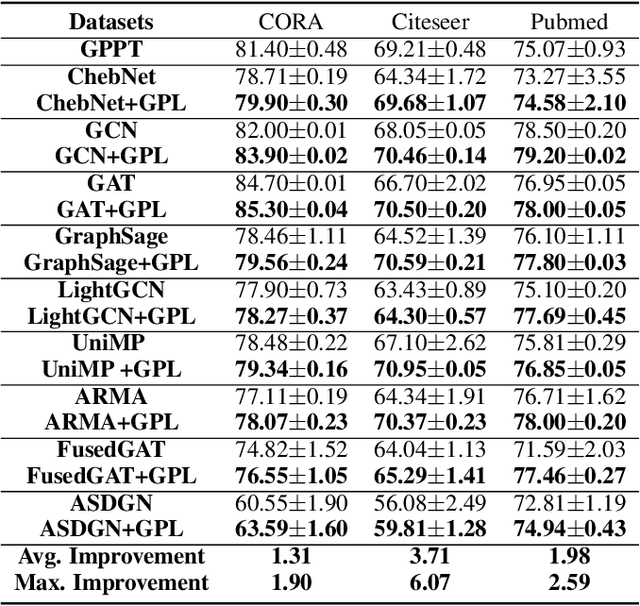
Graph neural networks (GNNs) are widely applied in graph data modeling. However, existing GNNs are often trained in a task-driven manner that fails to fully capture the intrinsic nature of the graph structure, resulting in sub-optimal node and graph representations. To address this limitation, we propose a novel Graph structure Prompt Learning method (GPL) to enhance the training of GNNs, which is inspired by prompt mechanisms in natural language processing. GPL employs task-independent graph structure losses to encourage GNNs to learn intrinsic graph characteristics while simultaneously solving downstream tasks, producing higher-quality node and graph representations. In extensive experiments on eleven real-world datasets, after being trained by GPL, GNNs significantly outperform their original performance on node classification, graph classification, and edge prediction tasks (up to 10.28%, 16.5%, and 24.15%, respectively). By allowing GNNs to capture the inherent structural prompts of graphs in GPL, they can alleviate the issue of over-smooth and achieve new state-of-the-art performances, which introduces a novel and effective direction for GNN research with potential applications in various domains.