 Add to Chrome
 Add to Firefox
 Add to Edge
EchoRisk: A Multicentre Echocardiography Dataset and Benchmark for Cardio-Oncology
Jul 01, 2026
Therapy-induced cardiotoxicity is the leading non-oncological cause of treatment interruption in breast cancer patients, yet early, automated risk stratification from routine cardiac imaging remains an unsolved problem. We present EchoRisk, the first curated, multicentre, longitudinal echocardiography dataset with explicit cardiotoxicity labels, released as the primary technical reference for the EchoRisk-MICCAI 2026 challenge. The dataset comprises 422 patients enrolled in the EU-funded CARDIOCARE prospective study across five European sites, yielding 2,159 echocardiography videos across 1,123 clinical exams acquired at up to five longitudinal timepoints, alongside a dedicated cohort of 280 patients with baseline imaging for early cardiotoxicity prediction. Three clinically grounded tasks are defined: automated estimation of left ventricular ejection fraction from cine video (Task 1), classification of LV dysfunction from longitudinal imaging (Task 2), and early prediction of therapy-induced cardiotoxicity from pre-therapy baseline echocardiography alone (Task 3). For each task we specify the evaluation protocol, primary and secondary metrics, and ranking procedure. We establish baseline performance using an R(2+1)D video backbone with LSTM aggregation trained from Kinetics-400 pretrained weights, demonstrating strong discriminative performance for cardiac functional assessment and LV dysfunction classification, while early cardiotoxicity prediction from a single pre-therapy video remains a significant open problem for the community. The dataset, evaluation code, and baseline implementations are publicly available to serve as a benchmark for further collaboration, comparison, and the creation of task-specific architectures in cardio-oncology.

TDGT: A Tabular Data Generation Toolkit supporting adaptive GPU-accelerated Bayesian mixture models, diffusion-based models, and latent-space generative modeling
Jun 30, 2026The growing demand for privacy-preserving data sharing has positioned synthetic data generation as a critical component of responsible AI workflows. Despite notable advances in generative modeling, existing solutions often lack integration of adaptive generation strategies, multi-metric evaluation, and accessible end-to-end generators within a unified web-based toolkit. In this work, we introduce TDGT (Tabular Data Generation Toolkit), a web-based toolkit for synthetic tabular data generation and fidelity assessment. TDGT introduces the Adaptive Bayesian Mixture Synthesizer (ABMS), a novel algorithm that autonomously determines the optimal number of mixture components through iterative cluster quality optimization, eliminating the need for manual hyperparameter configuration. Building upon ABMS, we further propose VAE-ABMS, a hybrid architecture that couples Variational Autoencoder-based latent space learning with adaptive Bayesian mixture synthesis, enabling high-fidelity generation of complex, nonlinear tabular distributions. For large-scale scenarios, TDGT provides a GPU-accelerated variant of ABMS leveraging CUDA-based k-means clustering and Gaussian mixture fitting. Synthetic data fidelity is assessed through eleven statistical fidelity metrics spanning distributional divergence, structural correlation, and sample-level similarity, complemented by privacy risk indicators including k-anonymity scoring and disclosure rate estimation. The web-based toolkit supports a real-time streaming interface with interactive Plotly-based visualizations. TDGT is assessed across datasets from healthcare, socioeconomic modeling, and cybersecurity domains, demonstrating consistent generation fidelity and statistical coherence across heterogeneous feature types and data scales.
Synthetic Data Blueprint (SDB): A modular framework for the statistical, structural, and graph-based evaluation of synthetic tabular data
Dec 16, 2025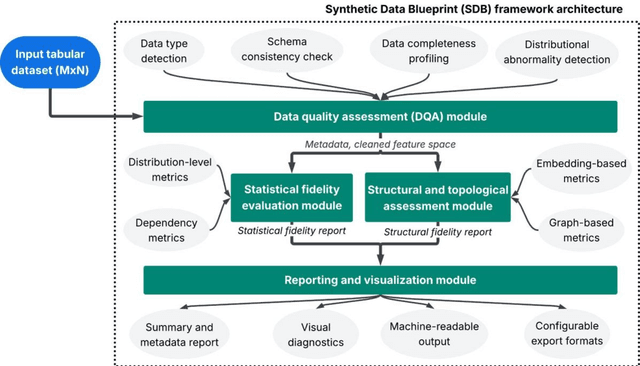
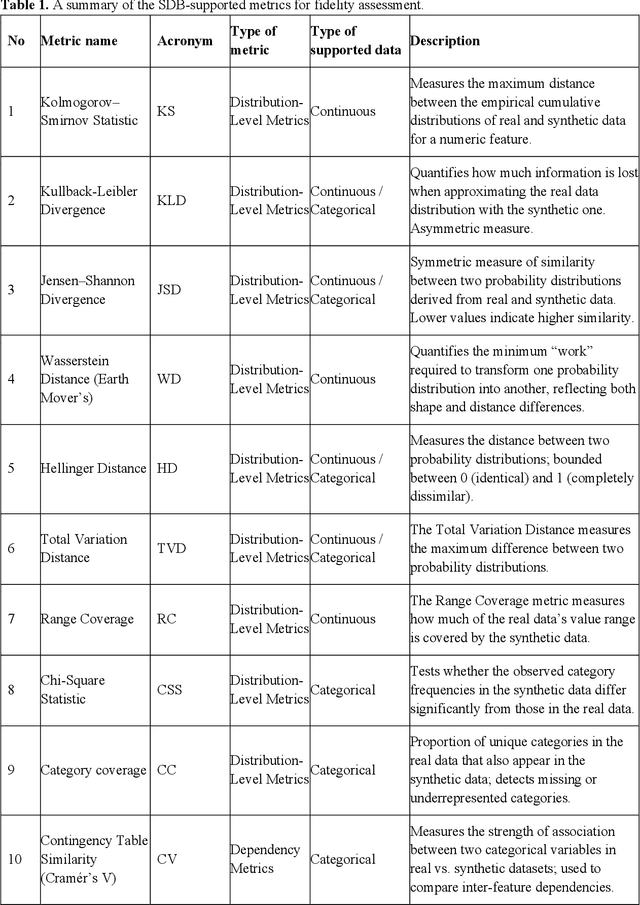
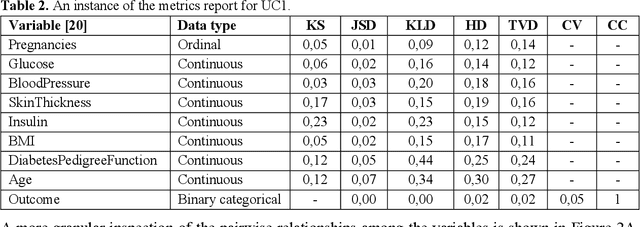
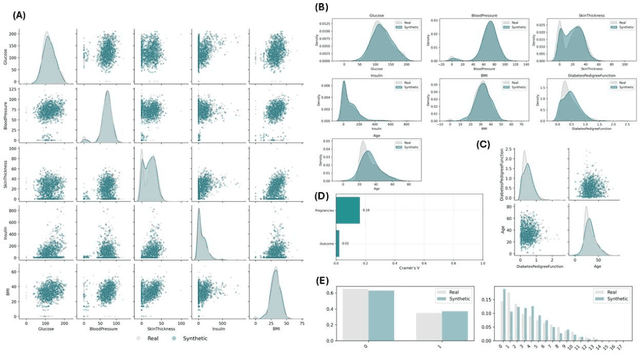
In the rapidly evolving era of Artificial Intelligence (AI), synthetic data are widely used to accelerate innovation while preserving privacy and enabling broader data accessibility. However, the evaluation of synthetic data remains fragmented across heterogeneous metrics, ad-hoc scripts, and incomplete reporting practices. To address this gap, we introduce Synthetic Data Blueprint (SDB), a modular Pythonic based library to quantitatively and visually assess the fidelity of synthetic tabular data. SDB supports: (i) automated feature-type detection, (ii) distributional and dependency-level fidelity metrics, (iii) graph- and embedding-based structure preservation scores, and (iv) a rich suite of data visualization schemas. To demonstrate the breadth, robustness, and domain-agnostic applicability of the SDB, we evaluated the framework across three real-world use cases that differ substantially in scale, feature composition, statistical complexity, and downstream analytical requirements. These include: (i) healthcare diagnostics, (ii) socioeconomic and financial modelling, and (iii) cybersecurity and network traffic analysis. These use cases reveal how SDB can address diverse data fidelity assessment challenges, varying from mixed-type clinical variables to high-cardinality categorical attributes and high-dimensional telemetry signals, while at the same time offering a consistent, transparent, and reproducible benchmarking across heterogeneous domains.
MAMA-MIA: A Large-Scale Multi-Center Breast Cancer DCE-MRI Benchmark Dataset with Expert Segmentations
Jun 19, 2024Current research in breast cancer Magnetic Resonance Imaging (MRI), especially with Artificial Intelligence (AI), faces challenges due to the lack of expert segmentations. To address this, we introduce the MAMA-MIA dataset, comprising 1506 multi-center dynamic contrast-enhanced MRI cases with expert segmentations of primary tumors and non-mass enhancement areas. These cases were sourced from four publicly available collections in The Cancer Imaging Archive (TCIA). Initially, we trained a deep learning model to automatically segment the cases, generating preliminary segmentations that significantly reduced expert segmentation time. Sixteen experts, averaging 9 years of experience in breast cancer, then corrected these segmentations, resulting in the final expert segmentations. Additionally, two radiologists conducted a visual inspection of the automatic segmentations to support future quality control studies. Alongside the expert segmentations, we provide 49 harmonized demographic and clinical variables and the pretrained weights of the well-known nnUNet architecture trained using the DCE-MRI full-images and expert segmentations. This dataset aims to accelerate the development and benchmarking of deep learning models and foster innovation in breast cancer diagnostics and treatment planning.
FUTURE-AI: Guiding Principles and Consensus Recommendations for Trustworthy Artificial Intelligence in Medical Imaging
Sep 29, 2021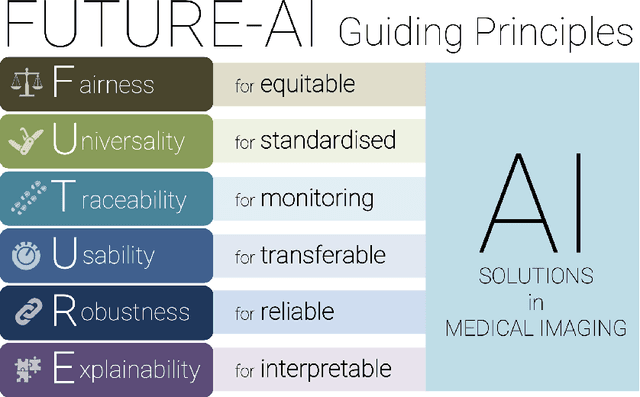
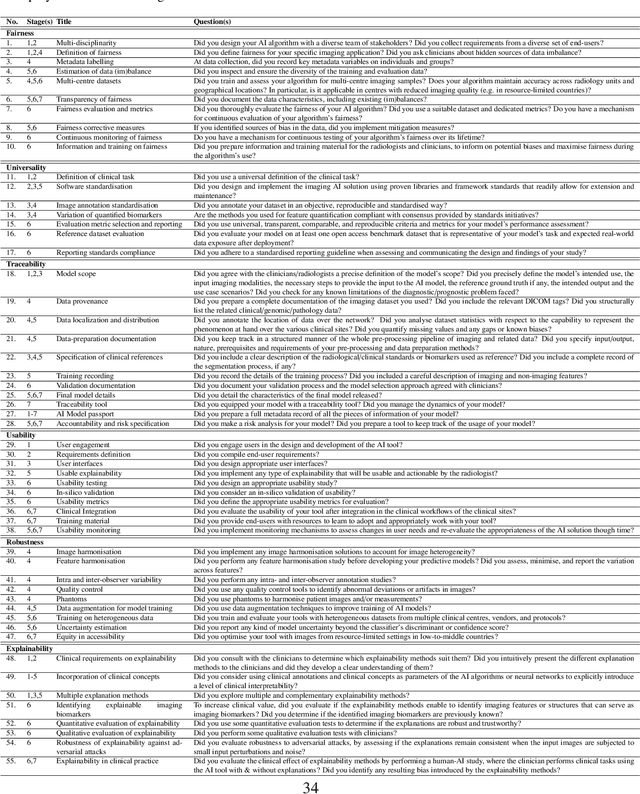
The recent advancements in artificial intelligence (AI) combined with the extensive amount of data generated by today's clinical systems, has led to the development of imaging AI solutions across the whole value chain of medical imaging, including image reconstruction, medical image segmentation, image-based diagnosis and treatment planning. Notwithstanding the successes and future potential of AI in medical imaging, many stakeholders are concerned of the potential risks and ethical implications of imaging AI solutions, which are perceived as complex, opaque, and difficult to comprehend, utilise, and trust in critical clinical applications. Despite these concerns and risks, there are currently no concrete guidelines and best practices for guiding future AI developments in medical imaging towards increased trust, safety and adoption. To bridge this gap, this paper introduces a careful selection of guiding principles drawn from the accumulated experiences, consensus, and best practices from five large European projects on AI in Health Imaging. These guiding principles are named FUTURE-AI and its building blocks consist of (i) Fairness, (ii) Universality, (iii) Traceability, (iv) Usability, (v) Robustness and (vi) Explainability. In a step-by-step approach, these guidelines are further translated into a framework of concrete recommendations for specifying, developing, evaluating, and deploying technically, clinically and ethically trustworthy AI solutions into clinical practice.
A new smart-cropping pipeline for prostate segmentation using deep learning networks
Jul 07, 2021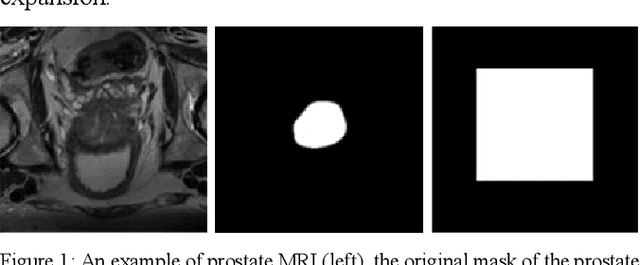
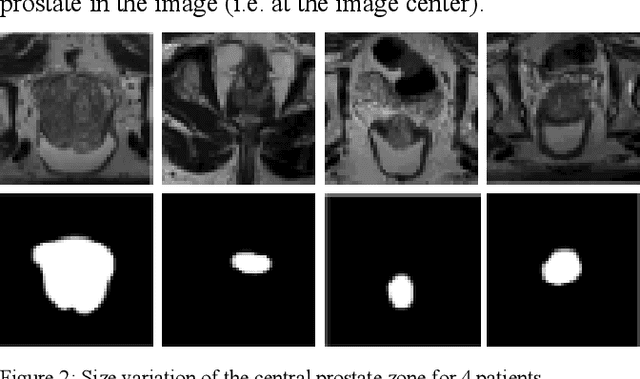
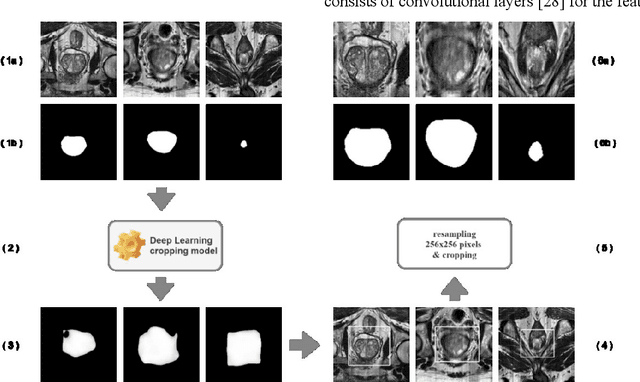
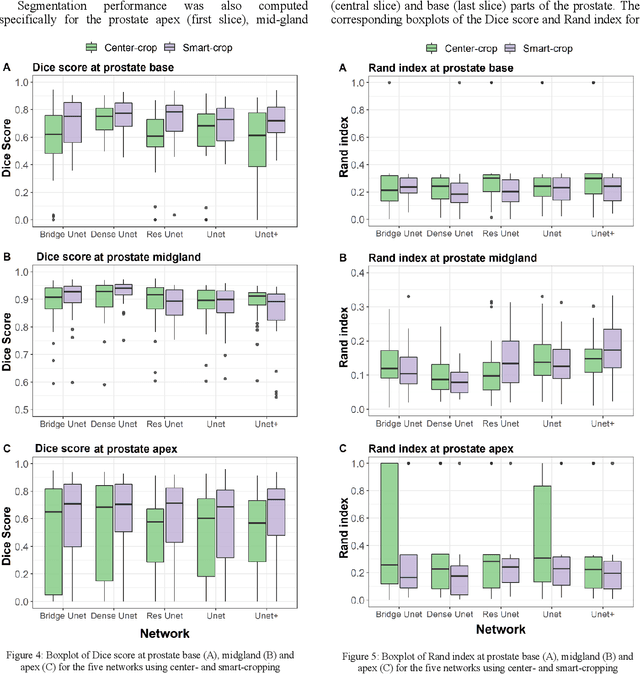
Prostate segmentation from magnetic resonance imaging (MRI) is a challenging task. In recent years, several network architectures have been proposed to automate this process and alleviate the burden of manual annotation. Although the performance of these models has achieved promising results, there is still room for improvement before these models can be used safely and effectively in clinical practice. One of the major challenges in prostate MR image segmentation is the presence of class imbalance in the image labels where the background pixels dominate over the prostate. In the present work we propose a DL-based pipeline for cropping the region around the prostate from MRI images to produce a more balanced distribution of the foreground pixels (prostate) and the background pixels and improve segmentation accuracy. The effect of DL-cropping for improving the segmentation performance compared to standard center-cropping is assessed using five popular DL networks for prostate segmentation, namely U-net, U-net+, Res Unet++, Bridge U-net and Dense U-net. The proposed smart-cropping outperformed the standard center cropping in terms of segmentation accuracy for all the evaluated prostate segmentation networks. In terms of Dice score, the highest improvement was achieved for the U-net+ and ResU-net++ architectures corresponding to 8.9% and 8%, respectively.