 Add to Chrome
 Add to Firefox
 Add to Edge
EchoRisk: A Multicentre Echocardiography Dataset and Benchmark for Cardio-Oncology
Jul 01, 2026
Therapy-induced cardiotoxicity is the leading non-oncological cause of treatment interruption in breast cancer patients, yet early, automated risk stratification from routine cardiac imaging remains an unsolved problem. We present EchoRisk, the first curated, multicentre, longitudinal echocardiography dataset with explicit cardiotoxicity labels, released as the primary technical reference for the EchoRisk-MICCAI 2026 challenge. The dataset comprises 422 patients enrolled in the EU-funded CARDIOCARE prospective study across five European sites, yielding 2,159 echocardiography videos across 1,123 clinical exams acquired at up to five longitudinal timepoints, alongside a dedicated cohort of 280 patients with baseline imaging for early cardiotoxicity prediction. Three clinically grounded tasks are defined: automated estimation of left ventricular ejection fraction from cine video (Task 1), classification of LV dysfunction from longitudinal imaging (Task 2), and early prediction of therapy-induced cardiotoxicity from pre-therapy baseline echocardiography alone (Task 3). For each task we specify the evaluation protocol, primary and secondary metrics, and ranking procedure. We establish baseline performance using an R(2+1)D video backbone with LSTM aggregation trained from Kinetics-400 pretrained weights, demonstrating strong discriminative performance for cardiac functional assessment and LV dysfunction classification, while early cardiotoxicity prediction from a single pre-therapy video remains a significant open problem for the community. The dataset, evaluation code, and baseline implementations are publicly available to serve as a benchmark for further collaboration, comparison, and the creation of task-specific architectures in cardio-oncology.

EffiSegNet: Gastrointestinal Polyp Segmentation through a Pre-Trained EfficientNet-based Network with a Simplified Decoder
Jul 23, 2024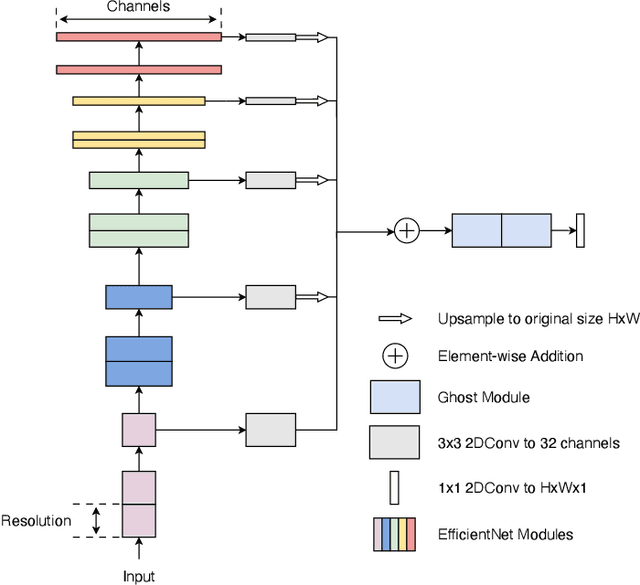
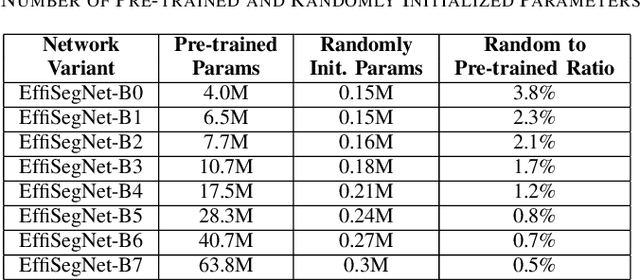
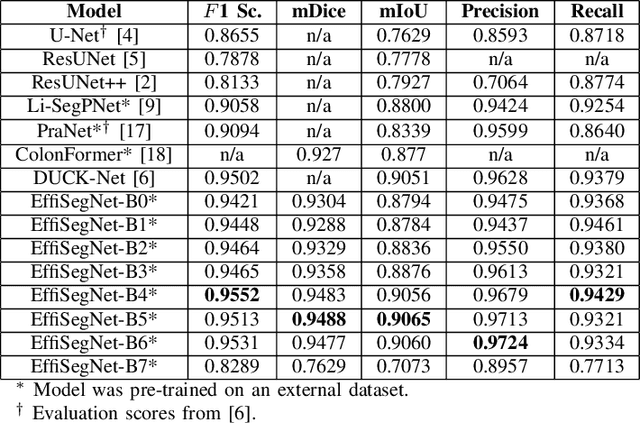
This work introduces EffiSegNet, a novel segmentation framework leveraging transfer learning with a pre-trained Convolutional Neural Network (CNN) classifier as its backbone. Deviating from traditional architectures with a symmetric U-shape, EffiSegNet simplifies the decoder and utilizes full-scale feature fusion to minimize computational cost and the number of parameters. We evaluated our model on the gastrointestinal polyp segmentation task using the publicly available Kvasir-SEG dataset, achieving state-of-the-art results. Specifically, the EffiSegNet-B4 network variant achieved an F1 score of 0.9552, mean Dice (mDice) 0.9483, mean Intersection over Union (mIoU) 0.9056, Precision 0.9679, and Recall 0.9429 with a pre-trained backbone - to the best of our knowledge, the highest reported scores in the literature for this dataset. Additional training from scratch also demonstrated exceptional performance compared to previous work, achieving an F1 score of 0.9286, mDice 0.9207, mIoU 0.8668, Precision 0.9311 and Recall 0.9262. These results underscore the importance of a well-designed encoder in image segmentation networks and the effectiveness of transfer learning approaches.