 Add to Chrome
 Add to Firefox
 Add to Edge
OliveGemma: A 3 Billion Visual Language Model for Recognising the Mediterranean & European Diet
Aug 04, 2026
Image based dietary assessment offers a scalable alternative to self reported food diaries, yet fine-grained food recognition remains challenging due to high intra-class variability and visually similar dishes. This study presents OliveGemma, a vision language model for recognising and reasoning about Mediterranean and European cuisine. Built on the open-weight PaliGemma-2-3B architecture, OliveGemma is fine-tuned with LoRA on a unified corpus of 17,340 images from three European research project datasets (MedGR, ODIN, and VIPPSTAR), reconciled into a vocabulary of 216 composed dish categories and paired with 102,642 instruction style question-answer items covering dish recognition, likely and visible ingredients, class boundary discrimination, visual evidence and overall visual food understanding. Under a 3-fold cross-validation scheme, OliveGemma achieves a top-1 accuracy of 92.96% +/- 0.91%, exceeding the strongest CNN baseline (DenseNet-121) by 7.31% and outperforming zero-shot frontier models with exact instructions and bounded classes including Gemini Flash 3 and 3.5, GPT-5.4 Mini, and Claude Haiku 4.6 by 8%, 46%, and 64% respectively. Furthermore, OliveGemma demonstrates competitive performance on Top-3 and Top-5 accuracy, being second best across CNNs and frontier models, surpassed only by DenseNet-121. In addition, OliveGemma achieves 90.79% +/- 1.3% Exact-Set on the likely ingredients of the food categories. These results demonstrate that PEFT adaptation of a small VLM can surpass substantially larger proprietary models on specialised food recognition. The model is publicly available at https://huggingface.co/JamesZar/OliveGemma-3B and the experiments and results can be found at https://github.com/tsiokris/OliveGemma.

TDGT: A Tabular Data Generation Toolkit supporting adaptive GPU-accelerated Bayesian mixture models, diffusion-based models, and latent-space generative modeling
Jun 30, 2026The growing demand for privacy-preserving data sharing has positioned synthetic data generation as a critical component of responsible AI workflows. Despite notable advances in generative modeling, existing solutions often lack integration of adaptive generation strategies, multi-metric evaluation, and accessible end-to-end generators within a unified web-based toolkit. In this work, we introduce TDGT (Tabular Data Generation Toolkit), a web-based toolkit for synthetic tabular data generation and fidelity assessment. TDGT introduces the Adaptive Bayesian Mixture Synthesizer (ABMS), a novel algorithm that autonomously determines the optimal number of mixture components through iterative cluster quality optimization, eliminating the need for manual hyperparameter configuration. Building upon ABMS, we further propose VAE-ABMS, a hybrid architecture that couples Variational Autoencoder-based latent space learning with adaptive Bayesian mixture synthesis, enabling high-fidelity generation of complex, nonlinear tabular distributions. For large-scale scenarios, TDGT provides a GPU-accelerated variant of ABMS leveraging CUDA-based k-means clustering and Gaussian mixture fitting. Synthetic data fidelity is assessed through eleven statistical fidelity metrics spanning distributional divergence, structural correlation, and sample-level similarity, complemented by privacy risk indicators including k-anonymity scoring and disclosure rate estimation. The web-based toolkit supports a real-time streaming interface with interactive Plotly-based visualizations. TDGT is assessed across datasets from healthcare, socioeconomic modeling, and cybersecurity domains, demonstrating consistent generation fidelity and statistical coherence across heterogeneous feature types and data scales.
Synthetic Data Blueprint (SDB): A modular framework for the statistical, structural, and graph-based evaluation of synthetic tabular data
Dec 16, 2025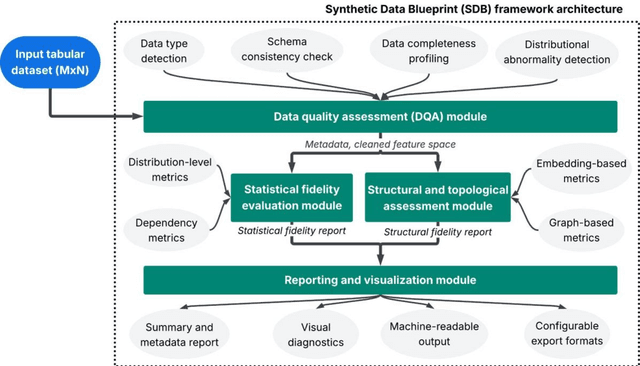
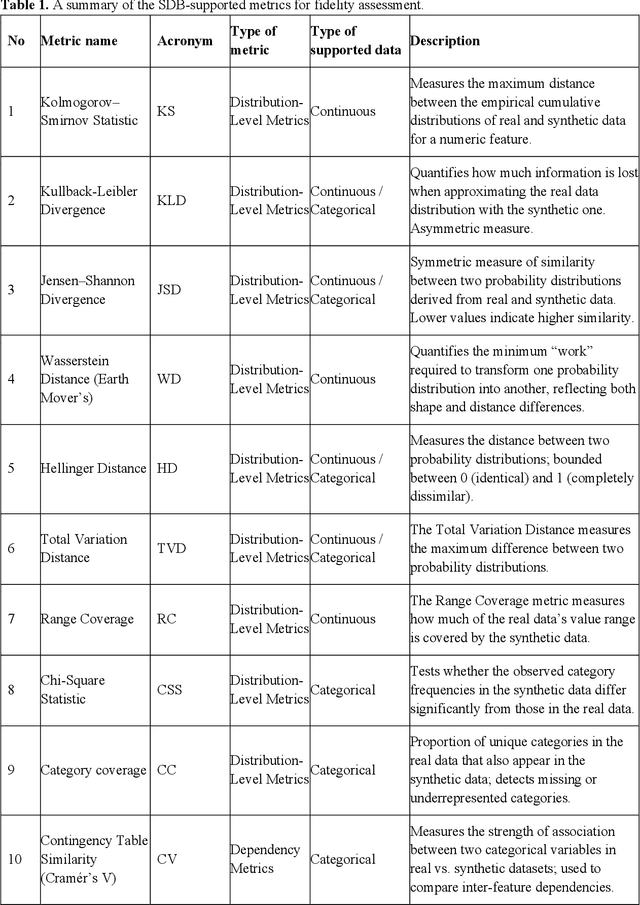
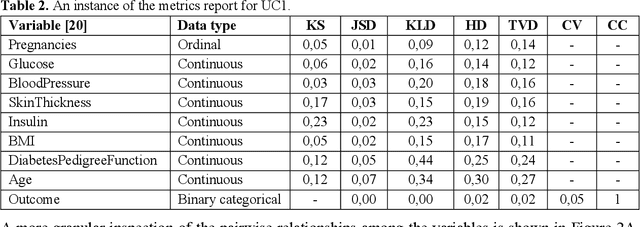
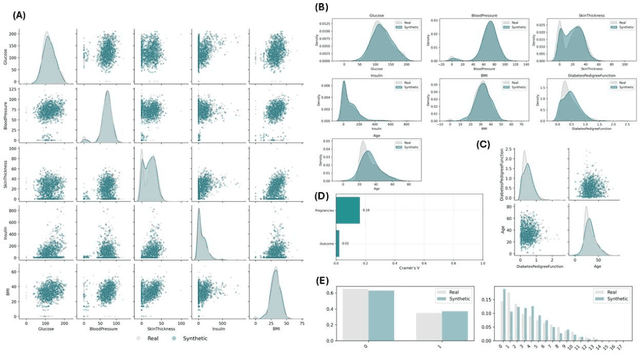
In the rapidly evolving era of Artificial Intelligence (AI), synthetic data are widely used to accelerate innovation while preserving privacy and enabling broader data accessibility. However, the evaluation of synthetic data remains fragmented across heterogeneous metrics, ad-hoc scripts, and incomplete reporting practices. To address this gap, we introduce Synthetic Data Blueprint (SDB), a modular Pythonic based library to quantitatively and visually assess the fidelity of synthetic tabular data. SDB supports: (i) automated feature-type detection, (ii) distributional and dependency-level fidelity metrics, (iii) graph- and embedding-based structure preservation scores, and (iv) a rich suite of data visualization schemas. To demonstrate the breadth, robustness, and domain-agnostic applicability of the SDB, we evaluated the framework across three real-world use cases that differ substantially in scale, feature composition, statistical complexity, and downstream analytical requirements. These include: (i) healthcare diagnostics, (ii) socioeconomic and financial modelling, and (iii) cybersecurity and network traffic analysis. These use cases reveal how SDB can address diverse data fidelity assessment challenges, varying from mixed-type clinical variables to high-cardinality categorical attributes and high-dimensional telemetry signals, while at the same time offering a consistent, transparent, and reproducible benchmarking across heterogeneous domains.