 Add to Chrome
 Add to Firefox
 Add to Edge
Synthetic Data Blueprint (SDB): A modular framework for the statistical, structural, and graph-based evaluation of synthetic tabular data
Dec 16, 2025
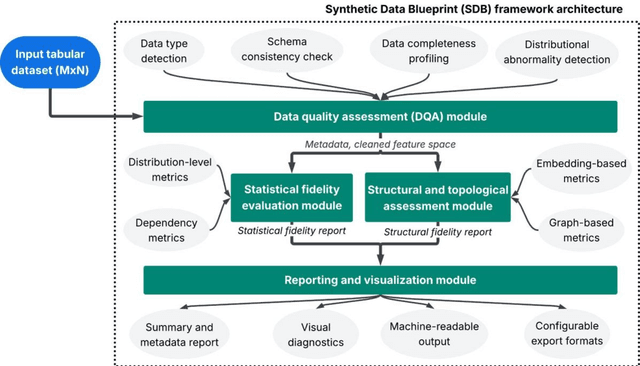
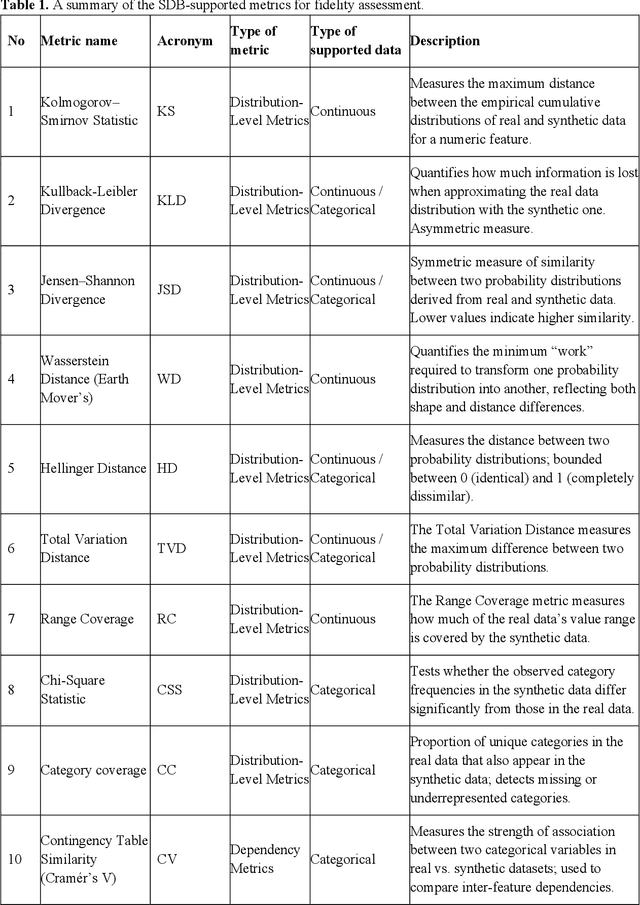
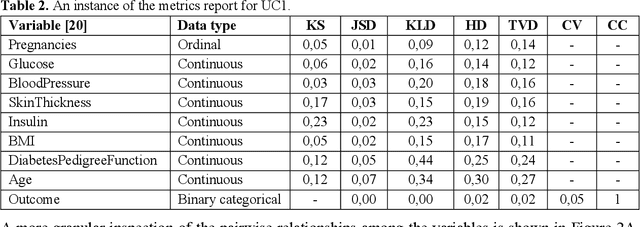
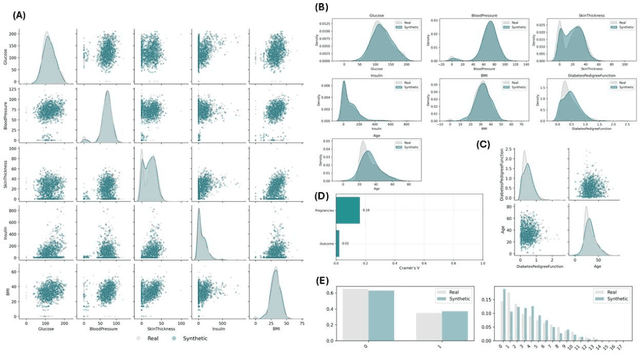
In the rapidly evolving era of Artificial Intelligence (AI), synthetic data are widely used to accelerate innovation while preserving privacy and enabling broader data accessibility. However, the evaluation of synthetic data remains fragmented across heterogeneous metrics, ad-hoc scripts, and incomplete reporting practices. To address this gap, we introduce Synthetic Data Blueprint (SDB), a modular Pythonic based library to quantitatively and visually assess the fidelity of synthetic tabular data. SDB supports: (i) automated feature-type detection, (ii) distributional and dependency-level fidelity metrics, (iii) graph- and embedding-based structure preservation scores, and (iv) a rich suite of data visualization schemas. To demonstrate the breadth, robustness, and domain-agnostic applicability of the SDB, we evaluated the framework across three real-world use cases that differ substantially in scale, feature composition, statistical complexity, and downstream analytical requirements. These include: (i) healthcare diagnostics, (ii) socioeconomic and financial modelling, and (iii) cybersecurity and network traffic analysis. These use cases reveal how SDB can address diverse data fidelity assessment challenges, varying from mixed-type clinical variables to high-cardinality categorical attributes and high-dimensional telemetry signals, while at the same time offering a consistent, transparent, and reproducible benchmarking across heterogeneous domains.

A new smart-cropping pipeline for prostate segmentation using deep learning networks
Jul 07, 2021
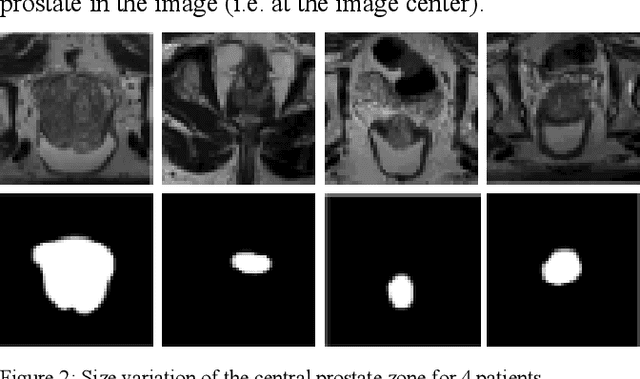
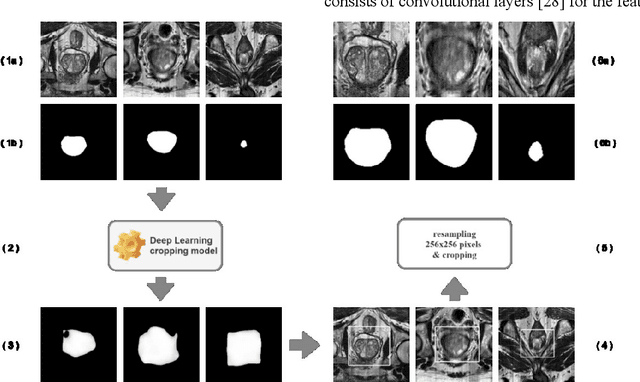
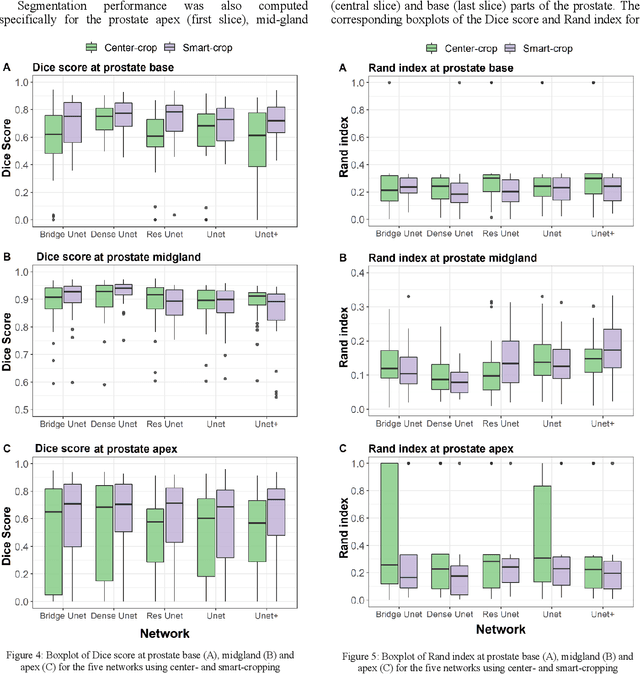
Prostate segmentation from magnetic resonance imaging (MRI) is a challenging task. In recent years, several network architectures have been proposed to automate this process and alleviate the burden of manual annotation. Although the performance of these models has achieved promising results, there is still room for improvement before these models can be used safely and effectively in clinical practice. One of the major challenges in prostate MR image segmentation is the presence of class imbalance in the image labels where the background pixels dominate over the prostate. In the present work we propose a DL-based pipeline for cropping the region around the prostate from MRI images to produce a more balanced distribution of the foreground pixels (prostate) and the background pixels and improve segmentation accuracy. The effect of DL-cropping for improving the segmentation performance compared to standard center-cropping is assessed using five popular DL networks for prostate segmentation, namely U-net, U-net+, Res Unet++, Bridge U-net and Dense U-net. The proposed smart-cropping outperformed the standard center cropping in terms of segmentation accuracy for all the evaluated prostate segmentation networks. In terms of Dice score, the highest improvement was achieved for the U-net+ and ResU-net++ architectures corresponding to 8.9% and 8%, respectively.