 Add to Chrome
 Add to Firefox
 Add to Edge
BLINK: Behavioral Latent Modeling of NK Cell Cytotoxicity
Mar 05, 2026
Machine learning models of cellular interaction dynamics hold promise for understanding cell behavior. Natural killer (NK) cell cytotoxicity is a prominent example of such interaction dynamics and is commonly studied using time-resolved multi-channel fluorescence microscopy. Although tumor cell death events can be annotated at single frames, NK cytotoxic outcome emerges over time from cellular interactions and cannot be reliably inferred from frame-wise classification alone. We introduce BLINK, a trajectory-based recurrent state-space model that serves as a cell world model for NK-tumor interactions. BLINK learns latent interaction dynamics from partially observed NK-tumor interaction sequences and predicts apoptosis increments that accumulate into cytotoxic outcomes. Experiments on long-term time-lapse NK-tumor recordings show improved cytotoxic outcome detection and enable forecasting of future outcomes, together with an interpretable latent representation that organizes NK trajectories into coherent behavioral modes and temporally structured interaction phases. BLINK provides a unified framework for quantitative evaluation and structured modeling of NK cytotoxic behavior at the single-cell level.

A statistical perspective on transformers for small longitudinal cohort data
Feb 18, 2026Modeling of longitudinal cohort data typically involves complex temporal dependencies between multiple variables. There, the transformer architecture, which has been highly successful in language and vision applications, allows us to account for the fact that the most recently observed time points in an individual's history may not always be the most important for the immediate future. This is achieved by assigning attention weights to observations of an individual based on a transformation of their values. One reason why these ideas have not yet been fully leveraged for longitudinal cohort data is that typically, large datasets are required. Therefore, we present a simplified transformer architecture that retains the core attention mechanism while reducing the number of parameters to be estimated, to be more suitable for small datasets with few time points. Guided by a statistical perspective on transformers, we use an autoregressive model as a starting point and incorporate attention as a kernel-based operation with temporal decay, where aggregation of multiple transformer heads, i.e. different candidate weighting schemes, is expressed as accumulating evidence on different types of underlying characteristics of individuals. This also enables a permutation-based statistical testing procedure for identifying contextual patterns. In a simulation study, the approach is shown to recover contextual dependencies even with a small number of individuals and time points. In an application to data from a resilience study, we identify temporal patterns in the dynamics of stress and mental health. This indicates that properly adapted transformers can not only achieve competitive predictive performance, but also uncover complex context dependencies in small data settings.
Combining propensity score methods with variational autoencoders for generating synthetic data in presence of latent sub-groups
Dec 12, 2023In settings requiring synthetic data generation based on a clinical cohort, e.g., due to data protection regulations, heterogeneity across individuals might be a nuisance that we need to control or faithfully preserve. The sources of such heterogeneity might be known, e.g., as indicated by sub-groups labels, or might be unknown and thus reflected only in properties of distributions, such as bimodality or skewness. We investigate how such heterogeneity can be preserved and controlled when obtaining synthetic data from variational autoencoders (VAEs), i.e., a generative deep learning technique that utilizes a low-dimensional latent representation. To faithfully reproduce unknown heterogeneity reflected in marginal distributions, we propose to combine VAEs with pre-transformations. For dealing with known heterogeneity due to sub-groups, we complement VAEs with models for group membership, specifically from propensity score regression. The evaluation is performed with a realistic simulation design that features sub-groups and challenging marginal distributions. The proposed approach faithfully recovers the latter, compared to synthetic data approaches that focus purely on marginal distributions. Propensity scores add complementary information, e.g., when visualized in the latent space, and enable sampling of synthetic data with or without sub-group specific characteristics. We also illustrate the proposed approach with real data from an international stroke trial that exhibits considerable distribution differences between study sites, in addition to bimodality. These results indicate that describing heterogeneity by statistical approaches, such as propensity score regression, might be more generally useful for complementing generative deep learning for obtaining synthetic data that faithfully reflects structure from clinical cohorts.
Adapting deep generative approaches for getting synthetic data with realistic marginal distributions
May 14, 2021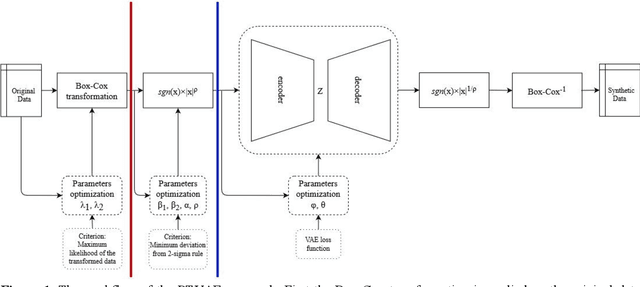

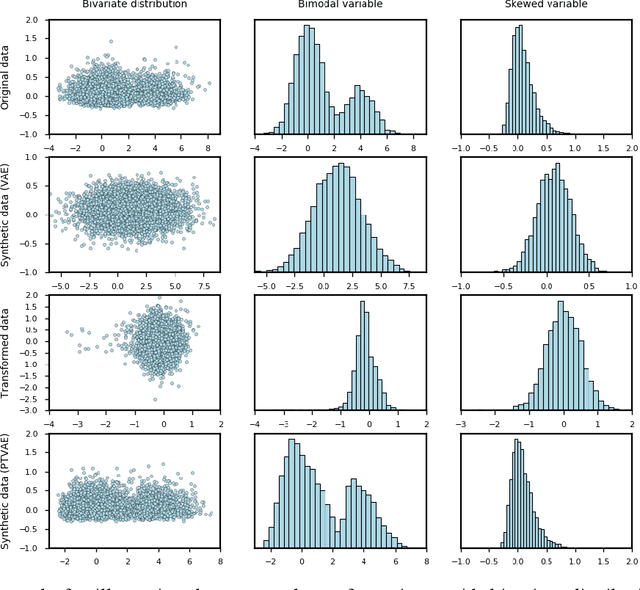

Synthetic data generation is of great interest in diverse applications, such as for privacy protection. Deep generative models, such as variational autoencoders (VAEs), are a popular approach for creating such synthetic datasets from original data. Despite the success of VAEs, there are limitations when it comes to the bimodal and skewed marginal distributions. These deviate from the unimodal symmetric distributions that are encouraged by the normality assumption typically used for the latent representations in VAEs. While there are extensions that assume other distributions for the latent space, this does not generally increase flexibility for data with many different distributions. Therefore, we propose a novel method, pre-transformation variational autoencoders (PTVAEs), to specifically address bimodal and skewed data, by employing pre-transformations at the level of original variables. Two types of transformations are used to bring the data close to a normal distribution by a separate parameter optimization for each variable in a dataset. We compare the performance of our method with other state-of-the-art methods for synthetic data generation. In addition to the visual comparison, we use a utility measurement for a quantitative evaluation. The results show that the PTVAE approach can outperform others in both bimodal and skewed data generation. Furthermore, the simplicity of the approach makes it usable in combination with other extensions of VAE.