 Add to Chrome
 Add to Firefox
 Add to Edge
Chrono-Gymnasium: An Open-Source, Gymnasium-Compatible Distributed Simulation Framework
May 14, 2026
High-fidelity physics simulation is essential for closing the sim-to-real gap in robotics and complex mechanical systems. However, the computational overhead of high-fidelity engines often limits their use in data-intensive tasks like Reinforcement Learning (RL) and global optimization. We introduce Chrono-Gymnasium, a distributed computing framework that scales the high-fidelity multi-body dynamics of Project Chrono across large-scale computing clusters. Built upon the Ray framework, Chrono-Gymnasium provides a standardized Gymnasium interface, enabling seamless integration with modern machine learning libraries while providing built-in synchronization and messaging primitives for distributed execution. We demonstrate the framework's capabilities through two distinct case studies: (1) the training of an RL agent for autonomous robotic navigation in complex terrains, and (2) the Bayesian Optimization of a planetary lander's design parameters to ensure landing stability. Our results show that Chrono-Gymnasium reduces wall-clock time for high-fidelity simulations without sacrificing physical accuracy, offering a scalable path for the design and control of complex robotic systems.

ChronoLLM: A Framework for Customizing Large Language Model for Digital Twins generalization based on PyChrono
Jan 07, 2025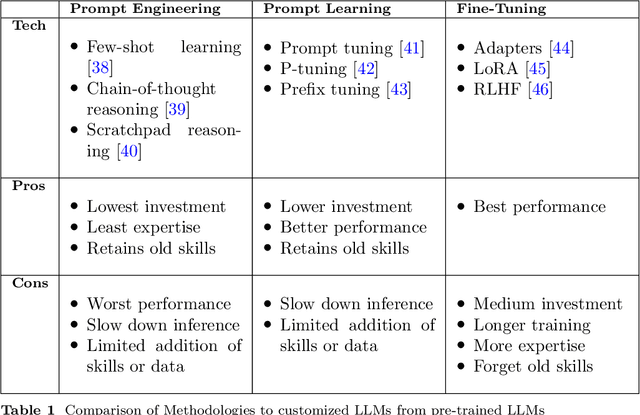
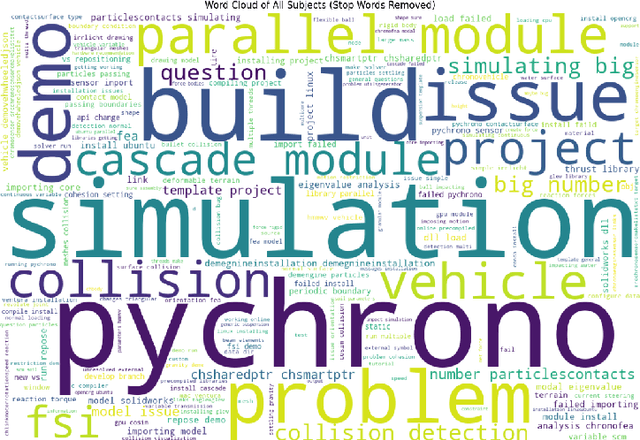
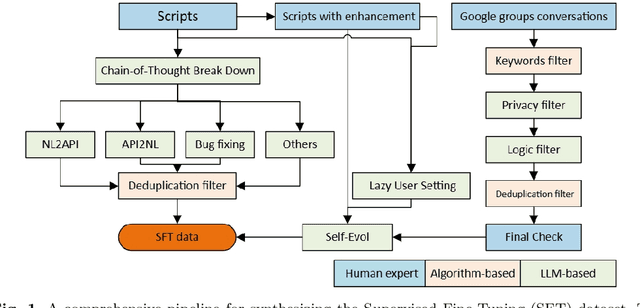
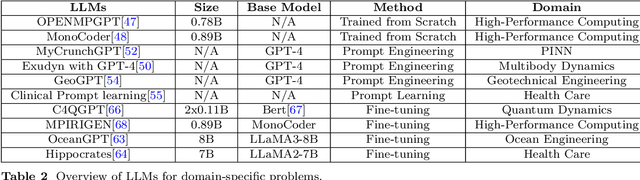
Recently, the integration of advanced simulation technologies with artificial intelligence (AI) is revolutionizing science and engineering research. ChronoLlama introduces a novel framework that customizes the open-source LLMs, specifically for code generation, paired with PyChrono for multi-physics simulations. This integration aims to automate and improve the creation of simulation scripts, thus enhancing model accuracy and efficiency. This combination harnesses the speed of AI-driven code generation with the reliability of physics-based simulations, providing a powerful tool for researchers and engineers. Empirical results indicate substantial enhancements in simulation setup speed, accuracy of the generated codes, and overall computational efficiency. ChronoLlama not only expedites the development and testing of multibody systems but also spearheads a scalable, AI-enhanced approach to managing intricate mechanical simulations. This pioneering integration of cutting-edge AI with traditional simulation platforms represents a significant leap forward in automating and optimizing design processes in engineering applications.
SimBench: A Rule-Based Multi-Turn Interaction Benchmark for Evaluating an LLM's Ability to Generate Digital Twins
Aug 21, 2024We introduce SimBench, a benchmark designed to evaluate the proficiency of student large language models (S-LLMs) in generating digital twins (DTs) that can be used in simulators for virtual testing. Given a collection of S-LLMs, this benchmark enables the ranking of the S-LLMs based on their ability to produce high-quality DTs. We demonstrate this by comparing over 20 open- and closed-source S-LLMs. Using multi-turn interactions, SimBench employs a rule-based judge LLM (J-LLM) that leverages both predefined rules and human-in-the-loop guidance to assign scores for the DTs generated by the S-LLM, thus providing a consistent and expert-inspired evaluation protocol. The J-LLM is specific to a simulator, and herein the proposed benchmarking approach is demonstrated in conjunction with the Chrono multi-physics simulator. Chrono provided the backdrop used to assess an S-LLM in relation to the latter's ability to create digital twins for multibody dynamics, finite element analysis, vehicle dynamics, robotic dynamics, and sensor simulations. The proposed benchmarking principle is broadly applicable and enables the assessment of an S-LLM's ability to generate digital twins for other simulation packages. All code and data are available at https://github.com/uwsbel/SimBench.