 Add to Chrome
 Add to Firefox
 Add to Edge
Investigating Counterfactual Unfairness in LLMs towards Identities through Humor
Apr 20, 2026
Humor holds up a mirror to social perception: what we find funny often reflects who we are and how we judge others. When language models engage with humor, their reactions expose the social assumptions they have internalized from training data. In this paper, we investigate counterfactual unfairness through humor by observing how the model's responses change when we swap who speaks and who is addressed while holding other factors constant. Our framework spans three tasks: humor generation refusal, speaker intention inference, and relational/societal impact prediction, covering both identity-agnostic humor and identity-specific disparagement humor. We introduce interpretable bias metrics that capture asymmetric patterns under identity swaps. Experiments across state-of-the-art models reveal consistent relational disparities: jokes told by privileged speakers are refused up to 67.5% more often, judged as malicious 64.7% more frequently, and rated up to 1.5 points higher in social harm on a 5-point scale. These patterns highlight how sensitivity and stereotyping coexist in generative models, complicating efforts toward fairness and cultural alignment.

A.X K1 Technical Report
Jan 15, 2026We introduce A.X K1, a 519B-parameter Mixture-of-Experts (MoE) language model trained from scratch. Our design leverages scaling laws to optimize training configurations and vocabulary size under fixed computational budgets. A.X K1 is pre-trained on a corpus of approximately 10T tokens, curated by a multi-stage data processing pipeline. Designed to bridge the gap between reasoning capability and inference efficiency, A.X K1 supports explicitly controllable reasoning to facilitate scalable deployment across diverse real-world scenarios. We propose a simple yet effective Think-Fusion training recipe, enabling user-controlled switching between thinking and non-thinking modes within a single unified model. Extensive evaluations demonstrate that A.X K1 achieves performance competitive with leading open-source models, while establishing a distinctive advantage in Korean-language benchmarks.
InfoCausalQA:Can Models Perform Non-explicit Causal Reasoning Based on Infographic?
Aug 08, 2025Recent advances in Vision-Language Models (VLMs) have demonstrated impressive capabilities in perception and reasoning. However, the ability to perform causal inference -- a core aspect of human cognition -- remains underexplored, particularly in multimodal settings. In this study, we introduce InfoCausalQA, a novel benchmark designed to evaluate causal reasoning grounded in infographics that combine structured visual data with textual context. The benchmark comprises two tasks: Task 1 focuses on quantitative causal reasoning based on inferred numerical trends, while Task 2 targets semantic causal reasoning involving five types of causal relations: cause, effect, intervention, counterfactual, and temporal. We manually collected 494 infographic-text pairs from four public sources and used GPT-4o to generate 1,482 high-quality multiple-choice QA pairs. These questions were then carefully revised by humans to ensure they cannot be answered based on surface-level cues alone but instead require genuine visual grounding. Our experimental results reveal that current VLMs exhibit limited capability in computational reasoning and even more pronounced limitations in semantic causal reasoning. Their significantly lower performance compared to humans indicates a substantial gap in leveraging infographic-based information for causal inference. Through InfoCausalQA, we highlight the need for advancing the causal reasoning abilities of multimodal AI systems.
THEANINE: Revisiting Memory Management in Long-term Conversations with Timeline-augmented Response Generation
Jun 16, 2024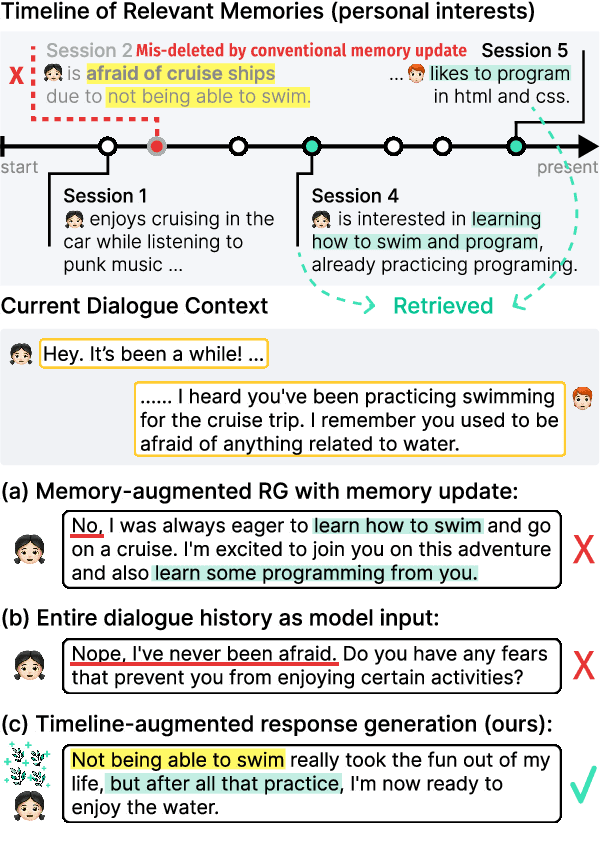
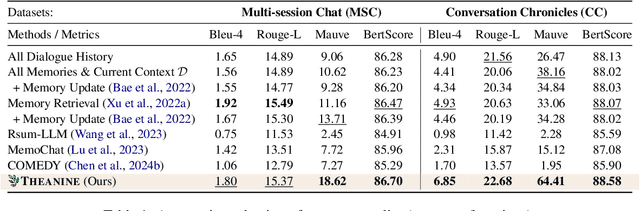
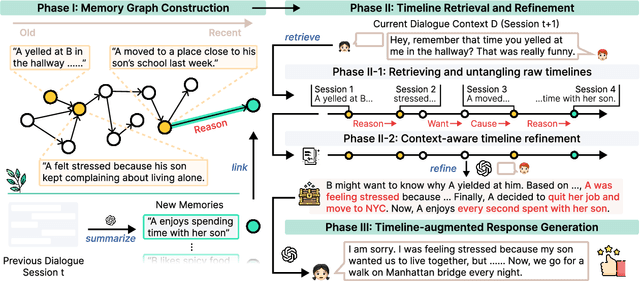

Large language models (LLMs) are capable of processing lengthy dialogue histories during prolonged interaction with users without additional memory modules; however, their responses tend to overlook or incorrectly recall information from the past. In this paper, we revisit memory-augmented response generation in the era of LLMs. While prior work focuses on getting rid of outdated memories, we argue that such memories can provide contextual cues that help dialogue systems understand the development of past events and, therefore, benefit response generation. We present Theanine, a framework that augments LLMs' response generation with memory timelines -- series of memories that demonstrate the development and causality of relevant past events. Along with Theanine, we introduce TeaFarm, a counterfactual-driven question-answering pipeline addressing the limitation of G-Eval in long-term conversations. Supplementary videos of our methods and the TeaBag dataset for TeaFarm evaluation are in https://theanine-693b0.web.app/.
Ever-Evolving Memory by Blending and Refining the Past
Mar 03, 2024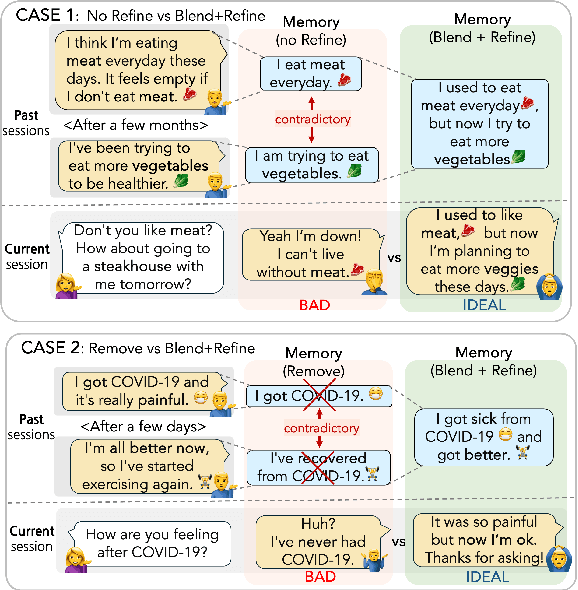
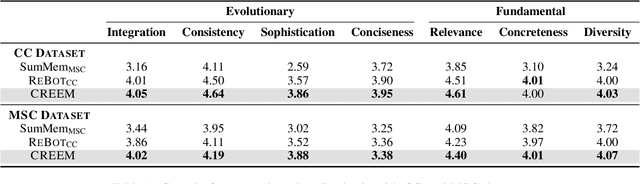
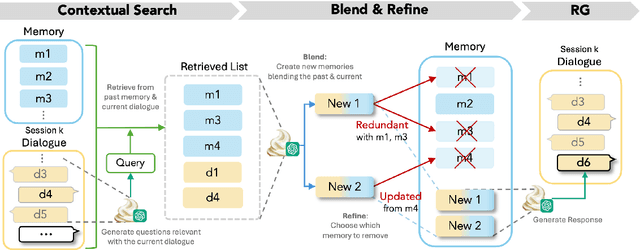
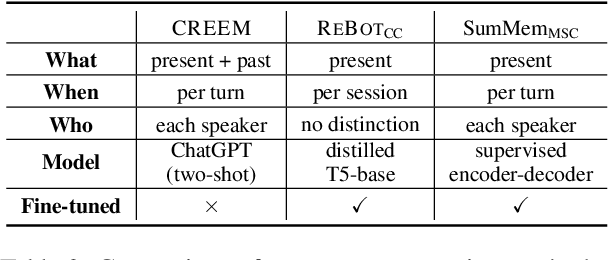
For a human-like chatbot, constructing a long-term memory is crucial. A naive approach for making a memory could be simply listing the summarized dialogue. However, this can lead to problems when the speaker's status change over time and contradictory information gets accumulated. It is important that the memory stays organized to lower the confusion for the response generator. In this paper, we propose a novel memory scheme for long-term conversation, CREEM. Unlike existing approaches that construct memory based solely on current sessions, our proposed model blending past memories during memory formation. Additionally, we introduce refining process to handle redundant or outdated information. This innovative approach seeks for overall improvement and coherence of chatbot responses by ensuring a more informed and dynamically evolving long-term memory.