 Add to Chrome
 Add to Firefox
 Add to Edge
Preference Packing: Efficient Preference Optimization for Large Language Models
Feb 27, 2026
Resource-efficient training optimization techniques are becoming increasingly important as the size of large language models (LLMs) continues to grow. In particular, batch packing is commonly used in pre-training and supervised fine-tuning to achieve resource-efficient training. We propose preference packing, a method to enhance resource efficiency in training techniques that use data with different responses for the same input prompt, such as reward models or Direct Preference Optimization (DPO). Preference packing improves resource efficiency by reducing the attention operations for duplicate input prompts and decreasing KV cache memory usage. We conducted experiments on text-only datasets and image-included datasets and achieved at least 37% reduction in training time. Notably, this method can be applied alongside existing optimization techniques such as batch sorting, resulting in a 3.22x speedup.

A.X K1 Technical Report
Jan 15, 2026We introduce A.X K1, a 519B-parameter Mixture-of-Experts (MoE) language model trained from scratch. Our design leverages scaling laws to optimize training configurations and vocabulary size under fixed computational budgets. A.X K1 is pre-trained on a corpus of approximately 10T tokens, curated by a multi-stage data processing pipeline. Designed to bridge the gap between reasoning capability and inference efficiency, A.X K1 supports explicitly controllable reasoning to facilitate scalable deployment across diverse real-world scenarios. We propose a simple yet effective Think-Fusion training recipe, enabling user-controlled switching between thinking and non-thinking modes within a single unified model. Extensive evaluations demonstrate that A.X K1 achieves performance competitive with leading open-source models, while establishing a distinctive advantage in Korean-language benchmarks.
SeRO: Self-Supervised Reinforcement Learning for Recovery from Out-of-Distribution Situations
Nov 07, 2023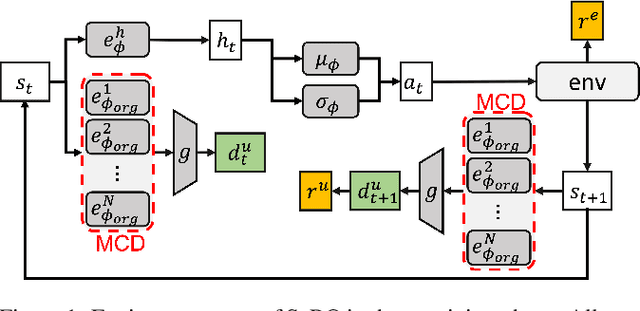
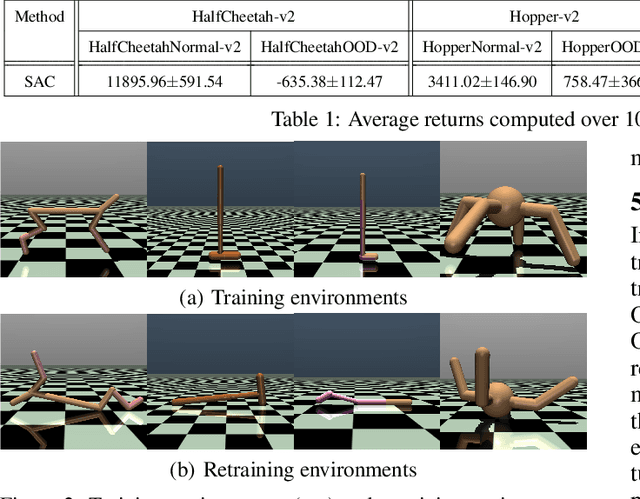
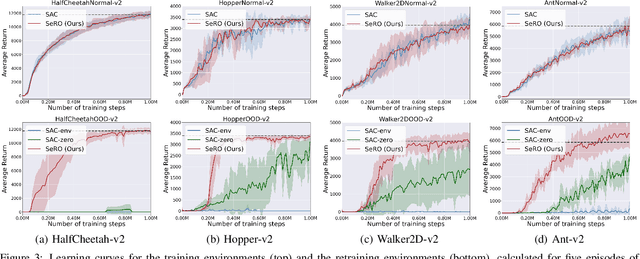
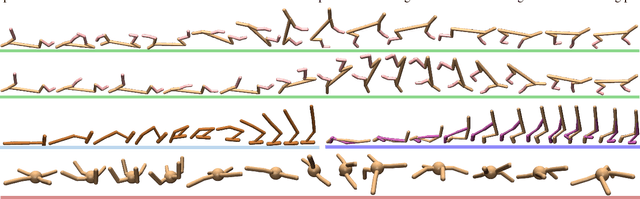
Robotic agents trained using reinforcement learning have the problem of taking unreliable actions in an out-of-distribution (OOD) state. Agents can easily become OOD in real-world environments because it is almost impossible for them to visit and learn the entire state space during training. Unfortunately, unreliable actions do not ensure that agents perform their original tasks successfully. Therefore, agents should be able to recognize whether they are in OOD states and learn how to return to the learned state distribution rather than continue to take unreliable actions. In this study, we propose a novel method for retraining agents to recover from OOD situations in a self-supervised manner when they fall into OOD states. Our in-depth experimental results demonstrate that our method substantially improves the agent's ability to recover from OOD situations in terms of sample efficiency and restoration of the performance for the original tasks. Moreover, we show that our method can retrain the agent to recover from OOD situations even when in-distribution states are difficult to visit through exploration.