 Add to Chrome
 Add to Firefox
 Add to Edge
ReImagine: Rethinking Controllable High-Quality Human Video Generation via Image-First Synthesis
Apr 21, 2026
Human video generation remains challenging due to the difficulty of jointly modeling human appearance, motion, and camera viewpoint under limited multi-view data. Existing methods often address these factors separately, resulting in limited controllability or reduced visual quality. We revisit this problem from an image-first perspective, where high-quality human appearance is learned via image generation and used as a prior for video synthesis, decoupling appearance modeling from temporal consistency. We propose a pose- and viewpoint-controllable pipeline that combines a pretrained image backbone with SMPL-X-based motion guidance, together with a training-free temporal refinement stage based on a pretrained video diffusion model. Our method produces high-quality, temporally consistent videos under diverse poses and viewpoints. We also release a canonical human dataset and an auxiliary model for compositional human image synthesis. Code and data are publicly available at https://github.com/Taited/ReImagine.

Condition Matters in Full-head 3D GANs
Feb 06, 2026Conditioning is crucial for stable training of full-head 3D GANs. Without any conditioning signal, the model suffers from severe mode collapse, making it impractical to training. However, a series of previous full-head 3D GANs conventionally choose the view angle as the conditioning input, which leads to a bias in the learned 3D full-head space along the conditional view direction. This is evident in the significant differences in generation quality and diversity between the conditional view and non-conditional views of the generated 3D heads, resulting in global incoherence across different head regions. In this work, we propose to use view-invariant semantic feature as the conditioning input, thereby decoupling the generative capability of 3D heads from the viewing direction. To construct a view-invariant semantic condition for each training image, we create a novel synthesized head image dataset. We leverage FLUX.1 Kontext to extend existing high-quality frontal face datasets to a wide range of view angles. The image clip feature extracted from the frontal view is then used as a shared semantic condition across all views in the extended images, ensuring semantic alignment while eliminating directional bias. This also allows supervision from different views of the same subject to be consolidated under a shared semantic condition, which accelerates training and enhances the global coherence of the generated 3D heads. Moreover, as GANs often experience slower improvements in diversity once the generator learns a few modes that successfully fool the discriminator, our semantic conditioning encourages the generator to follow the true semantic distribution, thereby promoting continuous learning and diverse generation. Extensive experiments on full-head synthesis and single-view GAN inversion demonstrate that our method achieves significantly higher fidelity, diversity, and generalizability.
Exploring Disentangled and Controllable Human Image Synthesis: From End-to-End to Stage-by-Stage
Mar 25, 2025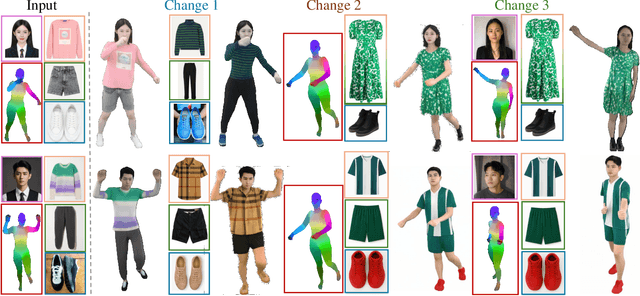

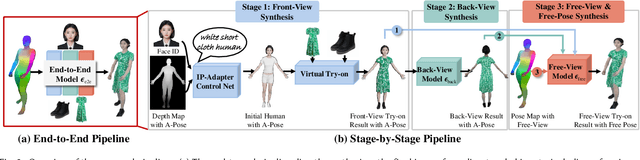
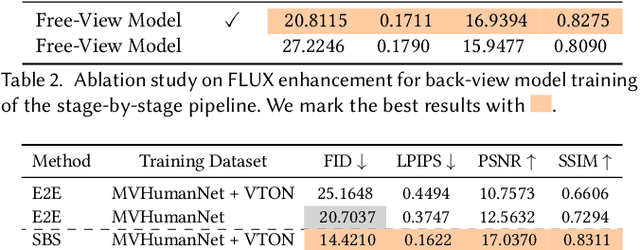
Achieving fine-grained controllability in human image synthesis is a long-standing challenge in computer vision. Existing methods primarily focus on either facial synthesis or near-frontal body generation, with limited ability to simultaneously control key factors such as viewpoint, pose, clothing, and identity in a disentangled manner. In this paper, we introduce a new disentangled and controllable human synthesis task, which explicitly separates and manipulates these four factors within a unified framework. We first develop an end-to-end generative model trained on MVHumanNet for factor disentanglement. However, the domain gap between MVHumanNet and in-the-wild data produce unsatisfacotry results, motivating the exploration of virtual try-on (VTON) dataset as a potential solution. Through experiments, we observe that simply incorporating the VTON dataset as additional data to train the end-to-end model degrades performance, primarily due to the inconsistency in data forms between the two datasets, which disrupts the disentanglement process. To better leverage both datasets, we propose a stage-by-stage framework that decomposes human image generation into three sequential steps: clothed A-pose generation, back-view synthesis, and pose and view control. This structured pipeline enables better dataset utilization at different stages, significantly improving controllability and generalization, especially for in-the-wild scenarios. Extensive experiments demonstrate that our stage-by-stage approach outperforms end-to-end models in both visual fidelity and disentanglement quality, offering a scalable solution for real-world tasks. Additional demos are available on the project page: https://taited.github.io/discohuman-project/.