 Add to Chrome
 Add to Firefox
 Add to Edge
JA-SIREN: Deterministic Initialization for Sinusoidal Networks via Spectral Matching
Jun 04, 2026
Existing implicit neural representation (INR) approaches suffer from stochastic initialization that does not guarantee consistent or high-quality performance across runs, with variations reaching more than 2.5 dB (78%) in image regression. This variation is problematic for scientific computing and simulation, where result reproducibility is crucial. To address this problem, we present Jacobi-Anger Sinusoidal Representation Network (JA-SIREN), a deterministic initialization scheme for sinusoidal networks grounded in classical spectral analysis. By computing the Discrete Sine Transform (DST) of the target signal and leveraging the Jacobi-Anger expansion, we derive closed-form weights for a two-layer sinusoidal MLP that analytically match the network's initial spectral response to the target signal, requiring no random seed or additional hyperparameter tuning. On the Kodak dataset, JA-SIREN achieves a mean PSNR of 67.18 dB, a 21.30 dB improvement over the best baseline. This is achieved with zero run-to-run variance, confirming that spectrally-informed initialization is a more effective and reproducible alternative to stochastic initialization for sinusoidal INRs.

Brain Tumors Classification for MR images based on Attention Guided Deep Learning Model
Apr 06, 2021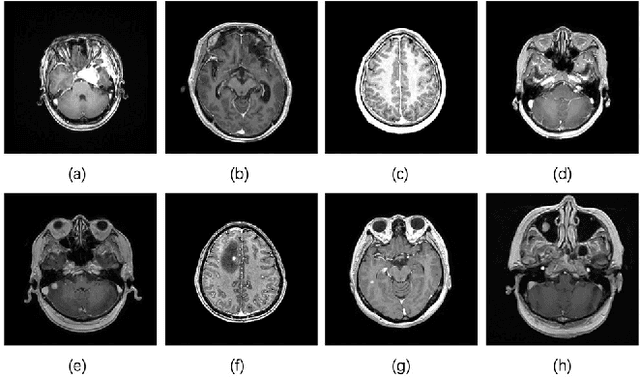
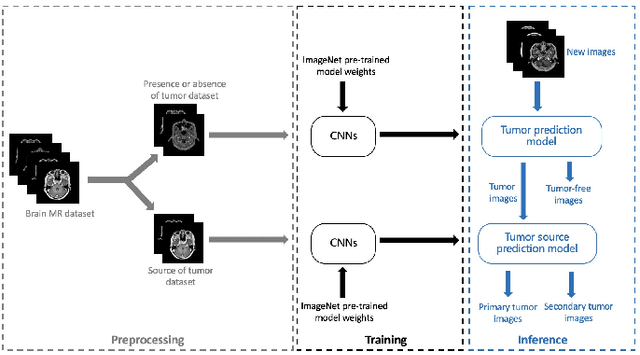
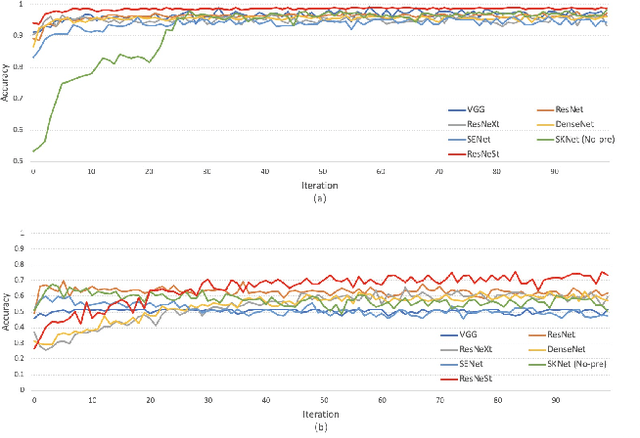
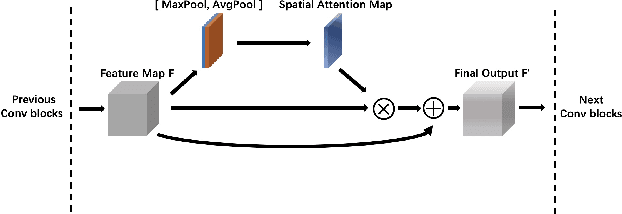
In the clinical diagnosis and treatment of brain tumors, manual image reading consumes a lot of energy and time. In recent years, the automatic tumor classification technology based on deep learning has entered people's field of vision. Brain tumors can be divided into primary and secondary intracranial tumors according to their source. However, to our best knowledge, most existing research on brain tumors are limited to primary intracranial tumor images and cannot classify the source of the tumor. In order to solve the task of tumor source type classification, we analyze the existing technology and propose an attention guided deep convolution neural network (CNN) model. Meanwhile, the method proposed in this paper also effectively improves the accuracy of classifying the presence or absence of tumor. For the brain MR dataset, our method can achieve the average accuracy of 99.18% under ten-fold cross-validation for identifying the presence or absence of tumor, and 83.38% for classifying the source of tumor. Experimental results show that our method is consistent with the method of medical experts. It can assist doctors in achieving efficient clinical diagnosis of brain tumors.