 Add to Chrome
 Add to Firefox
 Add to Edge
JA-SIREN: Deterministic Initialization for Sinusoidal Networks via Spectral Matching
Jun 04, 2026
Existing implicit neural representation (INR) approaches suffer from stochastic initialization that does not guarantee consistent or high-quality performance across runs, with variations reaching more than 2.5 dB (78%) in image regression. This variation is problematic for scientific computing and simulation, where result reproducibility is crucial. To address this problem, we present Jacobi-Anger Sinusoidal Representation Network (JA-SIREN), a deterministic initialization scheme for sinusoidal networks grounded in classical spectral analysis. By computing the Discrete Sine Transform (DST) of the target signal and leveraging the Jacobi-Anger expansion, we derive closed-form weights for a two-layer sinusoidal MLP that analytically match the network's initial spectral response to the target signal, requiring no random seed or additional hyperparameter tuning. On the Kodak dataset, JA-SIREN achieves a mean PSNR of 67.18 dB, a 21.30 dB improvement over the best baseline. This is achieved with zero run-to-run variance, confirming that spectrally-informed initialization is a more effective and reproducible alternative to stochastic initialization for sinusoidal INRs.

Toward a Low-Cost Perception System in Autonomous Vehicles: A Spectrum Learning Approach
Feb 04, 2025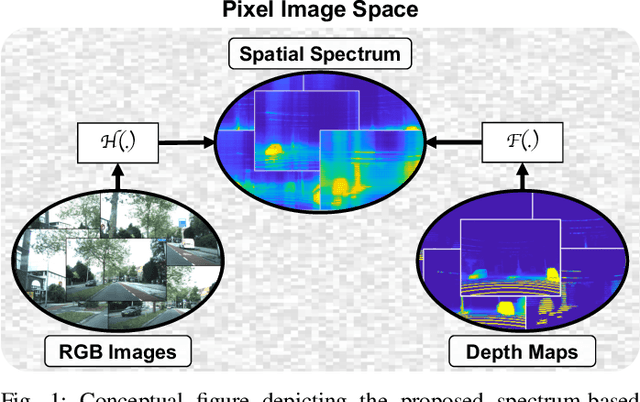
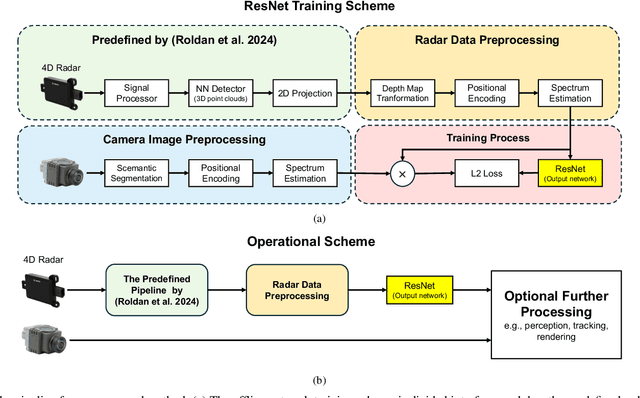

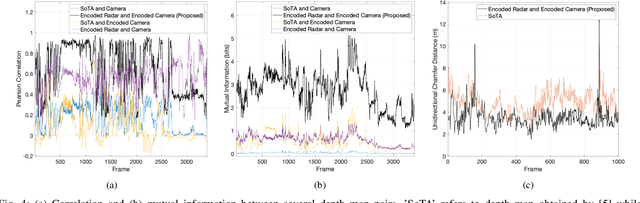
We present a cost-effective new approach for generating denser depth maps for Autonomous Driving (AD) and Autonomous Vehicles (AVs) by integrating the images obtained from deep neural network (DNN) 4D radar detectors with conventional camera RGB images. Our approach introduces a novel pixel positional encoding algorithm inspired by Bartlett's spatial spectrum estimation technique. This algorithm transforms both radar depth maps and RGB images into a unified pixel image subspace called the Spatial Spectrum, facilitating effective learning based on their similarities and differences. Our method effectively leverages high-resolution camera images to train radar depth map generative models, addressing the limitations of conventional radar detectors in complex vehicular environments, thus sharpening the radar output. We develop spectrum estimation algorithms tailored for radar depth maps and RGB images, a comprehensive training framework for data-driven generative models, and a camera-radar deployment scheme for AV operation. Our results demonstrate that our approach also outperforms the state-of-the-art (SOTA) by 27.95% in terms of Unidirectional Chamfer Distance (UCD).