 Add to Chrome
 Add to Firefox
 Add to Edge
Relational Appliances: A Robot in the Refrigerator for Home-Based Health Promotion
Feb 26, 2026
Kitchen appliances are frequently used domestic artifacts situated at the point of everyday dietary decision making, making them a promising but underexplored site for health promotion. We explore the concept of relational appliances: everyday household devices designed as embodied social actors that engage users through ongoing, personalized interaction. We focus on the refrigerator, whose unique affordances, including a fixed, sensor-rich environment, private interaction space, and close coupling to food items, support contextualized, conversational engagement during snack choices. We present an initial exploration of this concept through a pilot study deploying an anthropomorphic robotic head inside a household refrigerator. In a home-lab apartment, participants repeatedly retrieved snacks during simulated TV "commercial breaks" while interacting with a human-sized robotic head. Participants were randomized to either a health-promotion condition, in which the robot made healthy snack recommendations, or a social-chat control condition. Outcomes included compliance with recommendations, nutritional quality of selected snacks, and psychosocial measures related to acceptance of the robot. Results suggest that participants found the robot persuasive, socially engaging, and increasingly natural over time, often describing it as helpful, aware, and companionable. Most participants reported greater awareness of their snack decisions and expressed interest in having such a robot in their own home. We discuss implications for designing relational appliances that leverage anthropomorphism, trust, and long-term human-technology relationships for home-based health promotion.

Virtual Agent-Based Communication Skills Training to Facilitate Health Persuasion Among Peers
Dec 16, 2024
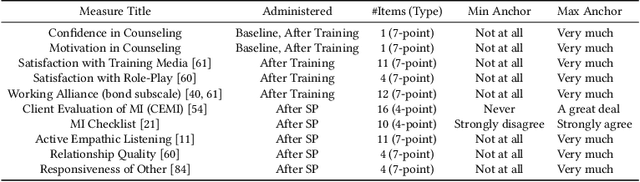

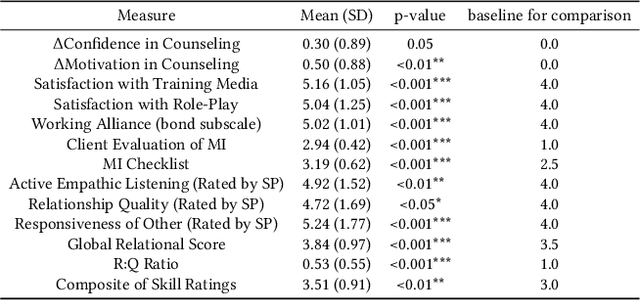
Many laypeople are motivated to improve the health behavior of their family or friends but do not know where to start, especially if the health behavior is potentially stigmatizing or controversial. We present an approach that uses virtual agents to coach community-based volunteers in health counseling techniques, such as motivational interviewing, and allows them to practice these skills in role-playing scenarios. We use this approach in a virtual agent-based system to increase COVID-19 vaccination by empowering users to influence their social network. In a between-subjects comparative design study, we test the effects of agent system interactivity and role-playing functionality on counseling outcomes, with participants evaluated by standardized patients and objective judges. We find that all versions are effective at producing peer counselors who score adequately on a standardized measure of counseling competence, and that participants were significantly more satisfied with interactive virtual agents compared to passive viewing of the training material. We discuss design implications for interpersonal skills training systems based on our findings.
Empathic Grounding: Explorations using Multimodal Interaction and Large Language Models with Conversational Agents
Jul 01, 2024We introduce the concept of "empathic grounding" in conversational agents as an extension of Clark's conceptualization of grounding in conversation in which the grounding criterion includes listener empathy for the speaker's affective state. Empathic grounding is generally required whenever the speaker's emotions are foregrounded and can make the grounding process more efficient and reliable by communicating both propositional and affective understanding. Both speaker expressions of affect and listener empathic grounding can be multimodal, including facial expressions and other nonverbal displays. Thus, models of empathic grounding for embodied agents should be multimodal to facilitate natural and efficient communication. We describe a multimodal model that takes as input user speech and facial expression to generate multimodal grounding moves for a listening agent using a large language model. We also describe a testbed to evaluate approaches to empathic grounding, in which a humanoid robot interviews a user about a past episode of pain and then has the user rate their perception of the robot's empathy. We compare our proposed model to one that only generates non-affective grounding cues in a between-subjects experiment. Findings demonstrate that empathic grounding increases user perceptions of empathy, understanding, emotional intelligence, and trust. Our work highlights the role of emotion awareness and multimodality in generating appropriate grounding moves for conversational agents.
Keeping Users Engaged During Repeated Administration of the Same Questionnaire: Using Large Language Models to Reliably Diversify Questions
Nov 21, 2023Standardized, validated questionnaires are vital tools in HCI research and healthcare, offering dependable self-report data. However, their repeated use in longitudinal or pre-post studies can induce respondent fatigue, impacting data quality via response biases and decreased response rates. We propose utilizing large language models (LLMs) to generate diverse questionnaire versions while retaining good psychometric properties. In a longitudinal study, participants engaged with our agent system and responded daily for two weeks to either a standardized depression questionnaire or one of two LLM-generated questionnaire variants, alongside a validated depression questionnaire. Psychometric testing revealed consistent covariation between the external criterion and the focal measure administered across the three conditions, demonstrating the reliability and validity of the LLM-generated variants. Participants found the repeated administration of the standardized questionnaire significantly more repetitive compared to the variants. Our findings highlight the potential of LLM-generated variants to invigorate questionnaires, fostering engagement and interest without compromising validity.