 Add to Chrome
 Add to Firefox
 Add to Edge
GroupAffect-4: A Multimodal Dataset of Four-Person Collaborative Interaction
May 19, 2026
Existing affective-computing, social-signal-processing, and meeting corpora capture important parts of human interaction, but they rarely support analysis of affect in co-located groups as a coupled individual, interpersonal, and group-level process. The required signals (per-participant physiology, eye movement, audio, self-report, task outcomes, and personality) are usually fragmented across separate dataset traditions. We introduce GroupAffect-4, a multimodal corpus of 40 participants in 10 four-person groups, each completing four ecologically varied collaborative tasks spanning information pooling, negotiation, idea generation, and a public-goods game. Each participant is instrumented with a wrist-worn physiology sensor, eye-tracking glasses, and a close-talk microphone; sessions include continuous affect self-reports, post-task questionnaires, task outcomes, and Big-Five personality scores, all time-aligned to a shared clock. The dataset covers over 91% of expected physiology windows and 98% of eye-tracking windows, with strong task validity confirmed by a clear affective manipulation check across the negotiation block. We define fifteen benchmarkable targets spanning three analysis levels -- within-person state, between-person traits, and group dynamics -- and report leave-one-group-out feasibility baselines establishing the dataset's evaluative scope. GroupAffect-4 is released with a BIDS-inspired structure, Croissant metadata, a datasheet, per-session quality reports, and open processing scripts. Code and processing scripts are available at https://github.com/meisamjam/GroupAffect-4; the dataset is publicly archived at https://zenodo.org/records/20037847.

AffectAI-Capture: A Reproducible Multimodal Protocol for Small-Group Meeting Research
May 19, 2026We present AffectAI-Capture, a protocol for collecting synchronized multimodal data in four-person meeting-like interactions, combining eye tracking, wearable physiology, close-talk and room audio, multi-view video, event logging, and structured self-report. Sessions use fixed task blocks grounded in established group-interaction paradigms, while acquisition and post-processing are organized around a single authoritative event timeline and standardized outputs. We describe the experimental rationale, synchronization philosophy, data organization, and practical trade-offs. Pilot-level validation of audio quality and video synchronization has been conducted using controlled bench tests; full protocol sessions with participants remain ongoing work. The contribution is a reproducible protocol architecture linking task design, instrumentation, timing provenance, and data packaging for affective, behavioral, and meeting-analytics research.
On Sequential Bayesian Optimization with Pairwise Comparison
Mar 24, 2021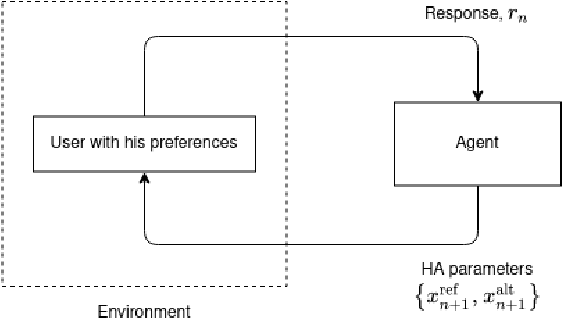
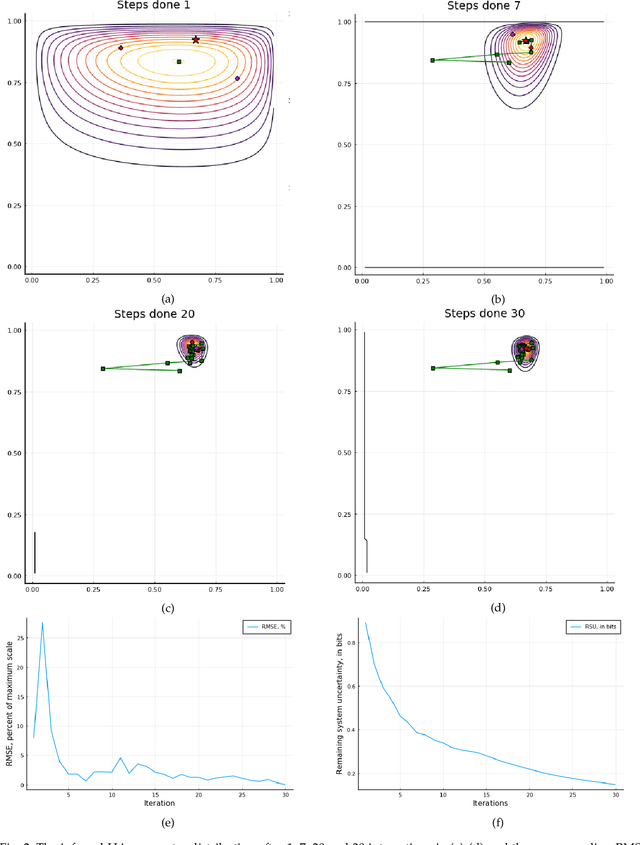
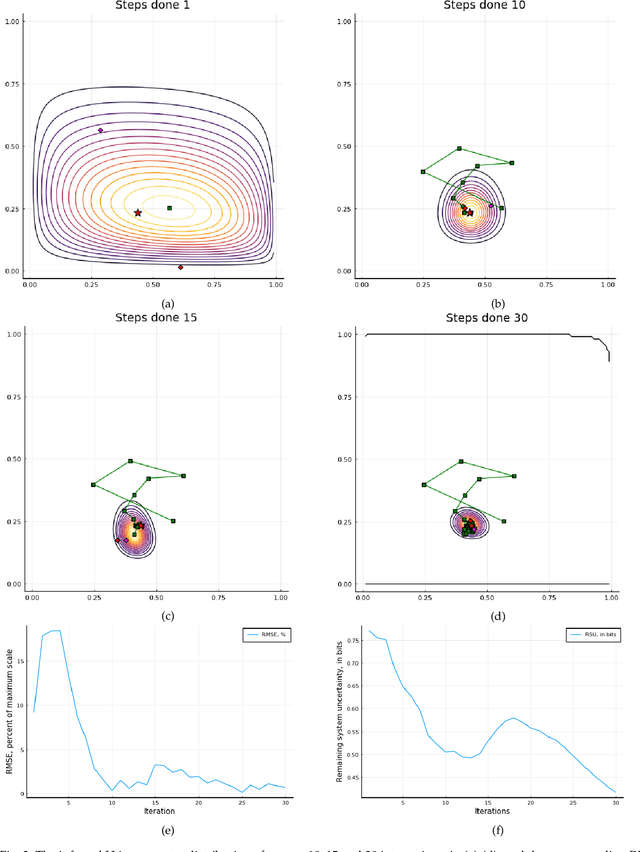
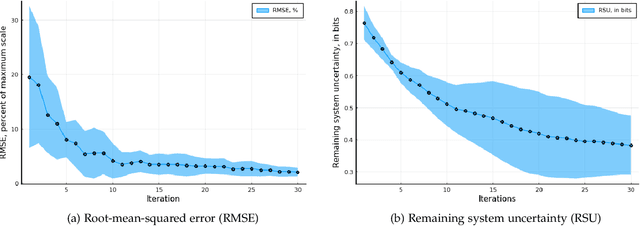
In this work, we study the problem of user preference learning on the example of parameter setting for a hearing aid (HA). We propose to use an agent that interacts with a HA user, in order to collect the most informative data, and learns user preferences for HA parameter settings, based on these data. We model the HA system as two interacting sub-systems, one representing a user with his/her preferences and another one representing an agent. In this system, the user responses to HA settings, proposed by the agent. In our user model, the responses are driven by a parametric user preference function. The agent comprises the sequential mechanisms for user model inference and HA parameter proposal generation. To infer the user model (preference function), Bayesian approximate inference is used in the agent. Here we propose the normalized weighted Kullback-Leibler (KL) divergence between true and agent-assigned predictive user response distributions as a metric to assess the quality of learned preferences. Moreover, our agent strategy for generating HA parameter proposals is to generate HA settings, responses to which help resolving uncertainty associated with prediction of the user responses the most. The resulting data, consequently, allows for efficient user model learning. The normalized weighted KL-divergence plays an important role here as well, since it characterizes the informativeness of the data to be used for probing the user. The efficiency of our approach is validated by numerical simulations.