 Add to Chrome
 Add to Firefox
 Add to Edge
Afri-MCQA: Multimodal Cultural Question Answering for African Languages
Jan 09, 2026
Africa is home to over one-third of the world's languages, yet remains underrepresented in AI research. We introduce Afri-MCQA, the first Multilingual Cultural Question-Answering benchmark covering 7.5k Q&A pairs across 15 African languages from 12 countries. The benchmark offers parallel English-African language Q&A pairs across text and speech modalities and was entirely created by native speakers. Benchmarking large language models (LLMs) on Afri-MCQA shows that open-weight models perform poorly across evaluated cultures, with near-zero accuracy on open-ended VQA when queried in native language or speech. To evaluate linguistic competence, we include control experiments meant to assess this specific aspect separate from cultural knowledge, and we observe significant performance gaps between native languages and English for both text and speech. These findings underscore the need for speech-first approaches, culturally grounded pretraining, and cross-lingual cultural transfer. To support more inclusive multimodal AI development in African languages, we release our Afri-MCQA under academic license or CC BY-NC 4.0 on HuggingFace (https://huggingface.co/datasets/Atnafu/Afri-MCQA)

MasakhaNEWS: News Topic Classification for African languages
Apr 19, 2023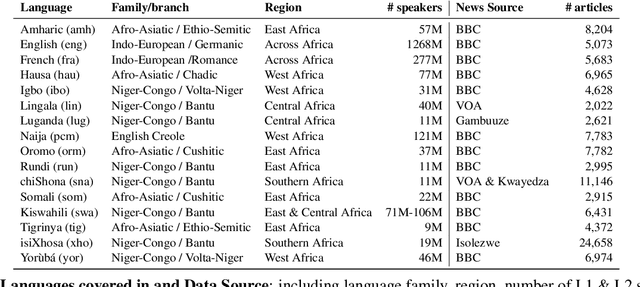
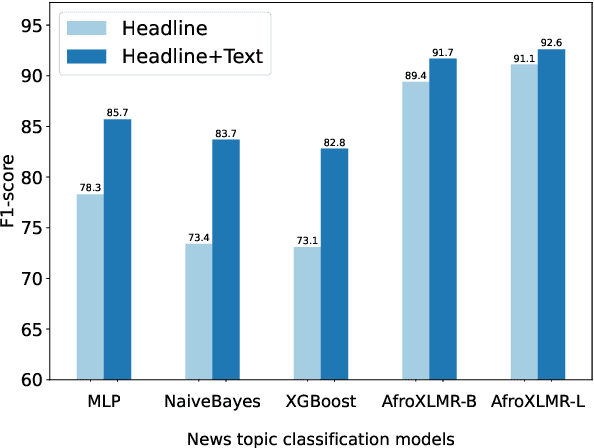

African languages are severely under-represented in NLP research due to lack of datasets covering several NLP tasks. While there are individual language specific datasets that are being expanded to different tasks, only a handful of NLP tasks (e.g. named entity recognition and machine translation) have standardized benchmark datasets covering several geographical and typologically-diverse African languages. In this paper, we develop MasakhaNEWS -- a new benchmark dataset for news topic classification covering 16 languages widely spoken in Africa. We provide an evaluation of baseline models by training classical machine learning models and fine-tuning several language models. Furthermore, we explore several alternatives to full fine-tuning of language models that are better suited for zero-shot and few-shot learning such as cross-lingual parameter-efficient fine-tuning (like MAD-X), pattern exploiting training (PET), prompting language models (like ChatGPT), and prompt-free sentence transformer fine-tuning (SetFit and Cohere Embedding API). Our evaluation in zero-shot setting shows the potential of prompting ChatGPT for news topic classification in low-resource African languages, achieving an average performance of 70 F1 points without leveraging additional supervision like MAD-X. In few-shot setting, we show that with as little as 10 examples per label, we achieved more than 90\% (i.e. 86.0 F1 points) of the performance of full supervised training (92.6 F1 points) leveraging the PET approach.