 Add to Chrome
 Add to Firefox
 Add to Edge
SeerGuard: A Safety Framework for Mobile GUI Agents via World Model Prediction
Jul 17, 2026
Mobile graphical user interface (GUI) agents have demonstrated remarkable capabilities in automating complex tasks, yet they introduce critical safety risks where a single erroneous action can lead to irreversible consequences. Existing safety mechanisms are primarily reactive, lacking the ability to assess risks before execution. In this paper, we introduce SeerGuard, a consequence-aware safety framework designed to mitigate these risks through pre-execution instruction-level screening and action-level risk assessment. Specifically, the action-level assessment analyzes agent-proposed actions within current GUI states, anticipating likely outcomes to identify risks before they are executed. To enable these capabilities, we construct a unified safety-augmented world model (SAWM) via multi-task learning, integrating semantic next-state prediction with safety risk assessment. Extensive experiments demonstrate that SeerGuard generalizes effectively across diverse mobile GUI agents. On Qwen3-VL-8B-Instruct, it increases the safety-utility score from $0.191$ to $0.596$ at $ω=0.8$ and reduces the risk-cost score from $0.347$ to $0.130$ at $α=0.8$. Further analyses on our SAWM validate the effectiveness of the instruction-level screening, alongside the capability of action risk assessment and next-state prediction.

Class-Incremental Few-Shot Event Detection
Apr 02, 2024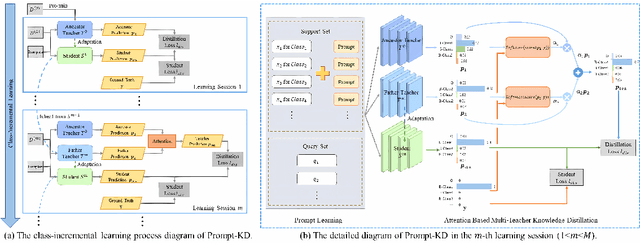

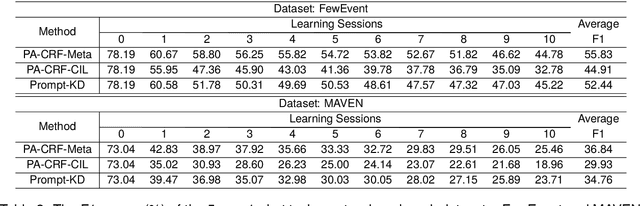
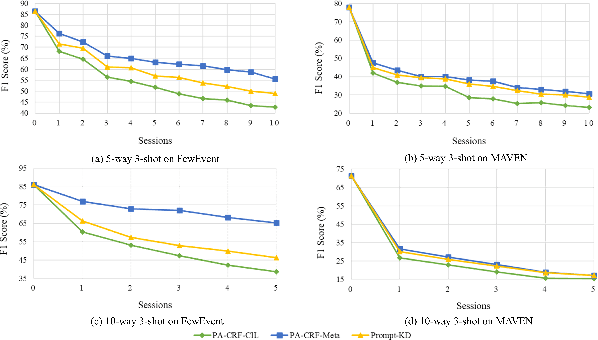
Event detection is one of the fundamental tasks in information extraction and knowledge graph. However, a realistic event detection system often needs to deal with new event classes constantly. These new classes usually have only a few labeled instances as it is time-consuming and labor-intensive to annotate a large number of unlabeled instances. Therefore, this paper proposes a new task, called class-incremental few-shot event detection. Nevertheless, this task faces two problems, i.e., old knowledge forgetting and new class overfitting. To solve these problems, this paper further presents a novel knowledge distillation and prompt learning based method, called Prompt-KD. Specifically, to handle the forgetting problem about old knowledge, Prompt-KD develops an attention based multi-teacher knowledge distillation framework, where the ancestor teacher model pre-trained on base classes is reused in all learning sessions, and the father teacher model derives the current student model via adaptation. On the other hand, in order to cope with the few-shot learning scenario and alleviate the corresponding new class overfitting problem, Prompt-KD is also equipped with a prompt learning mechanism. Extensive experiments on two benchmark datasets, i.e., FewEvent and MAVEN, demonstrate the superior performance of Prompt-KD.