 Add to Chrome
 Add to Firefox
 Add to Edge
SkyReels-V4: Multi-modal Video-Audio Generation, Inpainting and Editing model
Feb 26, 2026
SkyReels V4 is a unified multi modal video foundation model for joint video audio generation, inpainting, and editing. The model adopts a dual stream Multimodal Diffusion Transformer (MMDiT) architecture, where one branch synthesizes video and the other generates temporally aligned audio, while sharing a powerful text encoder based on the Multimodal Large Language Models (MMLM). SkyReels V4 accepts rich multi modal instructions, including text, images, video clips, masks, and audio references. By combining the MMLMs multi modal instruction following capability with in context learning in the video branch MMDiT, the model can inject fine grained visual guidance under complex conditioning, while the audio branch MMDiT simultaneously leverages audio references to guide sound generation. On the video side, we adopt a channel concatenation formulation that unifies a wide range of inpainting style tasks, such as image to video, video extension, and video editing under a single interface, and naturally extends to vision referenced inpainting and editing via multi modal prompts. SkyReels V4 supports up to 1080p resolution, 32 FPS, and 15 second duration, enabling high fidelity, multi shot, cinema level video generation with synchronized audio. To make such high resolution, long-duration generation computationally feasible, we introduce an efficiency strategy: Joint generation of low resolution full sequences and high-resolution keyframes, followed by dedicated super-resolution and frame interpolation models. To our knowledge, SkyReels V4 is the first video foundation model that simultaneously supports multi-modal input, joint video audio generation, and a unified treatment of generation, inpainting, and editing, while maintaining strong efficiency and quality at cinematic resolutions and durations.

Muon in Associative Memory Learning: Training Dynamics and Scaling Laws
Feb 05, 2026Muon updates matrix parameters via the matrix sign of the gradient and has shown strong empirical gains, yet its dynamics and scaling behavior remain unclear in theory. We study Muon in a linear associative memory model with softmax retrieval and a hierarchical frequency spectrum over query-answer pairs, with and without label noise. In this setting, we show that Gradient Descent (GD) learns frequency components at highly imbalanced rates, leading to slow convergence bottlenecked by low-frequency components. In contrast, the Muon optimizer mitigates this imbalance, leading to faster and more uniform progress. Specifically, in the noiseless case, Muon achieves an exponential speedup over GD; in the noisy case with a power-decay frequency spectrum, we derive Muon's optimization scaling law and demonstrate its superior scaling efficiency over GD. Furthermore, we show that Muon can be interpreted as an implicit matrix preconditioner arising from adaptive task alignment and block-symmetric gradient structure. In contrast, the preconditioner with coordinate-wise sign operator could match Muon under oracle access to unknown task representations, which is infeasible for SignGD in practice. Experiments on synthetic long-tail classification and LLaMA-style pre-training corroborate the theory.
Reasoning in Diffusion Large Language Models is Concentrated in Dynamic Confusion Zones
Nov 19, 2025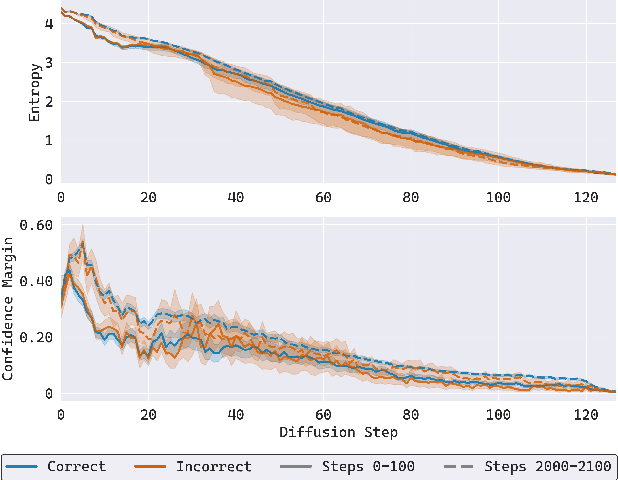
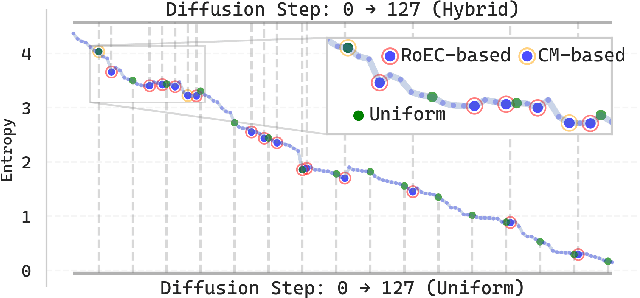

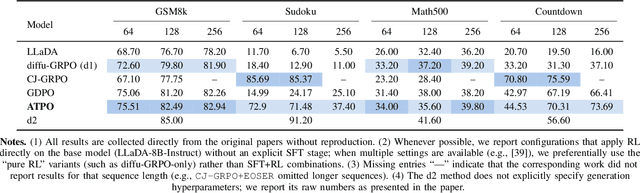
Diffusion Large Language Models (dLLMs) are rapidly emerging alongside autoregressive models as a powerful paradigm for complex reasoning, with reinforcement learning increasingly used for downstream alignment. Existing trajectory-based RL methods uniformly allocate policy gradients across denoising steps, implicitly treating all steps as equally important. We challenge this assumption by analyzing trajectories with several step-level metrics: entropy-based uncertainty, Confidence-Margin (CM) uncertainty, and Rate of Entropy Change (RoEC). These reveal structured "zones of confusion": transient spikes in uncertainty and instability that strongly predict final success or failure, while most steps remain stable. We propose Adaptive Trajectory Policy Optimization (ATPO), a lightweight step-selection strategy that dynamically reallocates gradient updates to these high-leverage steps without changing the RL objective, rewards, or compute budget. Using a hybrid RoEC+CM rule, ATPO delivers substantial gains in reasoning accuracy and training stability across benchmarks, showing that exploiting trajectory dynamics is key to advancing dLLM RL.