 Add to Chrome
 Add to Firefox
 Add to Edge
ProjAgent: Procedural Similarity Retrieval for Repository-Level Code Generation
Jul 09, 2026
Repository-level code generation requires implementing target functions while accounting for complex cross-file dependencies and project-specific conventions. Existing retrieval methods predominantly rely on lexical, structural, or semantic similarity, often overlooking repository functions that implement similar procedural logic despite differing in identifiers or application domains. We propose ProjAgent, a repository-level code generation system that introduces procedural similarity as an explicit retrieval signal. ProjAgent decomposes the target function into intermediate reasoning steps and employs an agentic workflow to retrieve repository functions that exhibit similar procedural behavior at each step. The retrieved procedural context is integrated with conventional semantic retrieval to construct a richer repository context for code generation. ProjAgent further incorporates a conservative static-analysis feedback loop that iteratively repairs generated code using compiler and static-analysis feedback. Evaluated on REPOCOD, ProjAgent achieves 41.14% Pass@1, outperforming existing retrieval-based baselines. These results demonstrate that procedural similarity is an effective and previously unexplored retrieval dimension for repository-level code generation.

A Deep Dive Into Large Language Model Code Generation Mistakes: What and Why?
Nov 03, 2024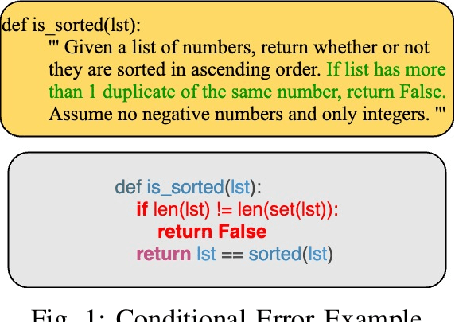
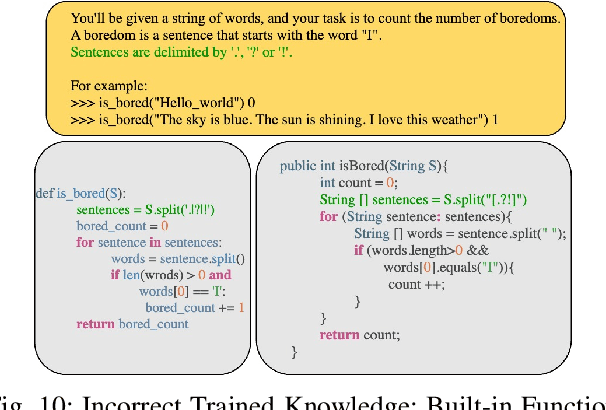
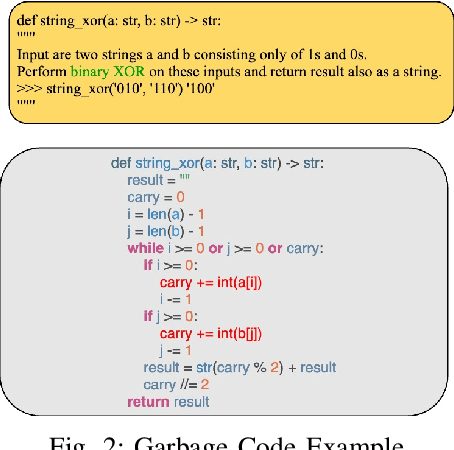
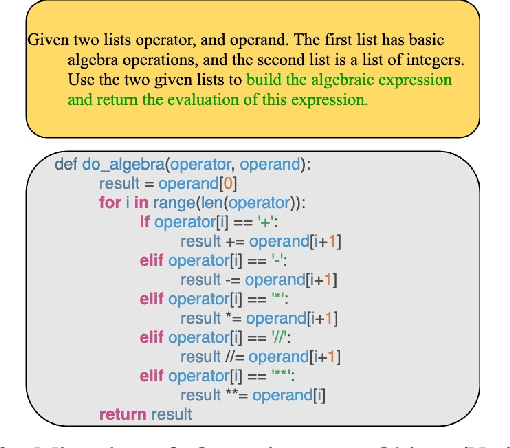
Recent advancements in Large Language Models (LLMs) have led to their widespread application in automated code generation. However, these models can still generate defective code that deviates from the specification. Previous research has mainly focused on the mistakes in LLM-generated standalone functions, overlooking real-world software development situations where the successful generation of the code requires software contexts such as external dependencies. In this paper, we considered both of these code generation situations and identified a range of \textit{non-syntactic mistakes} arising from LLMs' misunderstandings of coding question specifications. Seven categories of non-syntactic mistakes were identified through extensive manual analyses, four of which were missed by previous works. To better understand these mistakes, we proposed six reasons behind these mistakes from various perspectives. Moreover, we explored the effectiveness of LLMs in detecting mistakes and their reasons. Our evaluation demonstrated that GPT-4 with the ReAct prompting technique can achieve an F1 score of up to 0.65 when identifying reasons for LLM's mistakes, such as misleading function signatures. We believe that these findings offer valuable insights into enhancing the quality of LLM-generated code.