 Add to Chrome
 Add to Firefox
 Add to Edge
Adversarial Alignment and Disentanglement for Cross-Domain CTR Prediction with Domain-Encompassing Features
Jan 24, 2026
Cross-domain recommendation (CDR) has been increasingly explored to address data sparsity and cold-start issues. However, recent approaches typically disentangle domain-invariant features shared between source and target domains, as well as domain-specific features for each domain. However, they often rely solely on domain-invariant features combined with target domain-specific features, which can lead to suboptimal performance. To overcome the limitations, this paper presents the Adversarial Alignment and Disentanglement Cross-Domain Recommendation ($A^2DCDR$ ) model, an innovative approach designed to capture a comprehensive range of cross-domain information, including both domain-invariant and valuable non-aligned features. The $A^2DCDR$ model enhances cross-domain recommendation through three key components: refining MMD with adversarial training for better generalization, employing a feature disentangler and reconstruction mechanism for intra-domain disentanglement, and introducing a novel fused representation combining domain-invariant, non-aligned features with original contextual data. Experiments on real-world datasets and online A/B testing show that $A^2DCDR$ outperforms existing methods, confirming its effectiveness and practical applicability. The code is provided at https://github.com/youzi0925/A-2DCDR/tree/main.

DADNN: Multi-Scene CTR Prediction via Domain-Aware Deep Neural Network
Nov 24, 2020
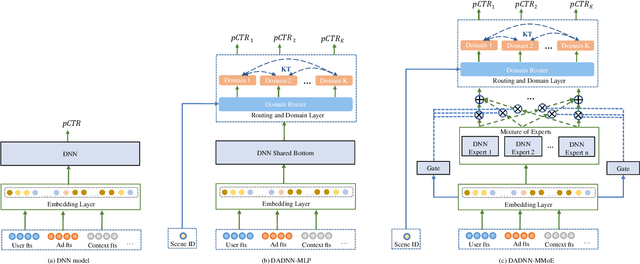
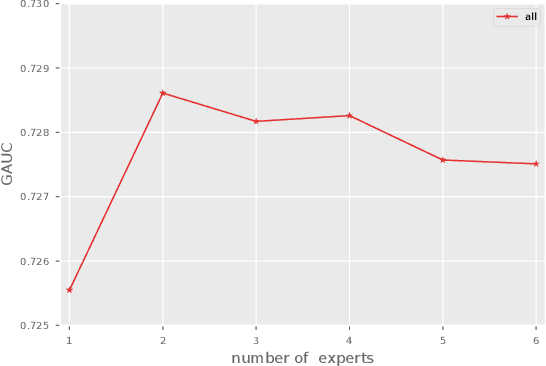
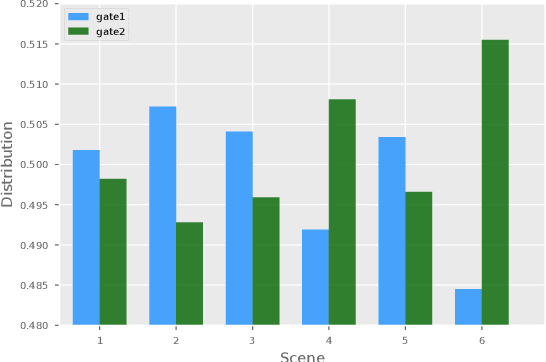
Click through rate(CTR) prediction is a core task in advertising systems. The booming e-commerce business in our company, results in a growing number of scenes. Most of them are so-called long-tail scenes, which means that the traffic of a single scene is limited, but the overall traffic is considerable. Typical studies mainly focus on serving a single scene with a well designed model. However, this method brings excessive resource consumption both on offline training and online serving. Besides, simply training a single model with data from multiple scenes ignores the characteristics of their own. To address these challenges, we propose a novel but practical model named Domain-Aware Deep Neural Network(DADNN) by serving multiple scenes with only one model. Specifically, shared bottom block among all scenes is applied to learn a common representation, while domain-specific heads maintain the characteristics of every scene. Besides, knowledge transfer is introduced to enhance the opportunity of knowledge sharing among different scenes. In this paper, we study two instances of DADNN where its shared bottom block is multilayer perceptron(MLP) and Multi-gate Mixture-of-Experts(MMoE) respectively, for which we denote as DADNN-MLP and DADNN-MMoE.Comprehensive offline experiments on a real production dataset from our company show that DADNN outperforms several state-of-the-art methods for multi-scene CTR prediction. Extensive online A/B tests reveal that DADNN-MLP contributes up to 6.7% CTR and 3.0% CPM(Cost Per Mille) promotion compared with a well-engineered DCN model. Furthermore, DADNN-MMoE outperforms DADNN-MLP with a relative improvement of 2.2% and 2.7% on CTR and CPM respectively. More importantly, DADNN utilizes a single model for multiple scenes which saves a lot of offline training and online serving resources.