 Add to Chrome
 Add to Firefox
 Add to Edge
UniSpace: Unified Visual Representation and Scalable Multimodal Modeling
Aug 09, 2026
Semantic vision encoders have become a central visual interface for multimodal understanding and semantic conditioning in image generation. However, their final tokens discard fine-grained visual details, leading to poor pixel reconstruction and limiting their use in reconstruction-sensitive tasks such as image generation and editing. In this work, we ask whether understanding, generation, and editing can be modeled in a single visual representation space built from a pretrained semantic ViT. We show that the frozen Transformer blocks of a semantic ViT are not intrinsically unable to preserve visual details. Instead, the original patch parameterization drives the representation toward semantic abstraction, making fine-grained information difficult to recover from the final tokens. Based on this observation, we introduce \emph{Patch Reparameterization}, which preserves the original semantic pathway while adding a reconstruction-aware patch embedding that provides fine-grained visual information to the same frozen ViT blocks. The resulting unified representation preserves multimodal understanding while enabling high-fidelity image reconstruction and a favorable reconstruction--generation trade-off. We further scale this representation into \emph{UniSpace}, an 8B Mixture-of-Transformer-Experts model that performs understanding, generation, and editing in the same visual space without a separate VAE pathway. System-level evaluations demonstrate practical text-to-image generation and instruction-based image editing, showing that a reparameterized pretrained ViT can serve as a unified visual interface for scalable multimodal modeling.

ViGoR-Bench: How Far Are Visual Generative Models From Zero-Shot Visual Reasoners?
Mar 26, 2026Beneath the stunning visual fidelity of modern AIGC models lies a "logical desert", where systems fail tasks that require physical, causal, or complex spatial reasoning. Current evaluations largely rely on superficial metrics or fragmented benchmarks, creating a ``performance mirage'' that overlooks the generative process. To address this, we introduce ViGoR Vision-G}nerative Reasoning-centric Benchmark), a unified framework designed to dismantle this mirage. ViGoR distinguishes itself through four key innovations: 1) holistic cross-modal coverage bridging Image-to-Image and Video tasks; 2) a dual-track mechanism evaluating both intermediate processes and final results; 3) an evidence-grounded automated judge ensuring high human alignment; and 4) granular diagnostic analysis that decomposes performance into fine-grained cognitive dimensions. Experiments on over 20 leading models reveal that even state-of-the-art systems harbor significant reasoning deficits, establishing ViGoR as a critical ``stress test'' for the next generation of intelligent vision models. The demo have been available at https://vincenthancoder.github.io/ViGoR-Bench/
Nonlinear Inverse Design of Mechanical Multi-Material Metamaterials Enabled by Video Denoising Diffusion and Structure Identifier
Sep 20, 2024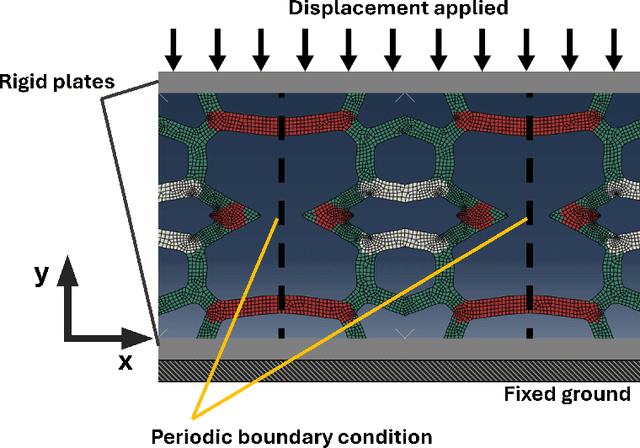


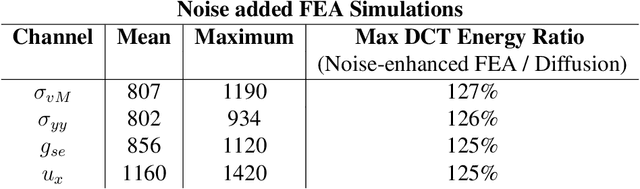
Metamaterials, synthetic materials with customized properties, have emerged as a promising field due to advancements in additive manufacturing. These materials derive unique mechanical properties from their internal lattice structures, which are often composed of multiple materials that repeat geometric patterns. While traditional inverse design approaches have shown potential, they struggle to map nonlinear material behavior to multiple possible structural configurations. This paper presents a novel framework leveraging video diffusion models, a type of generative artificial Intelligence (AI), for inverse multi-material design based on nonlinear stress-strain responses. Our approach consists of two key components: (1) a fields generator using a video diffusion model to create solution fields based on target nonlinear stress-strain responses, and (2) a structure identifier employing two UNet models to determine the corresponding multi-material 2D design. By incorporating multiple materials, plasticity, and large deformation, our innovative design method allows for enhanced control over the highly nonlinear mechanical behavior of metamaterials commonly seen in real-world applications. It offers a promising solution for generating next-generation metamaterials with finely tuned mechanical characteristics.
Exploring the structure-property relations of thin-walled, 2D extruded lattices using neural networks
May 13, 2022


This paper investigates the structure-property relations of thin-walled lattices under dynamic longitudinal compression, characterized by their cross-sections and heights. These relations elucidate the interactions of different geometric features of a design on mechanical response, including energy absorption. We proposed a combinatorial, key-based design system to generate different lattice designs and used the finite element method to simulate their response with the Johnson-Cook material model. Using an autoencoder, we encoded the cross-sectional images of the lattices into latent design feature vectors, which were supplied to the neural network model to generate predictions. The trained models can accurately predict lattice energy absorption curves in the key-based design system and can be extended to new designs outside of the system via transfer learning.