 Add to Chrome
 Add to Firefox
 Add to Edge
SinGeo: Unlock Single Model's Potential for Robust Cross-View Geo-Localization
Mar 10, 2026
Robust cross-view geo-localization (CVGL) remains challenging despite the surge in recent progress. Existing methods still rely on field-of-view (FoV)-specific training paradigms, where models are optimized under a fixed FoV but collapse when tested on unseen FoVs and unknown orientations. This limitation necessitates deploying multiple models to cover diverse variations. Although studies have explored dynamic FoV training by simply randomizing FoVs, they failed to achieve robustness across diverse conditions -- implicitly assuming all FoVs are equally difficult. To address this gap, we present SinGeo, a simple yet powerful framework that enables a single model to realize robust cross-view geo-localization without additional modules or explicit transformations. SinGeo employs a dual discriminative learning architecture that enhances intra-view discriminability within both ground and satellite branches, and is the first to introduce a curriculum learning strategy to achieve robust CVGL. Extensive evaluations on four benchmark datasets reveal that SinGeo sets state-of-the-art (SOTA) results under diverse conditions, and notably outperforms methods specifically trained for extreme FoVs. Beyond superior performance, SinGeo also exhibits cross-architecture transferability. Furthermore, we propose a consistency evaluation method to quantitatively assess model stability under varying views, providing an explainable perspective for understanding and advancing robustness in future CVGL research. Codes will be available upon acceptance.

Weight-based Channel-model Matrix Framework: a reasonable solution for EEG-based cross-dataset emotion recognition
Sep 13, 2022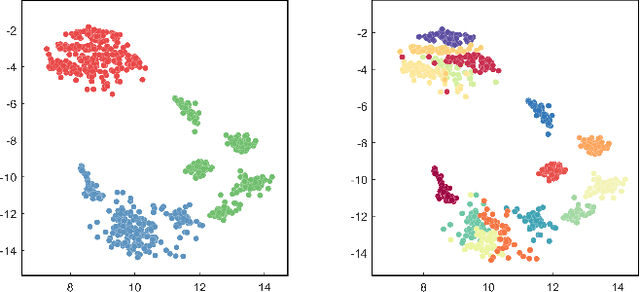
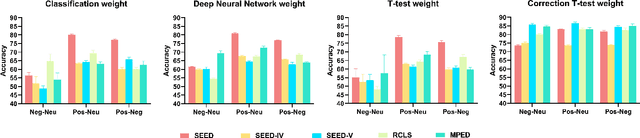
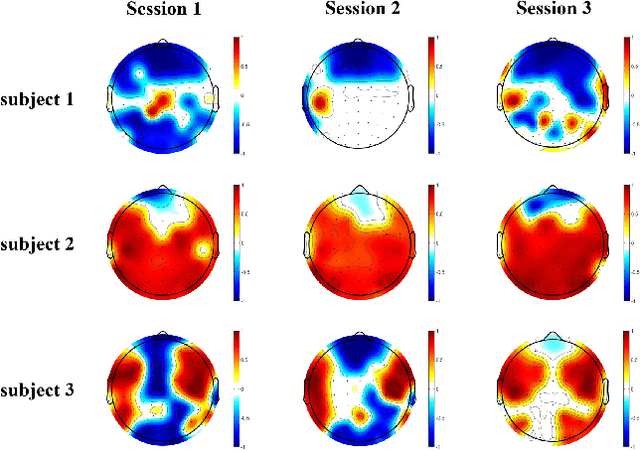
Cross-dataset emotion recognition as an extremely challenging task in the field of EEG-based affective computing is influenced by many factors, which make the universal models yield unsatisfactory results. Facing the situation that lack of EEG information decoding researches, we first analyzed the impact of different EEG information(individual, session, emotion, trial) to emotion recognition by sample space visualization, sample aggregation phenomenon quantification, and energy pattern analysis on five public datasets. And based on these phenomena and patterns, we provided the processing methods and interpretable work of various EEG differences. Through the analysis of emotional feature distribution patterns, Individual Emotional Feature Distribution Difference(IEFDD) was found. After analyzing the limitations of traditional modeling approach suffering from IEFDD, we proposed the Weight-based Channel-model Matrix Framework(WCMF). In order to characterize emotional feature distribution patterns reasonably, four weight extraction methods were designed, and the optimal of them is Correction T-test(CT) weight extraction method. Finally, the performance of WCMF was validated on cross-dataset tasks in two kinds of experiments that simulated different practical scenarios, the results showed WCMF had more stable and better emotion recognition ability.