 Add to Chrome
 Add to Firefox
 Add to Edge
Trace2Policy: From Expert Behavior Traces to Self-Evolving Decision Agents
Jun 09, 2026
Decision rules that enterprise experts apply tacitly -- in auditing, compliance, and contract review -- can be systematically recovered and improved through iterative error analysis. We present \textbf{Trace2Policy}, whose core mechanism -- \textbf{EISR} (\textbf{E}rror-driven \textbf{I}terative \textbf{S}kill \textbf{R}efinement) -- maintains a human-readable rule document as its optimization target: each round executes the rules on a validation set, clusters errors by root cause into MISSING, WRONG, or CONFLICT types, applies targeted patches, and commits only those that pass a regression gate. \textbf{For this class of compliance-sensitive, skewed-base-rate decision tasks, we identify rule quality -- not model capability -- as the dominant performance lever}: across five LLMs, one-shot distillation plateaus near $\sim$70\% on the deployed pool, while eight EISR rounds lift the same rules to 79.6\% when compiled into deterministic Python -- zero LLM calls at inference. \textbf{Execution form compounds the gain: in production, the same EISR-refined content runs 9.8~pp higher as compiled Python than as an LLM prompt, a form-and-engineering bundle the 22-day deployment matured together.} Deployed for 22 days at a major logistics carrier (3,349 audit cases), the compiled pipeline outperforms the pure-LLM baseline it replaced (72.7\%); on these calibrated, skewed-base-rate workloads, re-enabling LLM fallback monotonically degrades accuracy. An LLM-driven variant, \textbf{Auto-EISR}, reproduces this refinement at \$5--\$10 per cycle versus $\sim$70 expert-hours, and transfers to four public benchmarks spanning legal reasoning (LegalBench) and process-mining decisions (BPIC 2012) without re-engineering.

Collaborative Attention Memory Network for Video Object Segmentation
May 23, 2022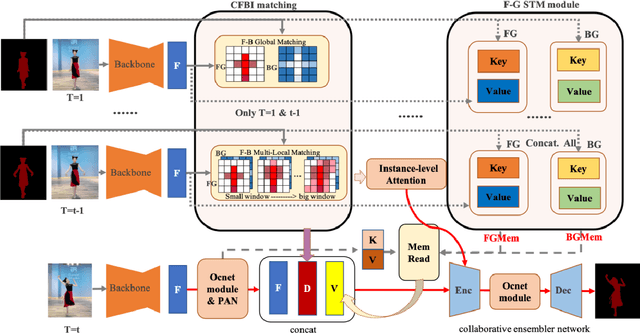
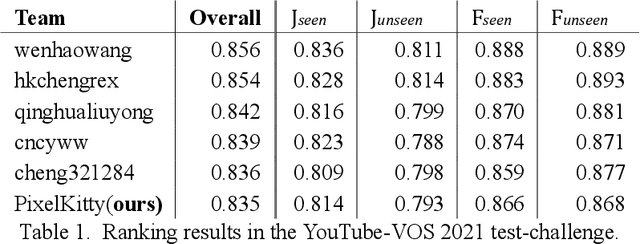
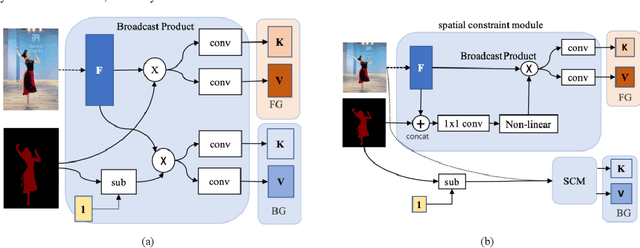
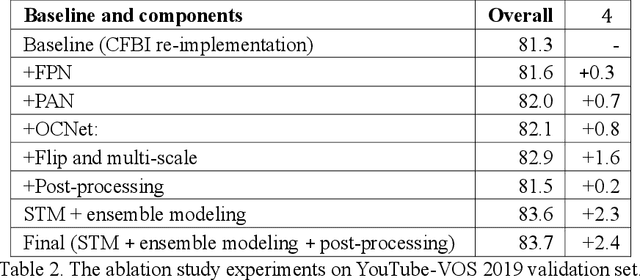
Semi-supervised video object segmentation is a fundamental yet Challenging task in computer vision. Embedding matching based CFBI series networks have achieved promising results by foreground-background integration approach. Despite its superior performance, these works exhibit distinct shortcomings, especially the false predictions caused by little appearance instances in first frame, even they could easily be recognized by previous frame. Moreover, they suffer from object's occlusion and error drifts. In order to overcome the shortcomings , we propose Collaborative Attention Memory Network with an enhanced segmentation head. We introduce a object context scheme that explicitly enhances the object information, which aims at only gathering the pixels that belong to the same category as a given pixel as its context. Additionally, a segmentation head with Feature Pyramid Attention(FPA) module is adopted to perform spatial pyramid attention structure on high-level output. Furthermore, we propose an ensemble network to combine STM network with all these new refined CFBI network. Finally, we evaluated our approach on the 2021 Youtube-VOS challenge where we obtain 6th place with an overall score of 83.5\%.