 Add to Chrome
 Add to Firefox
 Add to Edge
Clinical Risk-Aware Multi-Level Grading for Coronary Artery Stenosis through Curved Feature Reconstruction
Jun 29, 2026
Developing a multi-level grading model for coronary artery stenosis holds great clinical significance for the diagnosis of coronary artery disease. However, designing an effective multi-level deep learning algorithm faces significant challenges. Specifically, utilizing CCTA or 3D SCPR images alone presents inherent shortcomings: CCTA images are difficult to analyze due to the tortuous paths of blood vessels, while 3D SCPR images are prone to abnormal distortions that hinder accurate grading. Furthermore, different stenosis grades are associated with varying clinical risks, and incorporating this association into the algorithm is non-trivial. To address the former problems, we propose the Curved Feature Reconstruction (CFR) module, which uses vessel curves as prior and employs a point-by-point correspondence strategy to precisely align and fuse features from both 3D SCPR and CCTA images. Meanwhile, a Clinical Risk-Aware (CR) Loss is employed to introduce clinical risk relevance into the network training so that the algorithm can better align with the clinical diagnosis. The experimental results on a in-house dataset reveal that our approach significantly outperforms other methods, and several ablation studies also demonstrate the effectiveness of our proposed designs.

Generative Dataset Distillation Based on Diffusion Model
Aug 16, 2024
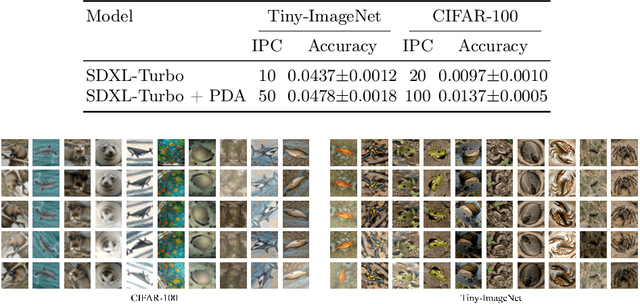
This paper presents our method for the generative track of The First Dataset Distillation Challenge at ECCV 2024. Since the diffusion model has become the mainstay of generative models because of its high-quality generative effects, we focus on distillation methods based on the diffusion model. Considering that the track can only generate a fixed number of images in 10 minutes using a generative model for CIFAR-100 and Tiny-ImageNet datasets, we need to use a generative model that can generate images at high speed. In this study, we proposed a novel generative dataset distillation method based on Stable Diffusion. Specifically, we use the SDXL-Turbo model which can generate images at high speed and quality. Compared to other diffusion models that can only generate images per class (IPC) = 1, our method can achieve an IPC = 10 for Tiny-ImageNet and an IPC = 20 for CIFAR-100, respectively. Additionally, to generate high-quality distilled datasets for CIFAR-100 and Tiny-ImageNet, we use the class information as text prompts and post data augmentation for the SDXL-Turbo model. Experimental results show the effectiveness of the proposed method, and we achieved third place in the generative track of the ECCV 2024 DD Challenge. Codes are available at https://github.com/Guang000/BANKO.
D$^4$M: Dataset Distillation via Disentangled Diffusion Model
Jul 21, 2024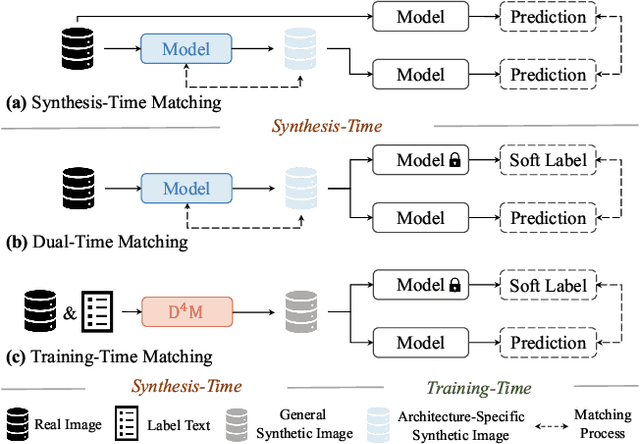
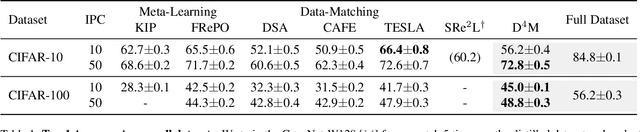
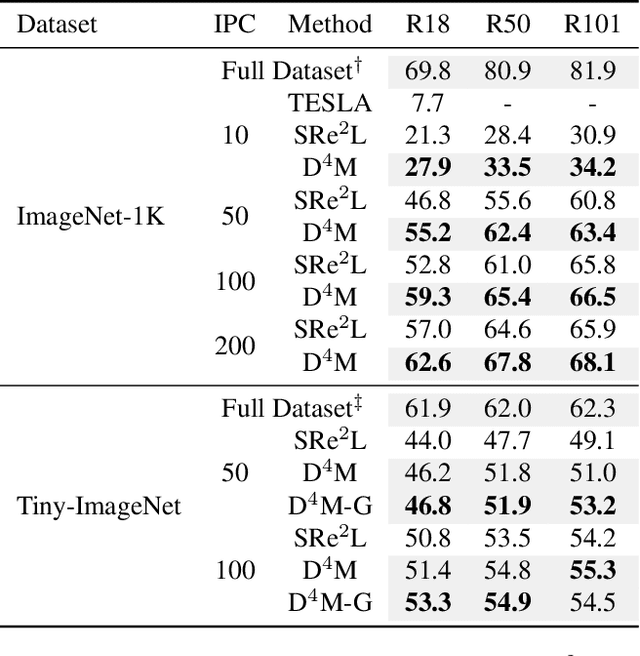
Dataset distillation offers a lightweight synthetic dataset for fast network training with promising test accuracy. To imitate the performance of the original dataset, most approaches employ bi-level optimization and the distillation space relies on the matching architecture. Nevertheless, these approaches either suffer significant computational costs on large-scale datasets or experience performance decline on cross-architectures. We advocate for designing an economical dataset distillation framework that is independent of the matching architectures. With empirical observations, we argue that constraining the consistency of the real and synthetic image spaces will enhance the cross-architecture generalization. Motivated by this, we introduce Dataset Distillation via Disentangled Diffusion Model (D$^4$M), an efficient framework for dataset distillation. Compared to architecture-dependent methods, D$^4$M employs latent diffusion model to guarantee consistency and incorporates label information into category prototypes. The distilled datasets are versatile, eliminating the need for repeated generation of distinct datasets for various architectures. Through comprehensive experiments, D$^4$M demonstrates superior performance and robust generalization, surpassing the SOTA methods across most aspects.