 Add to Chrome
 Add to Firefox
 Add to Edge
RLDX-1 Technical Report
May 05, 2026
While Vision-Language-Action models (VLAs) have shown remarkable progress toward human-like generalist robotic policies through the versatile intelligence (i.e. broad scene understanding and language-conditioned generalization) inherited from pre-trained Vision-Language Models, they still struggle with complex real-world tasks requiring broader functional capabilities (e.g. motion awareness, memory-aware decision making, and physical sensing). To address this, we introduce RLDX-1, a general-purpose robotic policy for dexterous manipulation built on the Multi-Stream Action Transformer (MSAT), an architecture that unifies these capabilities by integrating heterogeneous modalities through modality-specific streams with cross-modal joint self-attention. RLDX-1 further combines this architecture with system-level design choices, including synthesizing training data for rare manipulation scenarios, learning procedures specialized for human-like manipulation, and inference optimizations for real-time deployment. Through empirical evaluation, we show that RLDX-1 consistently outperforms recent frontier VLAs (e.g. $π_{0.5}$ and GR00T N1.6) across both simulation benchmarks and real-world tasks that require broad functional capabilities beyond general versatility. In particular, RLDX-1 shows superiority in ALLEX humanoid tasks by achieving success rates of 86.8% while $π_{0.5}$ and GR00T N1.6 achieve around 40%, highlighting the ability of RLDX-1 to control a high-DoF humanoid robot under diverse functional demands. Together, these results position RLDX-1 as a promising step toward reliable VLAs for complex, contact-rich, and dynamic real-world dexterous manipulation.

Solution for SMART-101 Challenge of CVPR Multi-modal Algorithmic Reasoning Task 2024
Jun 10, 2024
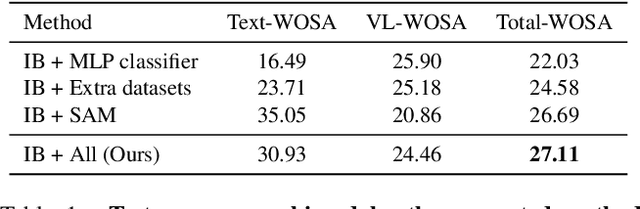

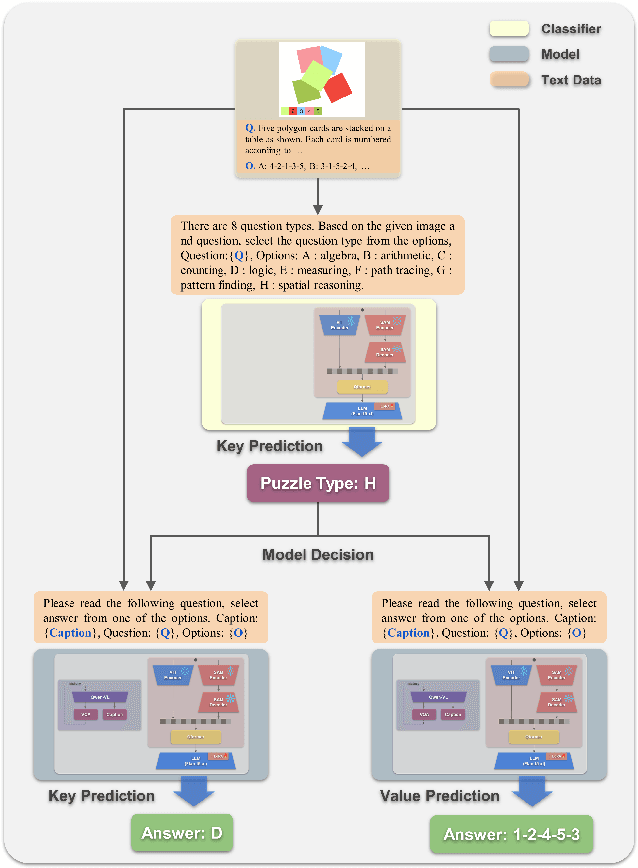
In this paper, the solution of HYU MLLAB KT Team to the Multimodal Algorithmic Reasoning Task: SMART-101 CVPR 2024 Challenge is presented. Beyond conventional visual question-answering problems, the SMART-101 challenge aims to achieve human-level multimodal understanding by tackling complex visio-linguistic puzzles designed for children in the 6-8 age group. To solve this problem, we suggest two main ideas. First, to utilize the reasoning ability of a large-scale language model (LLM), the given visual cues (images) are grounded in the text modality. For this purpose, we generate highly detailed text captions that describe the context of the image and use these captions as input for the LLM. Second, due to the nature of puzzle images, which often contain various geometric visual patterns, we utilize an object detection algorithm to ensure these patterns are not overlooked in the captioning process. We employed the SAM algorithm, which can detect various-size objects, to capture the visual features of these geometric patterns and used this information as input for the LLM. Under the puzzle split configuration, we achieved an option selection accuracy Oacc of 29.5 on the test set and a weighted option selection accuracy (WOSA) of 27.1 on the challenge set.
Towards Calibrated Robust Fine-Tuning of Vision-Language Models
Nov 06, 2023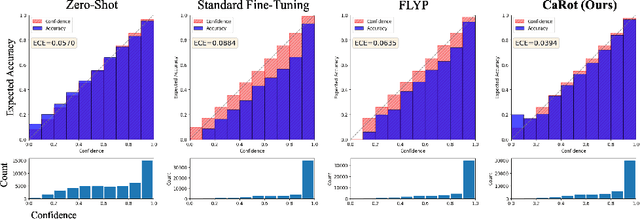
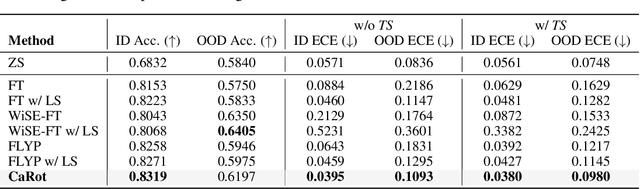
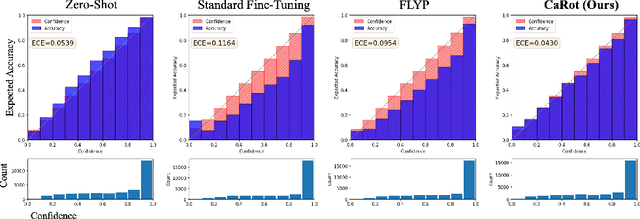
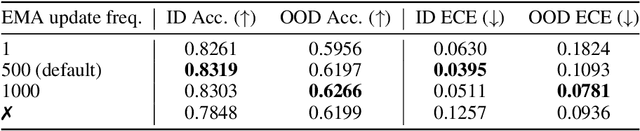
While fine-tuning unlocks the potential of a pre-trained model for a specific task, it compromises the model's ability to generalize to out-of-distribution (OOD) datasets. To mitigate this, robust fine-tuning aims to ensure performance on OOD datasets as well as on an in-distribution (ID) dataset for which the model is being tuned. However, another criterion for reliable machine learning (ML), confidence calibration, has been overlooked despite its increasing demand for real-world high-stakes ML applications (e.g., autonomous driving and medical diagnosis). For the first time, we raise concerns about the calibration of fine-tuned vision-language models (VLMs) under distribution shift by showing that naive fine-tuning and even state-of-the-art robust fine-tuning methods hurt the calibration of pre-trained VLMs, especially on OOD datasets. To address this issue, we provide a simple approach, called calibrated robust fine-tuning (CaRot), that incentivizes calibration and robustness on both ID and OOD datasets. Empirical results on ImageNet-1K distribution shift evaluation verify the effectiveness of our method.