 Add to Chrome
 Add to Firefox
 Add to Edge
MAR: Efficient Large Language Models via Module-aware Architecture Refinement
Jan 29, 2026
Large Language Models (LLMs) excel across diverse domains but suffer from high energy costs due to quadratic attention and dense Feed-Forward Network (FFN) operations. To address these issues, we propose Module-aware Architecture Refinement (MAR), a two-stage framework that integrates State Space Models (SSMs) for linear-time sequence modeling and applies activation sparsification to reduce FFN costs. In addition, to mitigate low information density and temporal mismatch in integrating Spiking Neural Networks (SNNs) with SSMs, we design the Adaptive Ternary Multi-step Neuron (ATMN) and the Spike-aware Bidirectional Distillation Strategy (SBDS). Extensive experiments demonstrate that MAR effectively restores the performance of its dense counterpart under constrained resources while substantially reducing inference energy consumption. Furthermore, it outperforms efficient models of comparable or even larger scale, underscoring its potential for building efficient and practical LLMs.

Temporal-Guided Visual Foundation Models for Event-Based Vision
Nov 09, 2025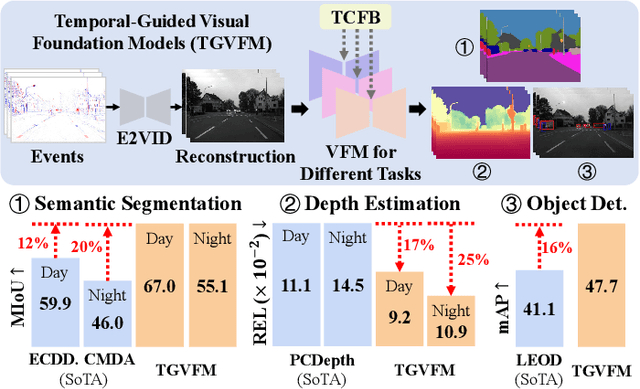
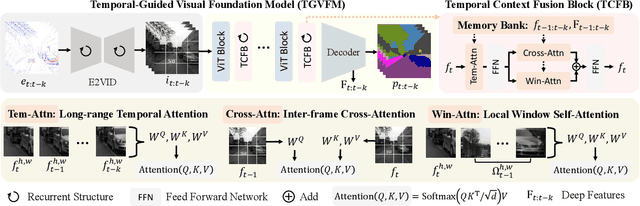
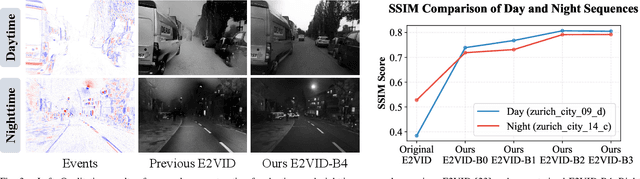
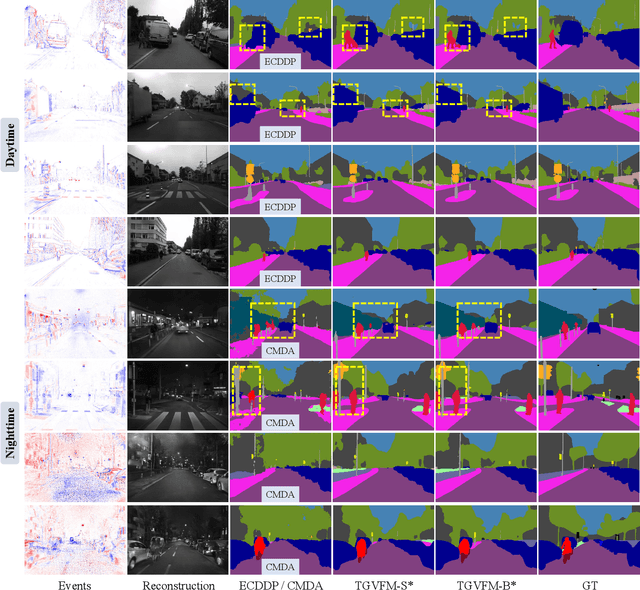
Event cameras offer unique advantages for vision tasks in challenging environments, yet processing asynchronous event streams remains an open challenge. While existing methods rely on specialized architectures or resource-intensive training, the potential of leveraging modern Visual Foundation Models (VFMs) pretrained on image data remains under-explored for event-based vision. To address this, we propose Temporal-Guided VFM (TGVFM), a novel framework that integrates VFMs with our temporal context fusion block seamlessly to bridge this gap. Our temporal block introduces three key components: (1) Long-Range Temporal Attention to model global temporal dependencies, (2) Dual Spatiotemporal Attention for multi-scale frame correlation, and (3) Deep Feature Guidance Mechanism to fuse semantic-temporal features. By retraining event-to-video models on real-world data and leveraging transformer-based VFMs, TGVFM preserves spatiotemporal dynamics while harnessing pretrained representations. Experiments demonstrate SoTA performance across semantic segmentation, depth estimation, and object detection, with improvements of 16%, 21%, and 16% over existing methods, respectively. Overall, this work unlocks the cross-modality potential of image-based VFMs for event-based vision with temporal reasoning. Code is available at https://github.com/XiaRho/TGVFM.