 Add to Chrome
 Add to Firefox
 Add to Edge
Agentic LLM Reasoning in a Self-Driving Laboratory for Air-Sensitive Lithium Halide Spinel Conductors
Apr 13, 2026
Self-driving laboratories promise to accelerate materials discovery. Yet current automated solid-state synthesis platforms are limited to ambient conditions, thereby precluding their use for air-sensitive materials. Here, we present A-Lab for Glovebox Powder Solid-state Synthesis (A-Lab GPSS), a robotic platform capable of synthesizing and characterizing air-sensitive inorganic materials under strict air-free conditions. By integrating an agentic AI framework into the A-Lab GPSS platform, we structure autonomous experimental design through abductive and inductive reasoning. We deploy this platform to explore the vast compositional space of lithium halide spinel solid-state ionic conductors. Across a synthesis campaign comprising 352 samples with diverse compositions, the system explores a broad chemical space, experimentally realizing 72% of the 171 possible pairwise combinations among the 19 metals considered in this study. Over the course of the campaign, the fraction of compositions exhibiting both good ionic conductivity (> 0.05 mS/cm) and high halide spinel phase purity increases from 1.33% in the first 75 agent-proposed samples to 5.33% in the final 75. Furthermore, by inspecting the AI's reasoning processes, we reveal distinct yet complementary discovery strategies: abductive reasoning interrogates abnormal observations within already explored regions, whereas inductive reasoning expands the search into broader, previously unvisited chemical space. This work establishes a scalable platform for the autonomous discovery of complex, air-sensitive solid-state materials.

AlabOS: A Python-based Reconfigurable Workflow Management Framework for Autonomous Laboratories
May 22, 2024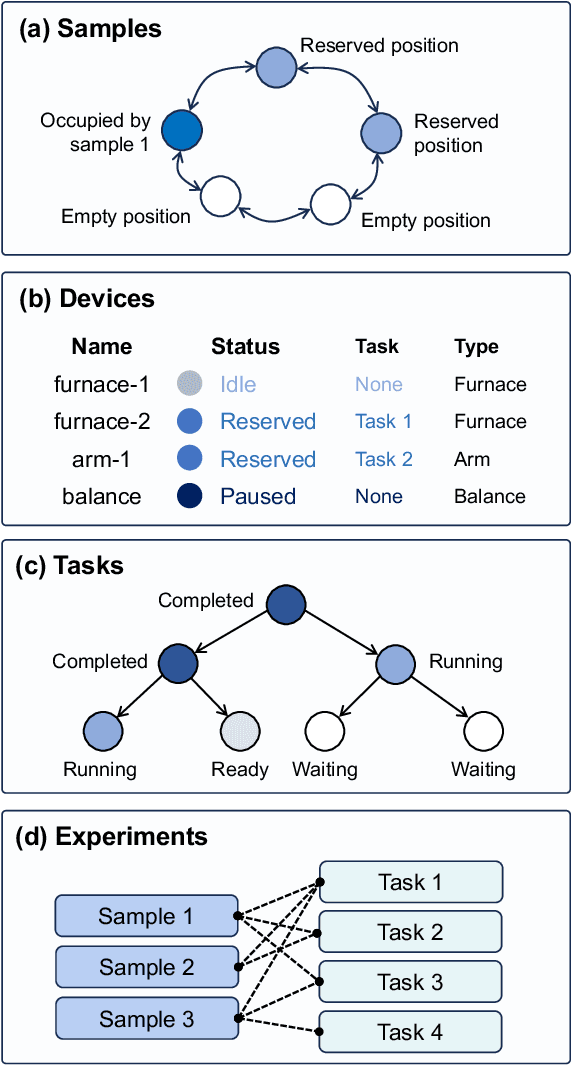
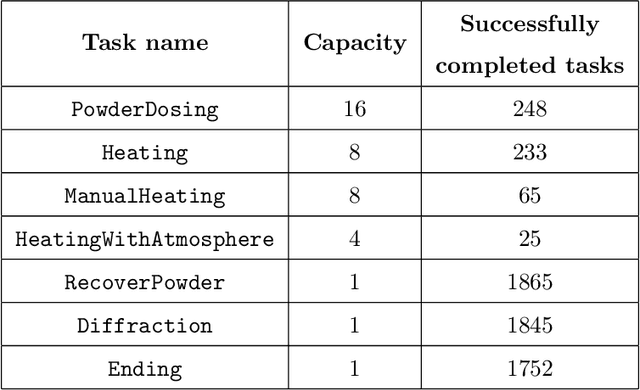
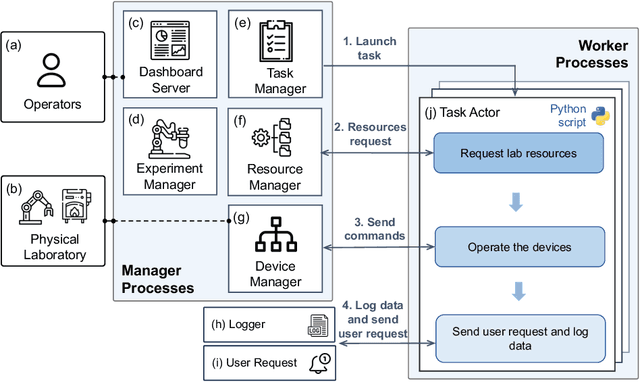
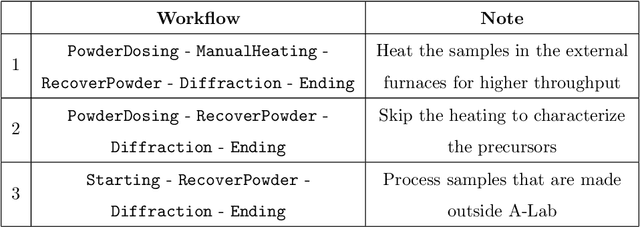
The recent advent of autonomous laboratories, coupled with algorithms for high-throughput screening and active learning, promises to accelerate materials discovery and innovation. As these autonomous systems grow in complexity, the demand for robust and efficient workflow management software becomes increasingly critical. In this paper, we introduce AlabOS, a general-purpose software framework for orchestrating experiments and managing resources, with an emphasis on automated laboratories for materials synthesis and characterization. We demonstrate the implementation of AlabOS in a prototype autonomous materials laboratory. AlabOS features a reconfigurable experiment workflow model, enabling the simultaneous execution of varied workflows composed of modular tasks. Therefore, AlabOS is well-suited to handle the rapidly changing experimental protocols defining the progress of self-driving laboratory development for materials research.