 Add to Chrome
 Add to Firefox
 Add to Edge
TaoLive Digital Avatar Agent Technical Report: Training Agents to Evolve with Their Harness
Aug 16, 2026
AI-powered digital-avatar streamers in live e-commerce must answer product questions, engage viewers, and execute changing business strategies in real time. This requires low latency, factual and effective replies, and rapid adaptation to updated campaign, compliance, and style requirements. We develop an evolvable Harness that decouples Skills, Hooks, system prompts, and tools from model weights, allowing runtime behavior to change without retraining. However, Harness evolution creates a moving execution environment: compact models fine-tuned on one configuration may memorize names, schemas, and prompt templates rather than follow the Harness currently provided, while stronger zero-shot models are too slow for real-time use. We address this tension with Harness-Aware Training (HAT), which makes Harness states part of the training distribution. HAT applies task-preserving Harness-State Augmentation (HSA) to Skills, tool schemas, prompt structures, and interaction constraints, and comprises three stages: HSA-based supervised fine-tuning, general on-policy distillation to recover general capabilities, and HSA-based agentic reinforcement learning in a production-informed live-room simulator. Across four evaluation sets with more than 4,500 cases, our compact 35B model scores 94.8 on real-world Live-Stream QA, versus 80.3 for the base model and 93.0 for the strongest evaluated general LLM, while scoring 94.6 on Harness-Variant QA and retaining 83.5 on IFEval. By contrast, fixed-Harness SFT reduces IFEval by 7.7 points. In a controlled complete-agent replay on one NVIDIA H20 GPU with MTP enabled, the system achieves 3.407 s P50 and 8.114 s P95 latency. These results show that HAT produces a latency-feasible compact agent that remains effective under evaluated Harness changes without sacrificing general instruction following.

PACE: A Playback-Aligned Context Engine for LLM-Based Full-Duplex Voice Dialogue
Aug 07, 2026LLM-based full-duplex voice services allow users to speak while the assistant is responding. Because servers can generate output and advance dialogue state faster than clients can play it, subsequent user speech may be interpreted based on content the user never heard. We call this failure Generative Context Mis-anchoring (GCM). To address GCM issues, we present PACE, a provider-independent middleware layer that anchors model-facing context to the client playback boundary, a system-observable proxy for what the user could have heard. After an interruption, PACE repairs this context to exclude assistant content that never reached playback, while preserving low-latency generation across heterogeneous voice runtimes. We implement PACE's audio-only projection path end to end in a browser-based realtime voice assistant using a black-box speech model, without modifying the model service. We also construct GCM-Bench, a new controlled benchmark dataset of 108 playback-relative referent-anchoring cases. On GCM-Bench, PACE raises Referent Anchoring Accuracy from 25.0% to 96.3% over a cancellation-only baseline. On 200 Full-Duplex-Bench v1 interruption samples, it preserves interruption response quality. These results show that grounding model-facing context in actual playback is a practical way to maintain consistency in full-duplex voice dialogue.
TaoMate: Anchor-Guided Memory Bridging Evolving and Reference States for Real-Time Audio-Video Digital Human Generation
Jul 27, 2026Real-time long-form digital-human generation relies on causal models to extend audio-visual content while preserving subject appearance and audio-video synchronization across successive segments. A bounded cache retains local motion and phonetic context but discards older evidence, whereas attending to the complete generated history is computationally expensive and can propagate accumulated errors. We present \method, an anchor-guided persistent-memory framework for few-step joint audio-video generation. The framework preserves an immutable visual anchor, compresses completed video and audio blocks into fixed-capacity dynamic states, and retrieves those states through modality-specific residual attention without extending the active cache. A reference-aware modulation method additionally conditions video features on dynamic and anchor appearance statistics. Anchor-preserving causal-context distillation varies rollout horizon, prefix provenance, and cache-history reliability while keeping the immutable visual anchor unperturbed. By separating persistent memory from stage-local denoising dependencies, \method further admits stage-parallel execution across blocks, accelerating autoregressive inference without pipeline-specific retraining. We evaluate long-form video continuations with appearance, temporal, synchronization, facial, and speech diagnostics. Results show that \method preserves stable appearance across prompt-conditioned segments and strong audio-visual synchronization under autoregressive generation. Our project page is https://taoliveaigc.github.io/TaoMate.
AptAvatar: Fast and Vivid Long-Form Audio-Driven Video Generation for Production-Ready Avatars
Jul 27, 2026Production-ready audio-driven avatar generation requires efficient inference without sacrificing fidelity or motion expressiveness. However, existing acceleration methods often compromise quality through restrictive architectural choices, such as causal attention and short temporal horizons, or by reducing model capacity and resolution. Without such compromises, we propose AptAvatar, a 14B-parameter long-form audio-driven avatar generation framework that delivers fast and expressive inference. For efficiency in production-level applications, AptAvatar addresses the extreme two-step generation challenge. To bridge the gap between the multi-step teacher model and the two-step student model, we introduce Endpoint-Anchored Distribution Distillation. It augments vanilla distribution matching with a dedicated Anchor Score Estimator trained on the trajectory-endpoint distribution defined from a frozen pretrained 4-step bridge generator. This provides an attainable endpoint-level anchor for the evolving two-step student. To improve long-horizon consistency, we further introduce Self-Generated History Replay, which reuses cached outputs from earlier generator checkpoints as history conditions during chunk-wise training. This approximates inference-time conditioning on self-generated histories without costly online rollouts, mitigating quality degradation from accumulated history errors. Extensive experiments demonstrate that AptAvatar generates vivid 720p long-form avatar videos with only 2 NFEs, achieving a 60x speedup while preserving visual fidelity and long-horizon identity. Code is available at https://github.com/TaoLiveAIGC/AptAvatar
CoInteract: Physically-Consistent Human-Object Interaction Video Synthesis via Spatially-Structured Co-Generation
Apr 21, 2026Synthesizing human--object interaction (HOI) videos has broad practical value in e-commerce, digital advertising, and virtual marketing. However, current diffusion models, despite their photorealistic rendering capability, still frequently fail on (i) the structural stability of sensitive regions such as hands and faces and (ii) physically plausible contact (e.g., avoiding hand--object interpenetration). We present CoInteract, an end-to-end framework for HOI video synthesis conditioned on a person reference image, a product reference image, text prompts, and speech audio. CoInteract introduces two complementary designs embedded into a Diffusion Transformer (DiT) backbone. First, we propose a Human-Aware Mixture-of-Experts (MoE) that routes tokens to lightweight, region-specialized experts via spatially supervised routing, improving fine-grained structural fidelity with minimal parameter overhead. Second, we propose Spatially-Structured Co-Generation, a dual-stream training paradigm that jointly models an RGB appearance stream and an auxiliary HOI structure stream to inject interaction geometry priors. During training, the HOI stream attends to RGB tokens and its supervision regularizes shared backbone weights; at inference, the HOI branch is removed for zero-overhead RGB generation. Experimental results demonstrate that CoInteract significantly outperforms existing methods in structural stability, logical consistency, and interaction realism.
Attention Grounded Enhancement for Visual Document Retrieval
Nov 17, 2025Visual document retrieval requires understanding heterogeneous and multi-modal content to satisfy information needs. Recent advances use screenshot-based document encoding with fine-grained late interaction, significantly improving retrieval performance. However, retrievers are still trained with coarse global relevance labels, without revealing which regions support the match. As a result, retrievers tend to rely on surface-level cues and struggle to capture implicit semantic connections, hindering their ability to handle non-extractive queries. To alleviate this problem, we propose a \textbf{A}ttention-\textbf{G}rounded \textbf{RE}triever \textbf{E}nhancement (AGREE) framework. AGREE leverages cross-modal attention from multimodal large language models as proxy local supervision to guide the identification of relevant document regions. During training, AGREE combines local signals with the global signals to jointly optimize the retriever, enabling it to learn not only whether documents match, but also which content drives relevance. Experiments on the challenging ViDoRe V2 benchmark show that AGREE significantly outperforms the global-supervision-only baseline. Quantitative and qualitative analyses further demonstrate that AGREE promotes deeper alignment between query terms and document regions, moving beyond surface-level matching toward more accurate and interpretable retrieval. Our code is available at: https://anonymous.4open.science/r/AGREE-2025.
LiveThinking: Enabling Real-Time Efficient Reasoning for AI-Powered Livestreaming via Reinforcement Learning
Oct 09, 2025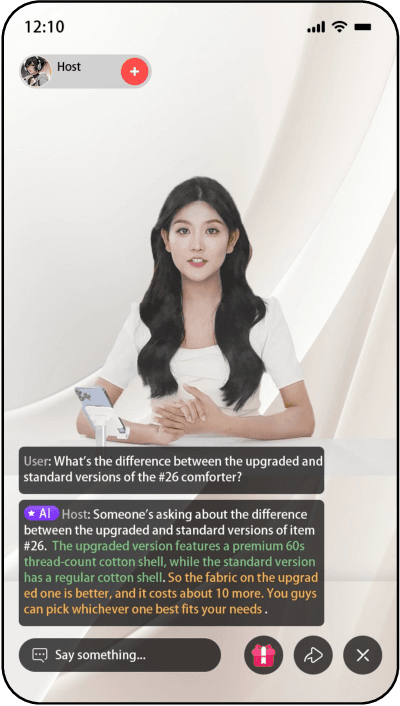
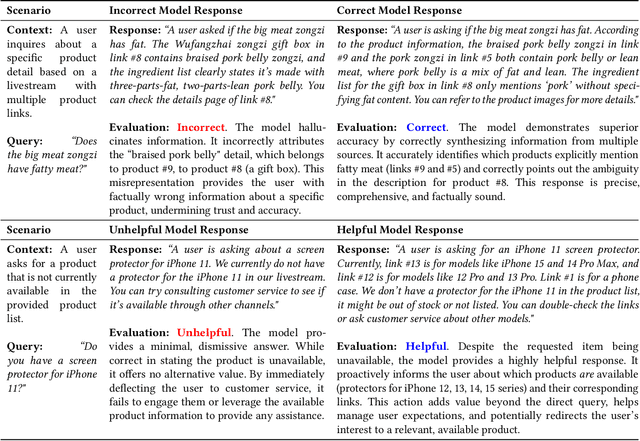
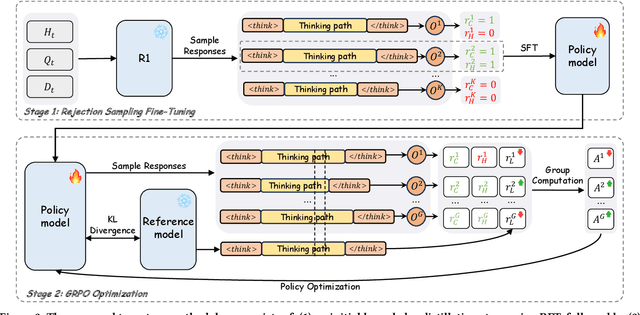
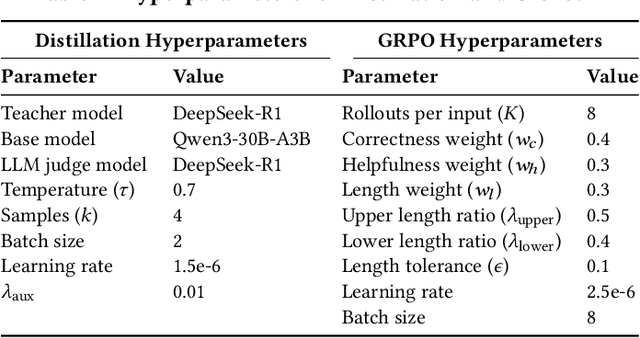
In AI-powered e-commerce livestreaming, digital avatars require real-time responses to drive engagement, a task for which high-latency Large Reasoning Models (LRMs) are ill-suited. We introduce LiveThinking, a practical two-stage optimization framework to bridge this gap. First, we address computational cost by distilling a 670B teacher LRM into a lightweight 30B Mixture-of-Experts (MoE) model (3B active) using Rejection Sampling Fine-Tuning (RFT). This reduces deployment overhead but preserves the teacher's verbose reasoning, causing latency. To solve this, our second stage employs reinforcement learning with Group Relative Policy Optimization (GRPO) to compress the model's reasoning path, guided by a multi-objective reward function balancing correctness, helpfulness, and brevity. LiveThinking achieves a 30-fold reduction in computational cost, enabling sub-second latency. In real-world application on Taobao Live, it improved response correctness by 3.3% and helpfulness by 21.8%. Tested by hundreds of thousands of viewers, our system led to a statistically significant increase in Gross Merchandise Volume (GMV), demonstrating its effectiveness in enhancing user experience and commercial performance in live, interactive settings.