 Add to Chrome
 Add to Firefox
 Add to Edge
Scaling Retrieval-Augmented Reasoning with Parallel Search and Explicit Merging
May 13, 2026
Deep search agents have proven effective in enhancing LLMs by retrieving external knowledge during multi-step reasoning. However, existing methods often generate a single query for retrieval at each reasoning step, limiting information coverage and introducing high noise. This may result in low signal-to-noise ratios (SNR) during search, degrading reasoning accuracy and leading to unnecessary reasoning steps. In this paper, we introduce MultiSearch, an RL-based framework that addresses these limitations through multi-query retrieval and explicit merging of retrieved information. At each reasoning step, MultiSearch generates queries from multiple perspectives and retrieves external information in parallel, expanding the scope of relevant information and mitigating the reliance on any single retrieval result. Then, the agent consolidates and refines retrieved information at the merging process, improving the SNR and ensuring more accurate reasoning. Additionally, we propose a reinforcement learning framework with a multi-process reward design to optimize agents for both multi-query retrieval and information consolidation. Extensive experiments on seven benchmarks demonstrate that MultiSearch outperforms baseline methods, enhancing the SNR of retrieval and improving reasoning performance in question-answering tasks.

Reasoning over Semantic IDs Enhances Generative Recommendation
Mar 24, 2026Recent advances in generative recommendation have leveraged pretrained LLMs by formulating sequential recommendation as autoregressive generation over a unified token space comprising language tokens and itemic identifiers, where each item is represented by a compact sequence of discrete tokens, namely Semantic IDs (SIDs). This SID-based formulation enables efficient decoding over large-scale item corpora and provides a natural interface for LLM-based recommenders to leverage rich world knowledge. Meanwhile, breakthroughs in LLM reasoning motivate reasoning-enhanced recommendation, yet effective reasoning over SIDs remains underexplored and challenging. Itemic tokens are not natively meaningful to LLMs; moreover, recommendation-oriented SID reasoning is hard to evaluate, making high-quality supervision scarce. To address these challenges, we propose SIDReasoner, a two-stage framework that elicits reasoning over SIDs by strengthening SID--language alignment to unlock transferable LLM reasoning, rather than relying on large amounts of recommendation-specific reasoning traces. Concretely, SIDReasoner first enhances SID-language alignment via multi-task training on an enriched SID-centered corpus synthesized by a stronger teacher model, grounding itemic tokens in diverse semantic and behavioral contexts. Building on this enhanced alignment, SIDReasoner further improves recommendation reasoning through outcome-driven reinforced optimization, which guides the model toward effective reasoning trajectories without requiring explicit reasoning annotations. Extensive experiments on three real-world datasets demonstrate the effectiveness of our reasoning-augmented SID-based generative recommendation. Beyond accuracy, the results highlight the broader potential of large reasoning models for generative recommendation, including improved interpretability and cross-domain generalization.
On Softmax Direct Preference Optimization for Recommendation
Jun 14, 2024
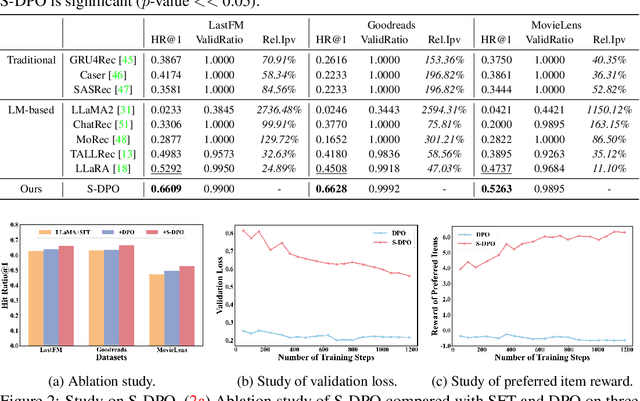
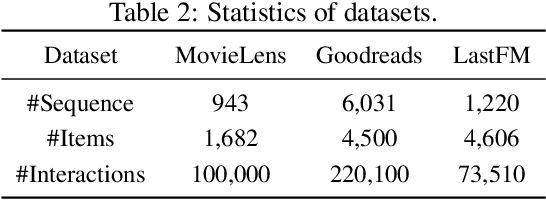
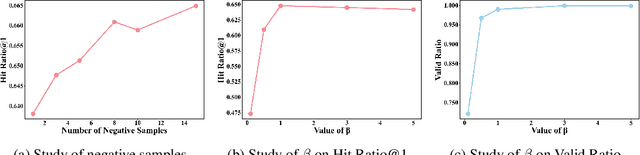
Recommender systems aim to predict personalized rankings based on user preference data. With the rise of Language Models (LMs), LM-based recommenders have been widely explored due to their extensive world knowledge and powerful reasoning abilities. Most of the LM-based recommenders convert historical interactions into language prompts, pairing with a positive item as the target response and fine-tuning LM with a language modeling loss. However, the current objective fails to fully leverage preference data and is not optimized for personalized ranking tasks, which hinders the performance of LM-based recommenders. Inspired by the current advancement of Direct Preference Optimization (DPO) in human preference alignment and the success of softmax loss in recommendations, we propose Softmax-DPO (S-DPO) to instill ranking information into the LM to help LM-based recommenders distinguish preferred items from negatives, rather than solely focusing on positives. Specifically, we incorporate multiple negatives in user preference data and devise an alternative version of DPO loss tailored for LM-based recommenders, connected to softmax sampling strategies. Theoretically, we bridge S-DPO with the softmax loss over negative sampling and find that it has a side effect of mining hard negatives, which assures its exceptional capabilities in recommendation tasks. Empirically, extensive experiments conducted on three real-world datasets demonstrate the superiority of S-DPO to effectively model user preference and further boost recommendation performance while mitigating the data likelihood decline issue of DPO. Our codes are available at https://github.com/chenyuxin1999/S-DPO.