 Add to Chrome
 Add to Firefox
 Add to Edge
Universal NER v2: Towards a Massively Multilingual Named Entity Recognition Benchmark
Apr 14, 2026
While multilingual language models promise to bring the benefits of LLMs to speakers of many languages, gold-standard evaluation benchmarks in most languages to interrogate these assumptions remain scarce. The Universal NER project, now entering its fourth year, is dedicated to building gold-standard multilingual Named Entity Recognition (NER) benchmark datasets. Inspired by existing massively multilingual efforts for other core NLP tasks (e.g., Universal Dependencies), the project uses a general tagset and thorough annotation guidelines to collect standardized, cross-lingual annotations of named entity spans. The first installment (UNER v1) was released in 2024, and the project has continued and expanded since then, with various organizers, annotators, and collaborators in an active community.

Anthropogenic Regional Adaptation in Multimodal Vision-Language Model
Apr 13, 2026While the field of vision-language (VL) has achieved remarkable success in integrating visual and textual information across multiple languages and domains, there is still no dedicated framework for assessing human-centric alignment in vision-language systems. We offer two contributions to address this gap. First, we introduce Anthropogenic Regional Adaptation: a novel paradigm that aims to optimize model relevance to specific regional contexts while ensuring the retention of global generalization capabilities. Second, we present a simple, but effective adaptation method named Geographical-generalization-made-easy (GG-EZ), which utilizes regional data filtering and model merging. Through comprehensive experiments on 3 VL architectures: large vision-language models, text-to-image diffusion models, and vision-language embedding models, and a case study in Southeast Asia (SEA) regional adaptation, we demonstrate the importance of Anthropogenic Regional Adaptation and the effectiveness of GG-EZ, showing 5-15% gains in cultural relevance metrics across SEA while maintaining over 98% of global performance and even occasionally surpassing it. Our findings establish Anthropogenic Regional Alignment as a foundational paradigm towards applicability of multimodal vision-language models in diverse regions and demonstrate a simple-yet-effective baseline method that optimizes regional value alignment while preserving global generalization.
CommonLID: Re-evaluating State-of-the-Art Language Identification Performance on Web Data
Jan 25, 2026Language identification (LID) is a fundamental step in curating multilingual corpora. However, LID models still perform poorly for many languages, especially on the noisy and heterogeneous web data often used to train multilingual language models. In this paper, we introduce CommonLID, a community-driven, human-annotated LID benchmark for the web domain, covering 109 languages. Many of the included languages have been previously under-served, making CommonLID a key resource for developing more representative high-quality text corpora. We show CommonLID's value by using it, alongside five other common evaluation sets, to test eight popular LID models. We analyse our results to situate our contribution and to provide an overview of the state of the art. In particular, we highlight that existing evaluations overestimate LID accuracy for many languages in the web domain. We make CommonLID and the code used to create it available under an open, permissive license.
Crowdsource, Crawl, or Generate? Creating SEA-VL, a Multicultural Vision-Language Dataset for Southeast Asia
Mar 10, 2025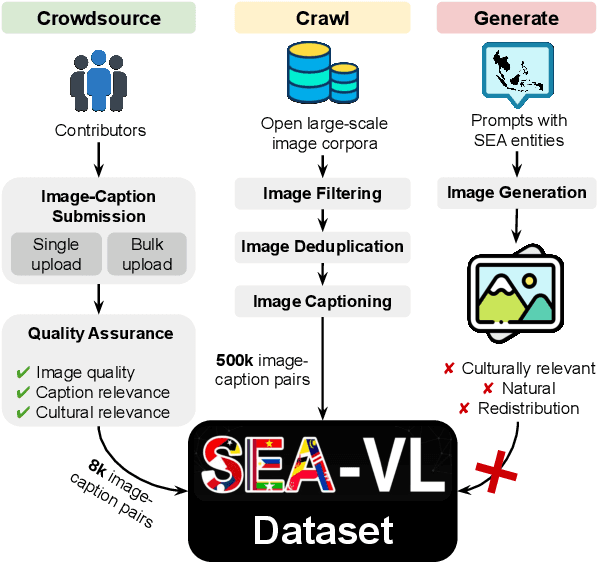
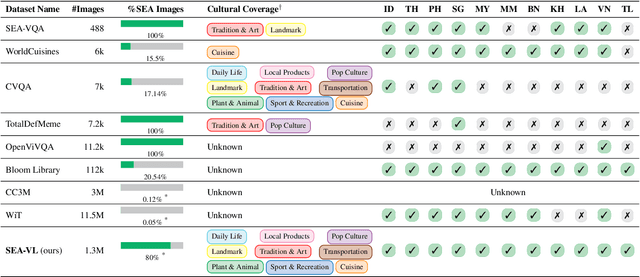
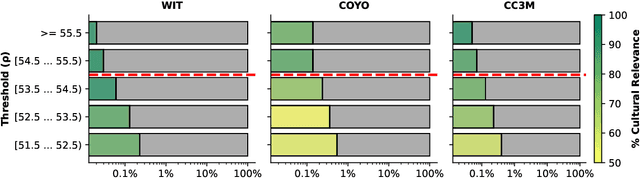
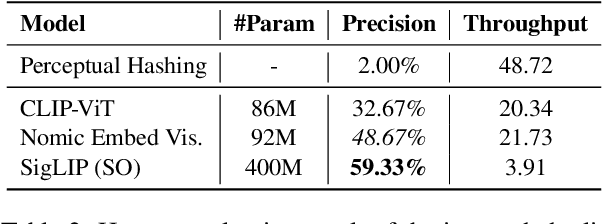
Southeast Asia (SEA) is a region of extraordinary linguistic and cultural diversity, yet it remains significantly underrepresented in vision-language (VL) research. This often results in artificial intelligence (AI) models that fail to capture SEA cultural nuances. To fill this gap, we present SEA-VL, an open-source initiative dedicated to developing high-quality, culturally relevant data for SEA languages. By involving contributors from SEA countries, SEA-VL aims to ensure better cultural relevance and diversity, fostering greater inclusivity of underrepresented languages in VL research. Beyond crowdsourcing, our initiative goes one step further in the exploration of the automatic collection of culturally relevant images through crawling and image generation. First, we find that image crawling achieves approximately ~85% cultural relevance while being more cost- and time-efficient than crowdsourcing. Second, despite the substantial progress in generative vision models, synthetic images remain unreliable in accurately reflecting SEA cultures. The generated images often fail to reflect the nuanced traditions and cultural contexts of the region. Collectively, we gather 1.28M SEA culturally-relevant images, more than 50 times larger than other existing datasets. Through SEA-VL, we aim to bridge the representation gap in SEA, fostering the development of more inclusive AI systems that authentically represent diverse cultures across SEA.
SmartLLM: Smart Contract Auditing using Custom Generative AI
Feb 17, 2025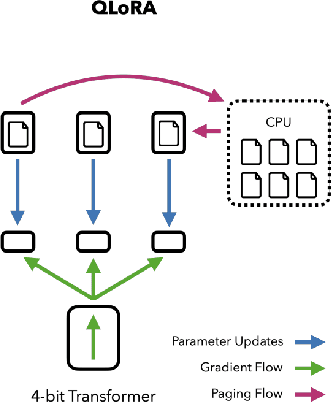
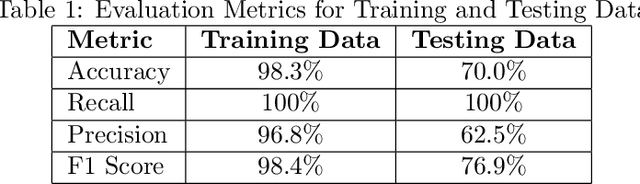
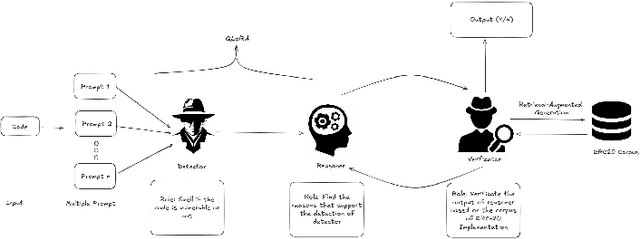
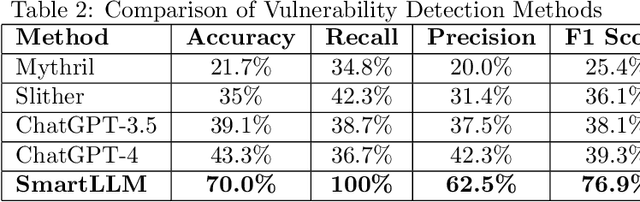
Smart contracts are essential to decentralized finance (DeFi) and blockchain ecosystems but are increasingly vulnerable to exploits due to coding errors and complex attack vectors. Traditional static analysis tools and existing vulnerability detection methods often fail to address these challenges comprehensively, leading to high false-positive rates and an inability to detect dynamic vulnerabilities. This paper introduces SmartLLM, a novel approach leveraging fine-tuned LLaMA 3.1 models with Retrieval-Augmented Generation (RAG) to enhance the accuracy and efficiency of smart contract auditing. By integrating domain-specific knowledge from ERC standards and employing advanced techniques such as QLoRA for efficient fine-tuning, SmartLLM achieves superior performance compared to static analysis tools like Mythril and Slither, as well as zero-shot large language model (LLM) prompting methods such as GPT-3.5 and GPT-4. Experimental results demonstrate a perfect recall of 100% and an accuracy score of 70%, highlighting the model's robustness in identifying vulnerabilities, including reentrancy and access control issues. This research advances smart contract security by offering a scalable and effective auditing solution, supporting the secure adoption of decentralized applications.