 Add to Chrome
 Add to Firefox
 Add to Edge
Deep Learning Estimation of Sex, Age, Height, and Weight from CT-derived Digitally Reconstructed Radiographs
Jul 21, 2026
Purpose: To develop and validate a deep learning ensemble for estimating adult sex, age, height, and weight from coronal digitally reconstructed radiographs (DRRs) generated from diagnostic CT. Materials and Methods: This retrospective study included 128,621 CT examinations from 80,004 adults at nine institutions in Japan. Three multitask models-ConvNeXt-Base, ViT-Base/16, and MaxViT-Base-were fine-tuned using coronal DRRs and combined by weighted averaging. Data were split by institution into training (114,147 examinations; seven institutions), tuning (4,305; one institution), and test (10,169; one institution) sets; generalizability was assessed on two non-Japanese datasets. Accuracy and mean absolute error (MAE) were used to evaluate sex classification and age, height, and weight regression, respectively. Body surface area (BSA)-corrected heart and liver volume trends were compared using true versus estimated height and weight. Results: In the test set (median age, 69.9 years; 4,899 of 10,169 [48.2%] male), overall sex-classification accuracy was 0.997 (95% CI, 0.996-0.998), and MAEs were 3.57 years (3.51-3.63), 2.59 cm (2.54-2.64), and 3.40 kg (3.34-3.47) for age, height, and weight, respectively. In examinations covering the chest through pelvis, accuracy was 1.000, and MAEs were 3.15 years, 2.28 cm, and 3.18 kg, respectively. BSA calculated from estimated values reproduced age-related heart and liver volume trends obtained using true values. On non-Japanese datasets, height error increased but was reduced by continued fine-tuning. Conclusion: The ensemble estimated adult sex, age, height, and weight from CT-derived DRRs, with generally lower errors in examinations with broader anatomical coverage.

A pre-training technique to localize medical BERT and enhance BioBERT
May 14, 2020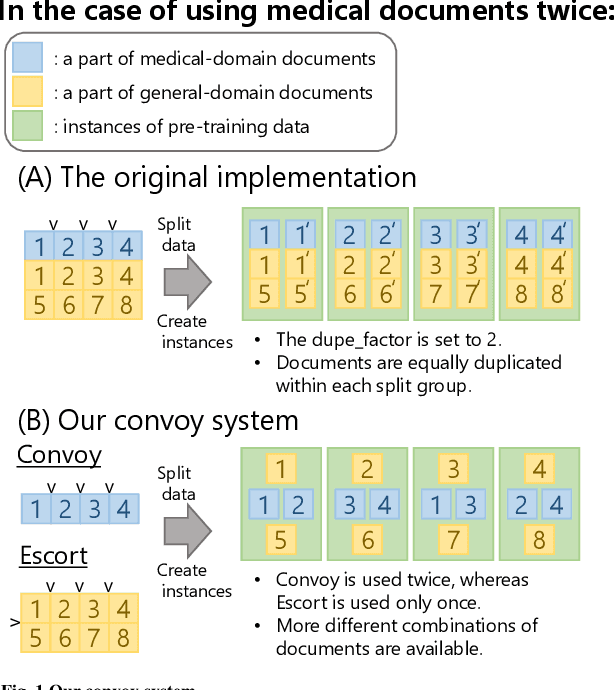
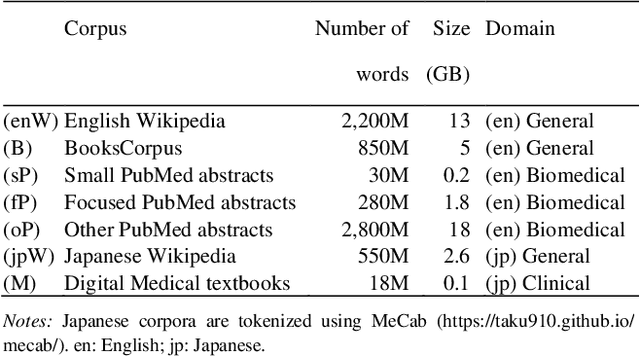
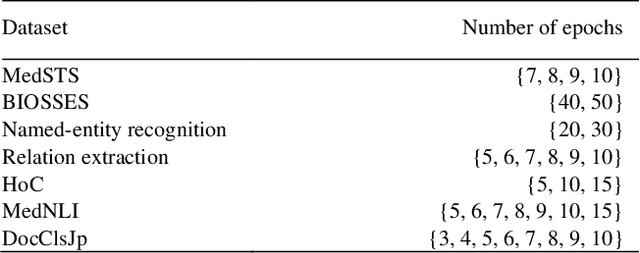
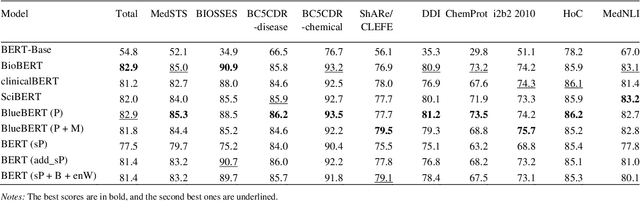
Bidirectional Encoder Representations from Transformers (BERT) models for biomedical specialties such as BioBERT and clinicalBERT have significantly improved in biomedical text-mining tasks and enabled us to extract valuable information from biomedical literature. However, we benefitted only in English because of the significant scarcity of high-quality medical documents, such as PubMed, in each language. Therefore, we propose a method that realizes a high-performance BERT model by using a small corpus. We introduce the method to train a BERT model on a small medical corpus both in English and Japanese, respectively, and then we evaluate each of them in terms of the biomedical language understanding evaluation (BLUE) benchmark and the medical-document-classification task in Japanese, respectively. After confirming their satisfactory performances, we apply our method to develop a model that outperforms the pre-existing models. Bidirectional Encoder Representations from Transformers for Biomedical Text Mining by Osaka University (ouBioBERT) achieves the best scores on 7 of the 10 datasets in terms of the BLUE benchmark. The total score is 1.0 points above that of BioBERT.