 Add to Chrome
 Add to Firefox
 Add to Edge
Deep Learning Estimation of Sex, Age, Height, and Weight from CT-derived Digitally Reconstructed Radiographs
Jul 21, 2026
Purpose: To develop and validate a deep learning ensemble for estimating adult sex, age, height, and weight from coronal digitally reconstructed radiographs (DRRs) generated from diagnostic CT. Materials and Methods: This retrospective study included 128,621 CT examinations from 80,004 adults at nine institutions in Japan. Three multitask models-ConvNeXt-Base, ViT-Base/16, and MaxViT-Base-were fine-tuned using coronal DRRs and combined by weighted averaging. Data were split by institution into training (114,147 examinations; seven institutions), tuning (4,305; one institution), and test (10,169; one institution) sets; generalizability was assessed on two non-Japanese datasets. Accuracy and mean absolute error (MAE) were used to evaluate sex classification and age, height, and weight regression, respectively. Body surface area (BSA)-corrected heart and liver volume trends were compared using true versus estimated height and weight. Results: In the test set (median age, 69.9 years; 4,899 of 10,169 [48.2%] male), overall sex-classification accuracy was 0.997 (95% CI, 0.996-0.998), and MAEs were 3.57 years (3.51-3.63), 2.59 cm (2.54-2.64), and 3.40 kg (3.34-3.47) for age, height, and weight, respectively. In examinations covering the chest through pelvis, accuracy was 1.000, and MAEs were 3.15 years, 2.28 cm, and 3.18 kg, respectively. BSA calculated from estimated values reproduced age-related heart and liver volume trends obtained using true values. On non-Japanese datasets, height error increased but was reduced by continued fine-tuning. Conclusion: The ensemble estimated adult sex, age, height, and weight from CT-derived DRRs, with generally lower errors in examinations with broader anatomical coverage.

Synthetic data generation method for hybrid image-tabular data using two generative adversarial networks
Aug 15, 2023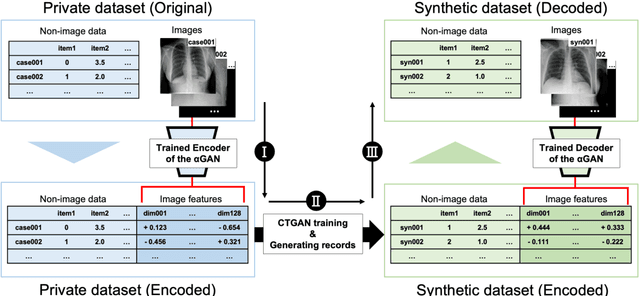

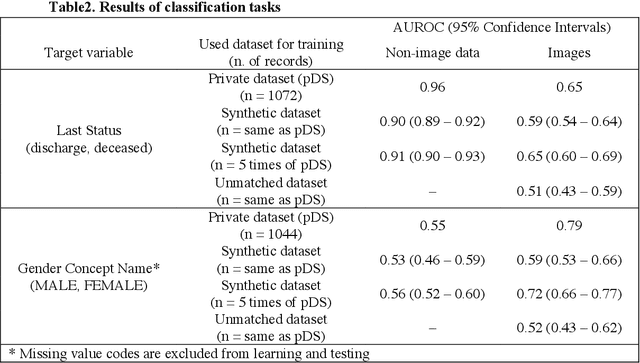
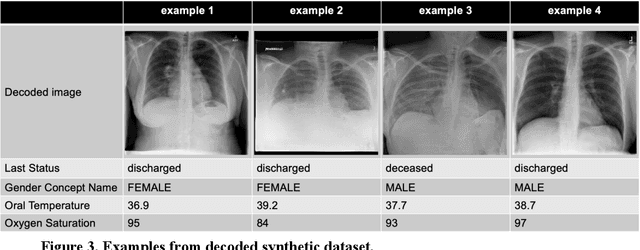
The generation of synthetic medical records using generative adversarial networks (GANs) has become increasingly important for addressing privacy concerns and promoting data sharing in the medical field. In this paper, we propose a novel method for generating synthetic hybrid medical records consisting of chest X-ray images (CXRs) and structured tabular data (including anthropometric data and laboratory tests) using an auto-encoding GAN ({\alpha}GAN) and a conditional tabular GAN (CTGAN). Our approach involves training a {\alpha}GAN model on a large public database (pDB) to reduce the dimensionality of CXRs. We then applied the trained encoder of the GAN model to the images in original database (oDB) to obtain the latent vectors. These latent vectors were combined with tabular data in oDB, and these joint data were used to train the CTGAN model. We successfully generated diverse synthetic records of hybrid CXR and tabular data, maintaining correspondence between them. We evaluated this synthetic database (sDB) through visual assessment, distribution of interrecord distances, and classification tasks. Our evaluation results showed that the sDB captured the features of the oDB while maintaining the correspondence between the images and tabular data. Although our approach relies on the availability of a large-scale pDB containing a substantial number of images with the same modality and imaging region as those in the oDB, this method has the potential for the public release of synthetic datasets without compromising the secondary use of data.