 Add to Chrome
 Add to Firefox
 Add to Edge
A Preliminary Study on Explaining Risk of Code Changes using LLM-Based Prediction Models
Jul 02, 2026
Predictions by machine learning (ML) and artificial intelligence (AI) models are often received skeptically unless they are paired with intelligible explanations. In the context of just-in-time defect prediction, highlighting small portions of a software change (diff) -- beyond rule-based lints -- where risk may be concentrated has not yet been extensively investigated. In this work, we leverage attention weights from an LLM-based Diff Risk Score (DRS) model to highlight parts of a diff that the model focuses on when predicting risk. We aggregate token-level attention into interpretable code units (lines, hunks, and files), and present the top-K units to developers as a lightweight form of guidance during code review. We evaluate our approach using expert-labeled changes that have caused real outages. Results show that the highlighted snippets cover expert-labeled outage-causing change lines 53.85% of the time when highlighting the top-2 hunks, while requiring developers to review 26.28% of the changed lines on average. Because attention is produced during standard model inference, the approach is scalable for large development workflows and can be surfaced in the code review UI with low additional latency.

Confucius Code Agent: Scalable Agent Scaffolding for Real-World Codebases
Dec 20, 2025Real-world software engineering tasks require coding agents that can operate over massive repositories, sustain long-horizon sessions, and reliably coordinate complex toolchains at test time. Existing research-grade coding agents offer transparency but struggle when scaled to heavier, production-level workloads, while production-grade systems achieve strong practical performance but provide limited extensibility, interpretability, and controllability. We introduce the Confucius Code Agent (CCA), a software engineering agent that can operate at large-scale codebases. CCA is built on top of the Confucius SDK, an agent development platform structured around three complementary perspectives: Agent Experience (AX), User Experience (UX), and Developer Experience (DX). The SDK integrates a unified orchestrator with hierarchical working memory for long-context reasoning, a persistent note-taking system for cross-session continual learning, and a modular extension system for reliable tool use. In addition, we introduce a meta-agent that automates the synthesis, evaluation, and refinement of agent configurations through a build-test-improve loop, enabling rapid adaptation to new tasks, environments, and tool stacks. Instantiated with these mechanisms, CCA demonstrates strong performance on real-world software engineering tasks. On SWE-Bench-Pro, CCA reaches a Resolve@1 of 54.3%, exceeding prior research baselines and comparing favorably to commercial results, under identical repositories, model backends, and tool access.
Rethinking Few-Shot Medical Image Segmentation by SAM2: A Training-Free Framework with Augmentative Prompting and Dynamic Matching
Mar 05, 2025
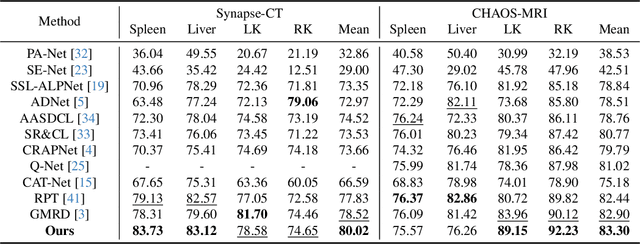
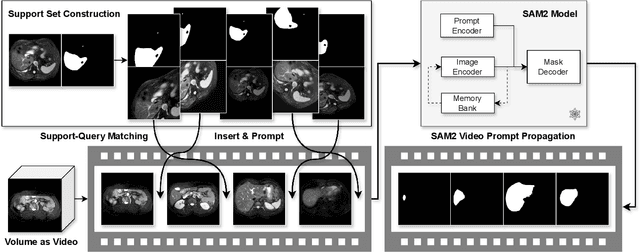
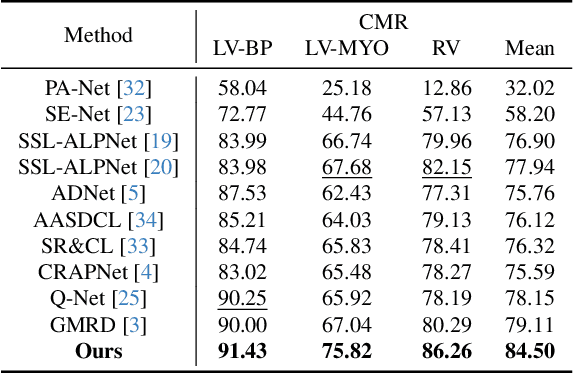
The reliance on large labeled datasets presents a significant challenge in medical image segmentation. Few-shot learning offers a potential solution, but existing methods often still require substantial training data. This paper proposes a novel approach that leverages the Segment Anything Model 2 (SAM2), a vision foundation model with strong video segmentation capabilities. We conceptualize 3D medical image volumes as video sequences, departing from the traditional slice-by-slice paradigm. Our core innovation is a support-query matching strategy: we perform extensive data augmentation on a single labeled support image and, for each frame in the query volume, algorithmically select the most analogous augmented support image. This selected image, along with its corresponding mask, is used as a mask prompt, driving SAM2's video segmentation. This approach entirely avoids model retraining or parameter updates. We demonstrate state-of-the-art performance on benchmark few-shot medical image segmentation datasets, achieving significant improvements in accuracy and annotation efficiency. This plug-and-play method offers a powerful and generalizable solution for 3D medical image segmentation.
Feature Selection Based on Orthogonal Constraints and Polygon Area
Feb 25, 2024The goal of feature selection is to choose the optimal subset of features for a recognition task by evaluating the importance of each feature, thereby achieving effective dimensionality reduction. Currently, proposed feature selection methods often overlook the discriminative dependencies between features and labels. To address this problem, this paper introduces a novel orthogonal regression model incorporating the area of a polygon. The model can intuitively capture the discriminative dependencies between features and labels. Additionally, this paper employs a hybrid non-monotone linear search method to efficiently tackle the non-convex optimization challenge posed by orthogonal constraints. Experimental results demonstrate that our approach not only effectively captures discriminative dependency information but also surpasses traditional methods in reducing feature dimensions and enhancing classification performance.