 Add to Chrome
 Add to Firefox
 Add to Edge
A single algorithm for both restless and rested rotting bandits
Apr 23, 2026
In many application domains (e.g., recommender systems, intelligent tutoring systems), the rewards associated to the actions tend to decrease over time. This decay is either caused by the actions executed in the past (e.g., a user may get bored when songs of the same genre are recommended over and over) or by an external factor (e.g., content becomes outdated). These two situations can be modeled as specific instances of the rested and restless bandit settings, where arms are rotting (i.e., their value decrease over time). These problems were thought to be significantly different, since Levine et al. (2017) showed that state-of-the-art algorithms for restless bandit perform poorly in the rested rotting setting. In this paper, we introduce a novel algorithm, Rotting Adaptive Window UCB (RAW-UCB), that achieves near-optimal regret in both rotting rested and restless bandit, without any prior knowledge of the setting (rested or restless) and the type of non-stationarity (e.g., piece-wise constant, bounded variation). This is in striking contrast with previous negative results showing that no algorithm can achieve similar results as soon as rewards are allowed to increase. We confirm our theoretical findings on a number of synthetic and dataset-based experiments.

Rotting bandits are no harder than stochastic ones
Nov 27, 2018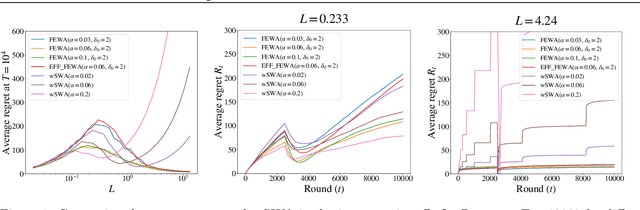
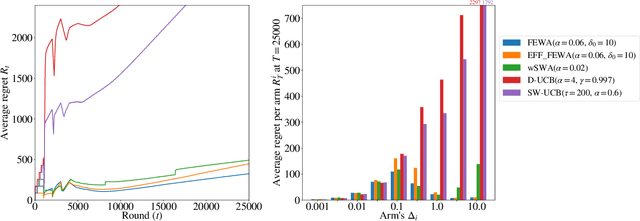
In bandits, arms' distributions are stationary. This is often violated in practice, where rewards change over time. In applications as recommendation systems, online advertising, and crowdsourcing, the changes may be triggered by the pulls, so that the arms' rewards change as a function of the number of pulls. In this paper, we consider the specific case of non-parametric rotting bandits, where the expected reward of an arm may decrease every time it is pulled. We introduce the filtering on expanding window average (FEWA) algorithm that at each round constructs moving averages of increasing windows to identify arms that are more likely to return high rewards when pulled once more. We prove that, without any knowledge on the decreasing behavior of the arms, FEWA achieves similar anytime problem-dependent, $\widetilde{\mathcal{O}}(\log{(KT)}),$ and problem-independent, $\widetilde{\mathcal{O}}(\sqrt{KT})$, regret bounds of near-optimal stochastic algorithms as UCB1 of Auer et al. (2002a). This result substantially improves the prior result of Levine et al. (2017) which needed knowledge of the horizon and decaying parameters to achieve problem-independent bound of only $\widetilde{\mathcal{O}}(K^{1/3}T^{2/3})$. Finally, we report simulations confirming the theoretical improvements of FEWA.