 Add to Chrome
 Add to Firefox
 Add to Edge
Learning is Forgetting: LLM Training As Lossy Compression
Apr 08, 2026
Despite the increasing prevalence of large language models (LLMs), we still have a limited understanding of how their representational spaces are structured. This limits our ability to interpret how and what they learn or relate them to learning in humans. We argue LLMs are best seen as an instance of lossy compression, where over training they learn by retaining only information in their training data relevant to their objective(s). We show pre-training results in models that are optimally compressed for next-sequence prediction, approaching the Information Bottleneck bound on compression. Across an array of open weights models, each compresses differently, likely due to differences in the data and training recipes used. However even across different families of LLMs the optimality of a model's compression, and the information present in it, can predict downstream performance on across a wide array of benchmarks, letting us directly link representational structure to actionable insights about model performance. In the general case the work presented here offers a unified Information-Theoretic framing for how these models learn that is deployable at scale.

Hierarchical Refinement: Optimal Transport to Infinity and Beyond
Mar 04, 2025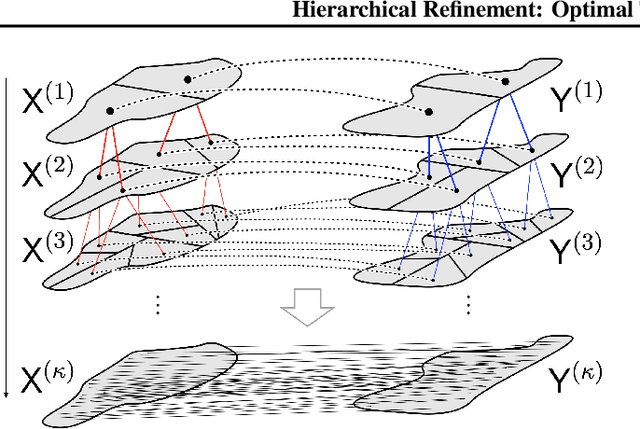
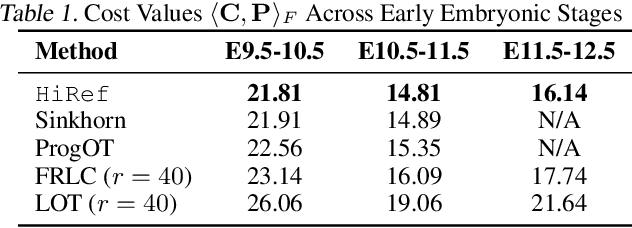
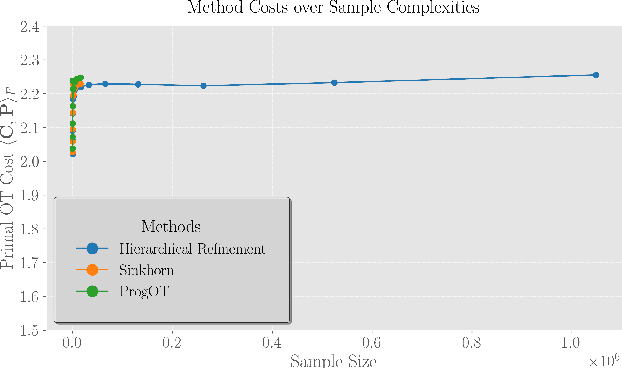
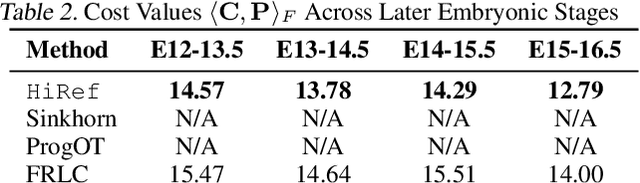
Optimal transport (OT) has enjoyed great success in machine-learning as a principled way to align datasets via a least-cost correspondence. This success was driven in large part by the runtime efficiency of the Sinkhorn algorithm [Cuturi 2013], which computes a coupling between points from two datasets. However, Sinkhorn has quadratic space complexity in the number of points, limiting the scalability to larger datasets. Low-rank OT achieves linear-space complexity, but by definition, cannot compute a one-to-one correspondence between points. When the optimal transport problem is an assignment problem between datasets then the optimal mapping, known as the Monge map, is guaranteed to be a bijection. In this setting, we show that the factors of an optimal low-rank coupling co-cluster each point with its image under the Monge map. We leverage this invariant to derive an algorithm, Hierarchical Refinement (HiRef), that dynamically constructs a multiscale partition of a dataset using low-rank OT subproblems, culminating in a bijective coupling. Hierarchical Refinement uses linear space and has log-linear runtime, retaining the space advantage of low-rank OT while overcoming its limited resolution. We demonstrate the advantages of Hierarchical Refinement on several datasets, including ones containing over a million points, scaling full-rank OT to problems previously beyond Sinkhorn's reach.
Low-Rank Optimal Transport through Factor Relaxation with Latent Coupling
Nov 15, 2024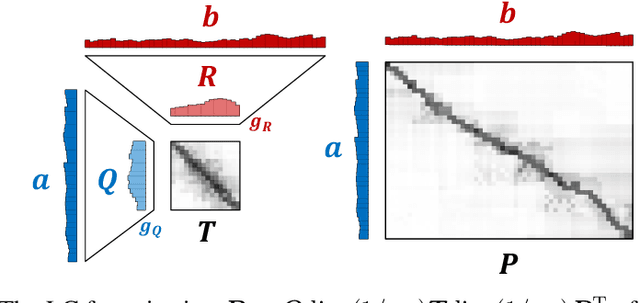
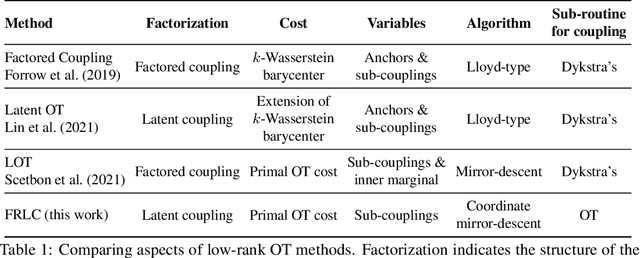
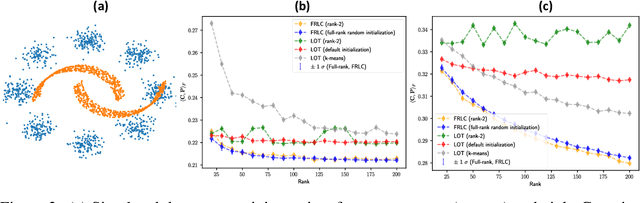
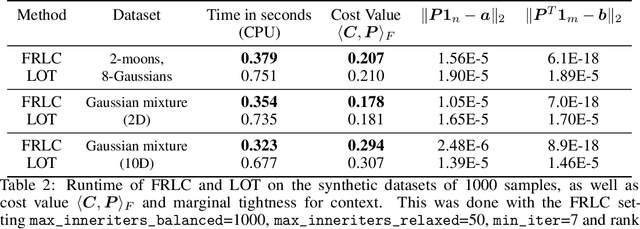
Optimal transport (OT) is a general framework for finding a minimum-cost transport plan, or coupling, between probability distributions, and has many applications in machine learning. A key challenge in applying OT to massive datasets is the quadratic scaling of the coupling matrix with the size of the dataset. [Forrow et al. 2019] introduced a factored coupling for the k-Wasserstein barycenter problem, which [Scetbon et al. 2021] adapted to solve the primal low-rank OT problem. We derive an alternative parameterization of the low-rank problem based on the $\textit{latent coupling}$ (LC) factorization previously introduced by [Lin et al. 2021] generalizing [Forrow et al. 2019]. The LC factorization has multiple advantages for low-rank OT including decoupling the problem into three OT problems and greater flexibility and interpretability. We leverage these advantages to derive a new algorithm $\textit{Factor Relaxation with Latent Coupling}$ (FRLC), which uses $\textit{coordinate}$ mirror descent to compute the LC factorization. FRLC handles multiple OT objectives (Wasserstein, Gromov-Wasserstein, Fused Gromov-Wasserstein), and marginal constraints (balanced, unbalanced, and semi-relaxed) with linear space complexity. We provide theoretical results on FRLC, and demonstrate superior performance on diverse applications -- including graph clustering and spatial transcriptomics -- while demonstrating its interpretability.