 Add to Chrome
 Add to Firefox
 Add to Edge
Biased Dreams: Limitations to Epistemic Uncertainty Quantification in Latent Space Models
Apr 28, 2026
Model-Based Reinforcement Learning distinguishes between physical dynamics models operating on proprioceptive inputs and latent dynamics models operating on high-dimensional image observations. A prominent latent approach is the Recurrent State Space Model used in the Dreamer family. While epistemic uncertainty quantification to inform exploration and mitigate model exploitation is well established for physical dynamics models, its transfer to latent dynamics models has received limited scrutiny. We empirically demonstrate that latent transitions are biased toward well-represented regions of latent space, exhibiting an attractor behavior that can deviate from true environment dynamics. As a result, discrepancies in environment dynamics may not manifest in latent space, undermining the reliability of epistemic uncertainty estimates. Because these attractors often lie in high-reward regions, latent rollouts systematically overestimate predicted rewards. Our findings highlight key limitations of epistemic uncertainty estimation in latent dynamics models and motivate more critical evaluation of this method.

Retargeting Visual Data with Deformation Fields
Nov 22, 2023


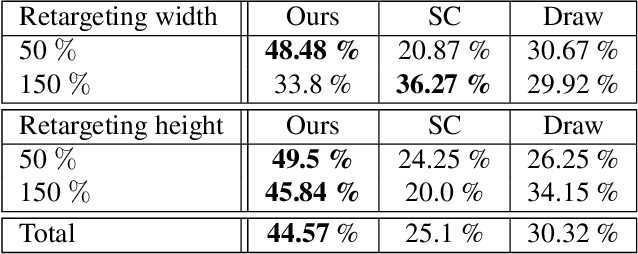
Seam carving is an image editing method that enable content-aware resizing, including operations like removing objects. However, the seam-finding strategy based on dynamic programming or graph-cut limits its applications to broader visual data formats and degrees of freedom for editing. Our observation is that describing the editing and retargeting of images more generally by a displacement field yields a generalisation of content-aware deformations. We propose to learn a deformation with a neural network that keeps the output plausible while trying to deform it only in places with low information content. This technique applies to different kinds of visual data, including images, 3D scenes given as neural radiance fields, or even polygon meshes. Experiments conducted on different visual data show that our method achieves better content-aware retargeting compared to previous methods.
Adaptive Voronoi NeRFs
Mar 30, 2023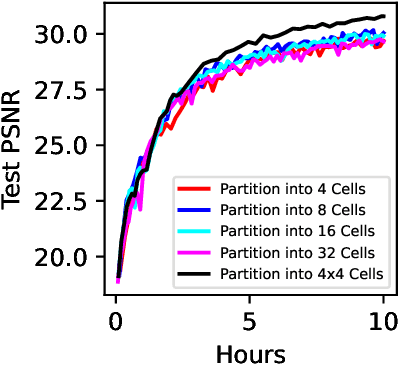
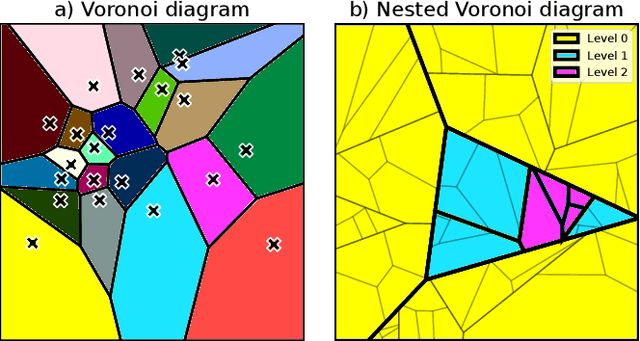
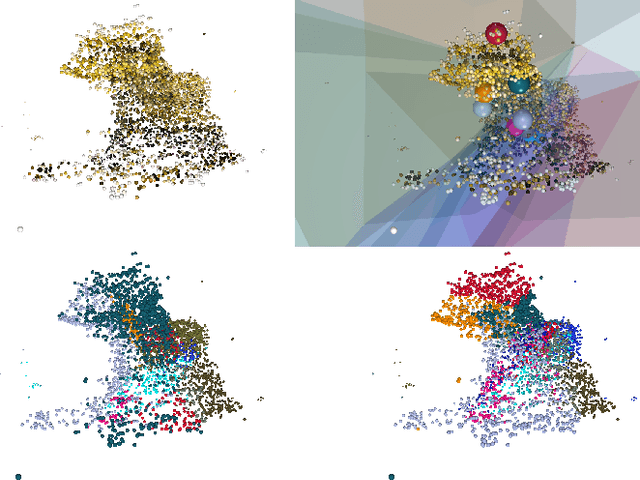

Neural Radiance Fields (NeRFs) learn to represent a 3D scene from just a set of registered images. Increasing sizes of a scene demands more complex functions, typically represented by neural networks, to capture all details. Training and inference then involves querying the neural network millions of times per image, which becomes impractically slow. Since such complex functions can be replaced by multiple simpler functions to improve speed, we show that a hierarchy of Voronoi diagrams is a suitable choice to partition the scene. By equipping each Voronoi cell with its own NeRF, our approach is able to quickly learn a scene representation. We propose an intuitive partitioning of the space that increases quality gains during training by distributing information evenly among the networks and avoids artifacts through a top-down adaptive refinement. Our framework is agnostic to the underlying NeRF method and easy to implement, which allows it to be applied to various NeRF variants for improved learning and rendering speeds.