 Add to Chrome
 Add to Firefox
 Add to Edge
Towards Sustainable Investment Policies Informed by Opponent Shaping
Feb 12, 2026
Addressing climate change requires global coordination, yet rational economic actors often prioritize immediate gains over collective welfare, resulting in social dilemmas. InvestESG is a recently proposed multi-agent simulation that captures the dynamic interplay between investors and companies under climate risk. We provide a formal characterization of the conditions under which InvestESG exhibits an intertemporal social dilemma, deriving theoretical thresholds at which individual incentives diverge from collective welfare. Building on this, we apply Advantage Alignment, a scalable opponent shaping algorithm shown to be effective in general-sum games, to influence agent learning in InvestESG. We offer theoretical insights into why Advantage Alignment systematically favors socially beneficial equilibria by biasing learning dynamics toward cooperative outcomes. Our results demonstrate that strategically shaping the learning processes of economic agents can result in better outcomes that could inform policy mechanisms to better align market incentives with long-term sustainability goals.

Advantage Alignment Algorithms
Jun 20, 2024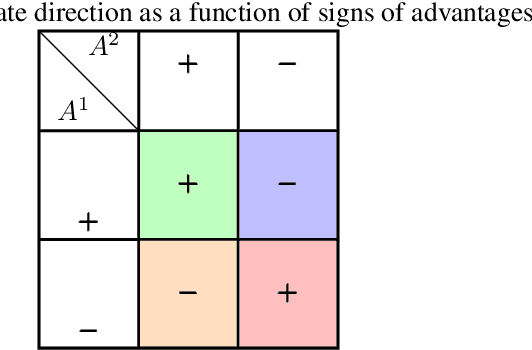
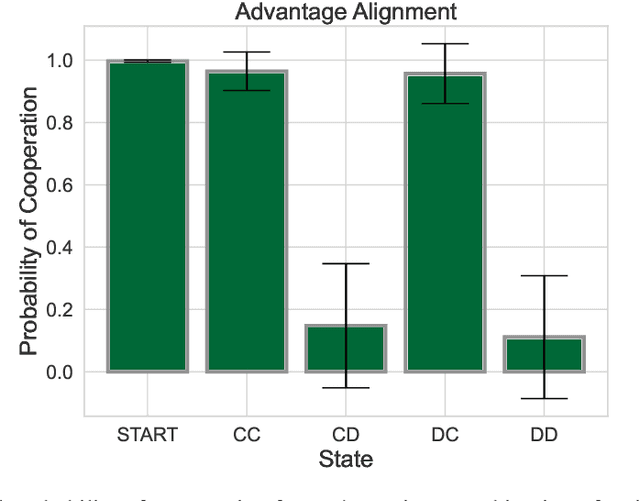
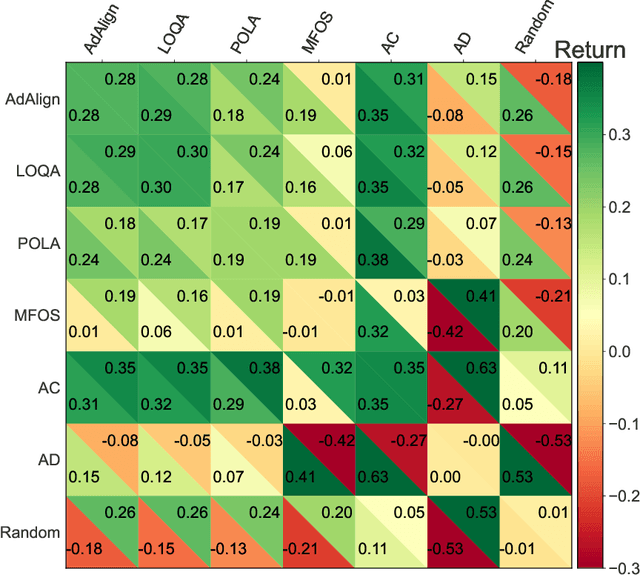
The growing presence of artificially intelligent agents in everyday decision-making, from LLM assistants to autonomous vehicles, hints at a future in which conflicts may arise from each agent optimizing individual interests. In general-sum games these conflicts are apparent, where naive Reinforcement Learning agents get stuck in Pareto-suboptimal Nash equilibria. Consequently, opponent shaping has been introduced as a method with success at finding socially beneficial equilibria in social dilemmas. In this work, we introduce Advantage Alignment, a family of algorithms derived from first principles that perform opponent shaping efficiently and intuitively. This is achieved by aligning the advantages of conflicting agents in a given game by increasing the probability of mutually-benefiting actions. We prove that existing opponent shaping methods, including LOLA and LOQA, implicitly perform Advantage Alignment. Compared to these works, Advantage Alignment mathematically simplifies the formulation of opponent shaping and seamlessly works for continuous action domains. We also demonstrate the effectiveness of our algorithm in a wide range of social dilemmas, achieving state of the art results in each case, including a social dilemma version of the Negotiation Game.
LOQA: Learning with Opponent Q-Learning Awareness
May 02, 2024



In various real-world scenarios, interactions among agents often resemble the dynamics of general-sum games, where each agent strives to optimize its own utility. Despite the ubiquitous relevance of such settings, decentralized machine learning algorithms have struggled to find equilibria that maximize individual utility while preserving social welfare. In this paper we introduce Learning with Opponent Q-Learning Awareness (LOQA), a novel, decentralized reinforcement learning algorithm tailored to optimizing an agent's individual utility while fostering cooperation among adversaries in partially competitive environments. LOQA assumes the opponent samples actions proportionally to their action-value function Q. Experimental results demonstrate the effectiveness of LOQA at achieving state-of-the-art performance in benchmark scenarios such as the Iterated Prisoner's Dilemma and the Coin Game. LOQA achieves these outcomes with a significantly reduced computational footprint, making it a promising approach for practical multi-agent applications.
Best Response Shaping
Apr 05, 2024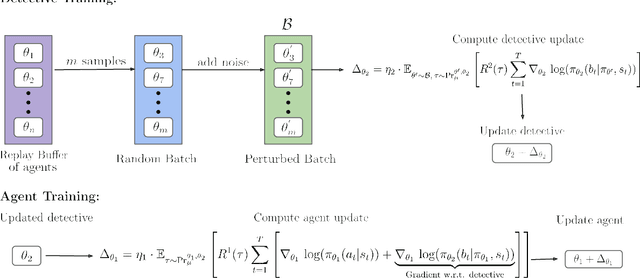
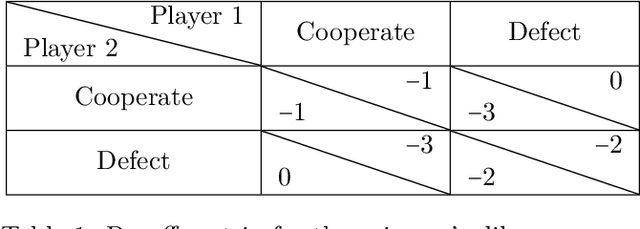
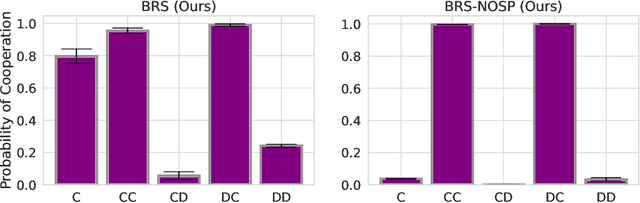
We investigate the challenge of multi-agent deep reinforcement learning in partially competitive environments, where traditional methods struggle to foster reciprocity-based cooperation. LOLA and POLA agents learn reciprocity-based cooperative policies by differentiation through a few look-ahead optimization steps of their opponent. However, there is a key limitation in these techniques. Because they consider a few optimization steps, a learning opponent that takes many steps to optimize its return may exploit them. In response, we introduce a novel approach, Best Response Shaping (BRS), which differentiates through an opponent approximating the best response, termed the "detective." To condition the detective on the agent's policy for complex games we propose a state-aware differentiable conditioning mechanism, facilitated by a question answering (QA) method that extracts a representation of the agent based on its behaviour on specific environment states. To empirically validate our method, we showcase its enhanced performance against a Monte Carlo Tree Search (MCTS) opponent, which serves as an approximation to the best response in the Coin Game. This work expands the applicability of multi-agent RL in partially competitive environments and provides a new pathway towards achieving improved social welfare in general sum games.