 Add to Chrome
 Add to Firefox
 Add to Edge
Enhancing Generalization in Sickle Cell Disease Diagnosis through Ensemble Methods and Feature Importance Analysis
Jan 19, 2026
This work presents a novel approach for selecting the optimal ensemble-based classification method and features with a primarly focus on achieving generalization, based on the state-of-the-art, to provide diagnostic support for Sickle Cell Disease using peripheral blood smear images of red blood cells. We pre-processed and segmented the microscopic images to ensure the extraction of high-quality features. To ensure the reliability of our proposed system, we conducted an in-depth analysis of interpretability. Leveraging techniques established in the literature, we extracted features from blood cells and employed ensemble machine learning methods to classify their morphology. Furthermore, we have devised a methodology to identify the most critical features for classification, aimed at reducing complexity and training time and enhancing interpretability in opaque models. Lastly, we validated our results using a new dataset, where our model overperformed state-of-the-art models in terms of generalization. The results of classifier ensembled of Random Forest and Extra Trees classifier achieved an harmonic mean of precision and recall (F1-score) of 90.71\% and a Sickle Cell Disease diagnosis support score (SDS-score) of 93.33\%. These results demonstrate notable enhancement from previous ones with Gradient Boosting classifier (F1-score 87.32\% and SDS-score 89.51\%). To foster scientific progress, we have made available the parameters for each model, the implemented code library, and the confusion matrices with the raw data.

Leveraging Large-Scale Face Datasets for Deep Periocular Recognition via Ocular Cropping
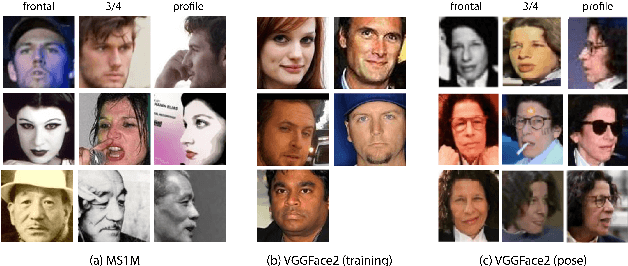
Oct 30, 2025We focus on ocular biometrics, specifically the periocular region (the area around the eye), which offers high discrimination and minimal acquisition constraints. We evaluate three Convolutional Neural Network architectures of varying depth and complexity to assess their effectiveness for periocular recognition. The networks are trained on 1,907,572 ocular crops extracted from the large-scale VGGFace2 database. This significantly contrasts with existing works, which typically rely on small-scale periocular datasets for training having only a few thousand images. Experiments are conducted with ocular images from VGGFace2-Pose, a subset of VGGFace2 containing in-the-wild face images, and the UFPR-Periocular database, which consists of selfies captured via mobile devices with user guidance on the screen. Due to the uncontrolled conditions of VGGFace2, the Equal Error Rates (EERs) obtained with ocular crops range from 9-15%, noticeably higher than the 3-6% EERs achieved using full-face images. In contrast, UFPR-Periocular yields significantly better performance (EERs of 1-2%), thanks to higher image quality and more consistent acquisition protocols. To the best of our knowledge, these are the lowest reported EERs on the UFPR dataset to date.
Deep Network Pruning: A Comparative Study on CNNs in Face Recognition
May 28, 2024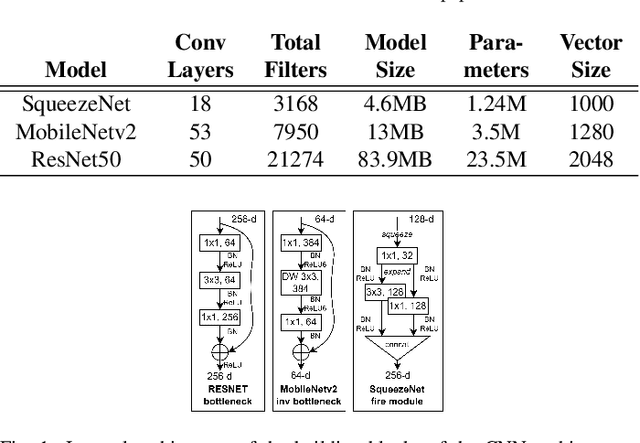
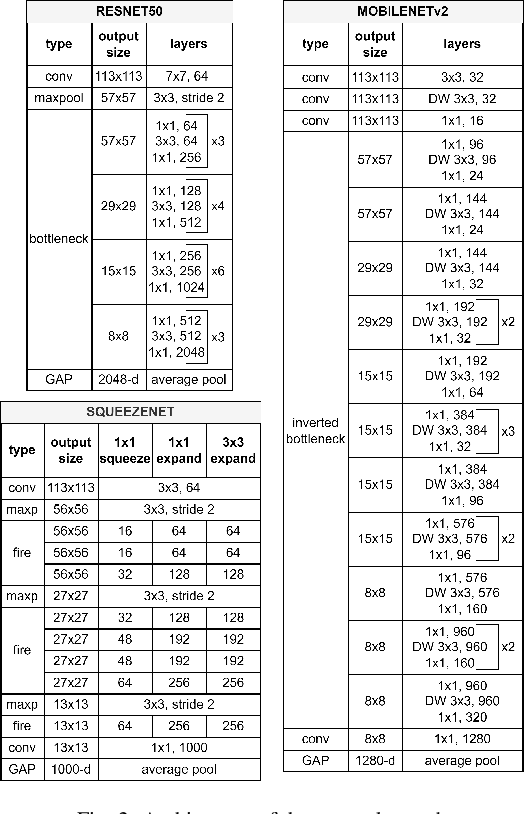
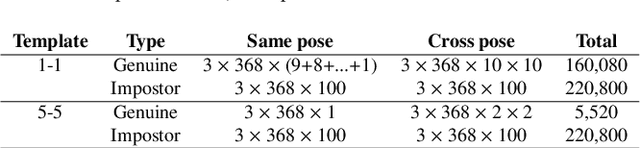
The widespread use of mobile devices for all kind of transactions makes necessary reliable and real-time identity authentication, leading to the adoption of face recognition (FR) via the cameras embedded in such devices. Progress of deep Convolutional Neural Networks (CNNs) has provided substantial advances in FR. Nonetheless, the size of state-of-the-art architectures is unsuitable for mobile deployment, since they often encompass hundreds of megabytes and millions of parameters. We address this by studying methods for deep network compression applied to FR. In particular, we apply network pruning based on Taylor scores, where less important filters are removed iteratively. The method is tested on three networks based on the small SqueezeNet (1.24M parameters) and the popular MobileNetv2 (3.5M) and ResNet50 (23.5M) architectures. These have been selected to showcase the method on CNNs with different complexities and sizes. We observe that a substantial percentage of filters can be removed with minimal performance loss. Also, filters with the highest amount of output channels tend to be removed first, suggesting that high-dimensional spaces within popular CNNs are over-dimensionated.
SqueezerFaceNet: Reducing a Small Face Recognition CNN Even More Via Filter Pruning
Jul 20, 2023The widespread use of mobile devices for various digital services has created a need for reliable and real-time person authentication. In this context, facial recognition technologies have emerged as a dependable method for verifying users due to the prevalence of cameras in mobile devices and their integration into everyday applications. The rapid advancement of deep Convolutional Neural Networks (CNNs) has led to numerous face verification architectures. However, these models are often large and impractical for mobile applications, reaching sizes of hundreds of megabytes with millions of parameters. We address this issue by developing SqueezerFaceNet, a light face recognition network which less than 1M parameters. This is achieved by applying a network pruning method based on Taylor scores, where filters with small importance scores are removed iteratively. Starting from an already small network (of 1.24M) based on SqueezeNet, we show that it can be further reduced (up to 40%) without an appreciable loss in performance. To the best of our knowledge, we are the first to evaluate network pruning methods for the task of face recognition.