 Add to Chrome
 Add to Firefox
 Add to Edge
SMILE-Next: Teaching Large Language Models to Detect, Classify, and Reason about Laughter
May 27, 2026
Laughter is a complex social signal that conveys communicative intent beyond amusement. While prior work has focused on isolated laughter analysis tasks, a comprehensive understanding of laughter in real-world scenarios remains underexplored. Therefore, we introduce SMILE-Next, a dataset for real-world laughter understanding with multimodal textual representations and question-answer annotations across three tasks: laughter detection, laughter type classification, and laughter reasoning. Building upon SMILE-Next, we aim to develop a laughter-specialized large language model capable of nuanced understanding of laughter in real-world contexts. To this end, we propose two key components: laughter-specific Self-Instruct and the Mixture-of-Laugh-Experts (MoLE) framework. Laughter-specific Self-Instruct enhances generalization across tasks and domains by automatically synthesizing diverse laughter-centric instructions. MoLE introduces a task-adaptive expert routing mechanism that dynamically selects specialized experts tailored to each laughter-related task, improving task-specific performance and efficiency. Experimental results show that the combination of our proposed components substantially outperforms multimodal LLM baselines, advancing robust real-world laughter understanding. Project page is at: https://mok0102.github.io/smile-next/.

FacEDiT: Unified Talking Face Editing and Generation via Facial Motion Infilling
Dec 16, 2025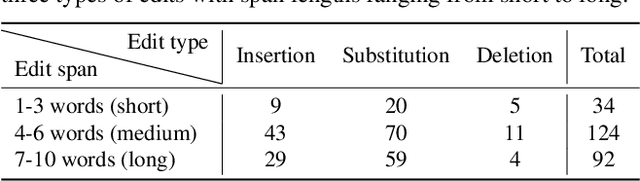
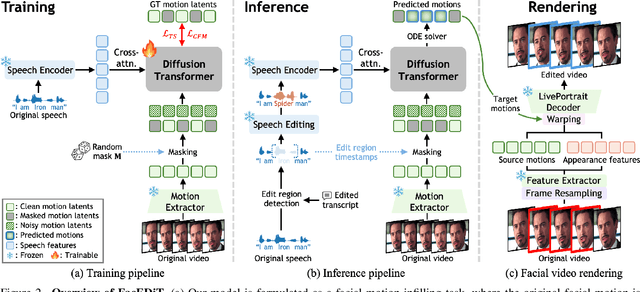

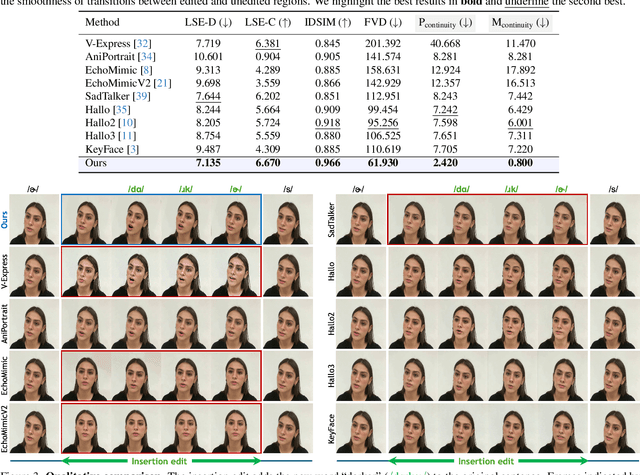
Talking face editing and face generation have often been studied as distinct problems. In this work, we propose viewing both not as separate tasks but as subtasks of a unifying formulation, speech-conditional facial motion infilling. We explore facial motion infilling as a self-supervised pretext task that also serves as a unifying formulation of dynamic talking face synthesis. To instantiate this idea, we propose FacEDiT, a speech-conditional Diffusion Transformer trained with flow matching. Inspired by masked autoencoders, FacEDiT learns to synthesize masked facial motions conditioned on surrounding motions and speech. This formulation enables both localized generation and edits, such as substitution, insertion, and deletion, while ensuring seamless transitions with unedited regions. In addition, biased attention and temporal smoothness constraints enhance boundary continuity and lip synchronization. To address the lack of a standard editing benchmark, we introduce FacEDiTBench, the first dataset for talking face editing, featuring diverse edit types and lengths, along with new evaluation metrics. Extensive experiments validate that talking face editing and generation emerge as subtasks of speech-conditional motion infilling; FacEDiT produces accurate, speech-aligned facial edits with strong identity preservation and smooth visual continuity while generalizing effectively to talking face generation.
CA^2ST: Cross-Attention in Audio, Space, and Time for Holistic Video Recognition
Mar 30, 2025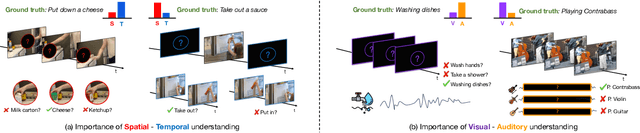
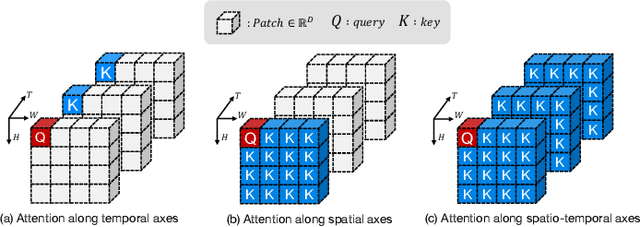
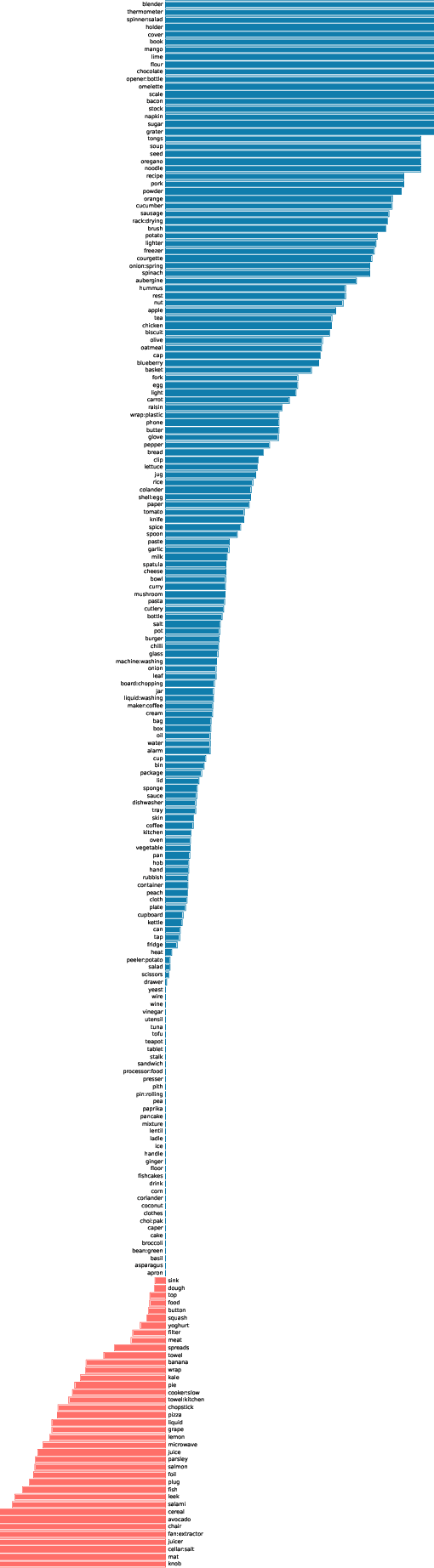
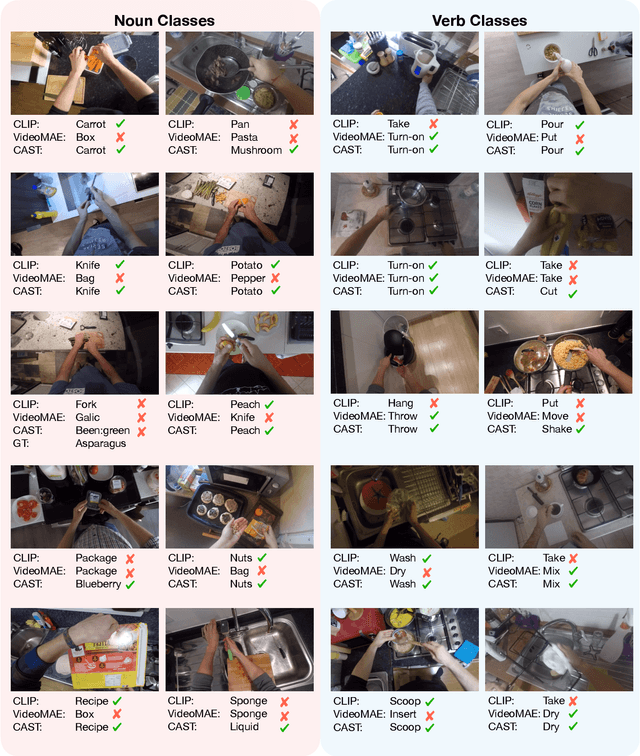
We propose Cross-Attention in Audio, Space, and Time (CA^2ST), a transformer-based method for holistic video recognition. Recognizing actions in videos requires both spatial and temporal understanding, yet most existing models lack a balanced spatio-temporal understanding of videos. To address this, we propose a novel two-stream architecture, called Cross-Attention in Space and Time (CAST), using only RGB input. In each layer of CAST, Bottleneck Cross-Attention (B-CA) enables spatial and temporal experts to exchange information and make synergistic predictions. For holistic video understanding, we extend CAST by integrating an audio expert, forming Cross-Attention in Visual and Audio (CAVA). We validate the CAST on benchmarks with different characteristics, EPIC-KITCHENS-100, Something-Something-V2, and Kinetics-400, consistently showing balanced performance. We also validate the CAVA on audio-visual action recognition benchmarks, including UCF-101, VGG-Sound, KineticsSound, and EPIC-SOUNDS. With a favorable performance of CAVA across these datasets, we demonstrate the effective information exchange among multiple experts within the B-CA module. In summary, CA^2ST combines CAST and CAVA by employing spatial, temporal, and audio experts through cross-attention, achieving balanced and holistic video understanding.